Live chimp rescued in Guinea

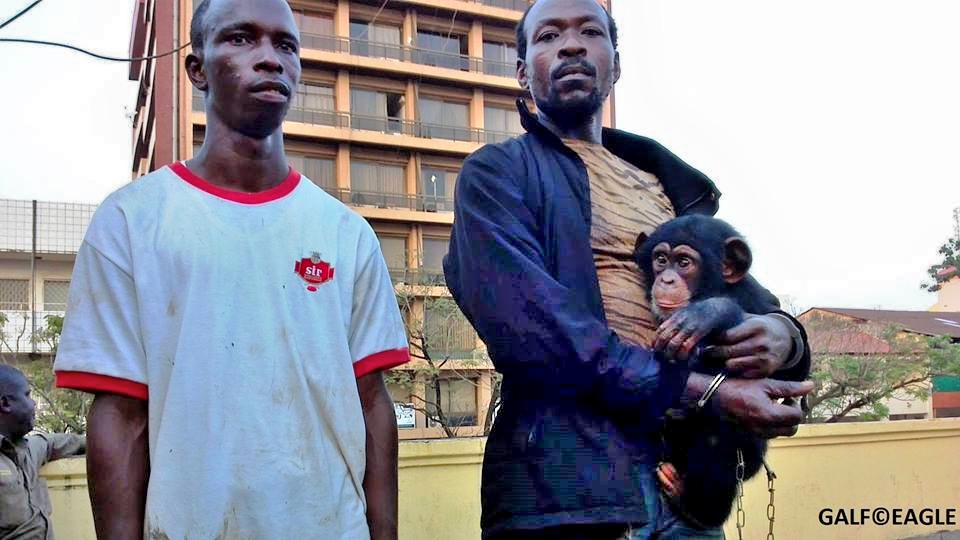
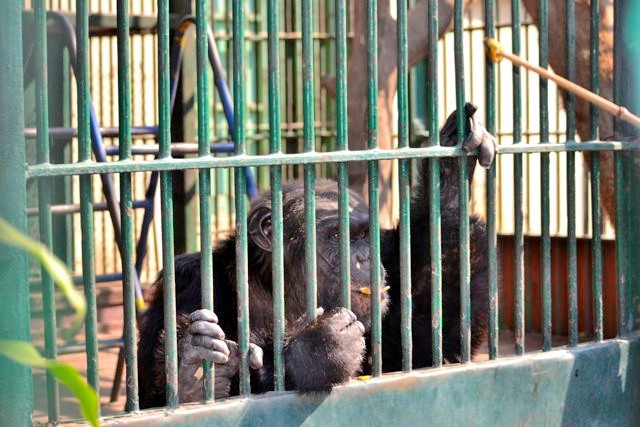
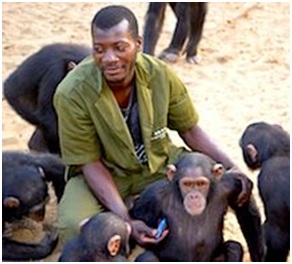
10565051_570704729742941_5508797749207500548_nTwo traffickers were arrested trying to sell a baby chimpanzee in Conakry, Guinea, but to whom and for what purpose remains a mystery. PEGAS has tried to learn the purpose of the chimpanzee capture from the wild in the Fouta region from the NGO involved, GALF (Guinée Application de la Loi Faunique), but was told only that it was not intended for international trade. Is there demand for baby chimpanzees in Conakry? We would certainly like to know more about that.

On its WARA Facebook page, GALF issued the following statement (translated from French):

“Following a tip-off by Guinea’s Chimpanzee Conservation Center (CCC), two men were arrested as they tried to market a chimpanzee in the capital, Conakry, on December 20. The sting operation was a joint effort of INTERPOL, Guinea’s Environment Ministry and GALF, the Guinean chapter of the Last Great Apes organization (LAGA). According to GALF, the men are part of a network that sources chimpanzees in the Fouta region. One of them is reported to be employed in chimpanzee conservation activities. The chimpanzee was confiscated and will be placed in the CCC’s sanctuary. The two men are being held in detention pending a hearing on December 22.”

VisionGuinea.info carried this report by Mady Bangoura on the arrests (translated from French):

Two alleged chimpanzee traffickers arrested in Conakry

(Conakry, Dec 20) The fight against commercializing wild animals advances well. The battle to protect animals thought to be potential reservoirs of deadly viruses, started a year ago by the authorities, seems to be gaining momentum in the field. After the Kindia and Labé case, two more presumed chimpanzee traffickers were arrested at Kaporo, in the Ratoma Commune of the Conakry suburbs.

During questioning, the accused buyer, Mamadou Moussa Barry, stated that he bought the animal from a friend with the intention of keeping it for himself.

However, attracted by the profit that the chimp’s sale could generate, Dinos Doré, who has served for a long time in conservation projects of animal species threatened by extinction, decided to act as a middleman between the owner and an eventual buyer of the merchandise.

The two were arrested Friday, December 19 as they tried to sell the animal. They are being held at the central Judiciary Police station for questioning before being transferred to the Dixinn court for arraignment. If convicted, they could face three to six months of imprisonment. The baby chimpanzee has been placed with the Chimpanzee Conservation Centre at Faranah where we’re told he will return to the wild.

Guinean law, as well as international conventions that Guinea is party to, classifies the chimpanzee as a totally protected animal species. Detention and commercial trade of such animals without prior authorization from the competent authorities is strictly prohibited.

Read the original article here.

Freedom a step closer: Argentina gives orangutan human rights

87e36a8b-1be4-4261-bc94-4c77e9d5b57f-460x276

Sandra pictured at the Buenos Aires Zoo. Marcos Brindicci/Reuters

In a landmark court decision, an Argentine court has recognized that an orangutan unlawfully imprisoned in a Buenos Aires zoo is a “non-human person” and thus entitled to habeas corpus rights. Argentina has shown itself to be more enlightened than the United States in recognizing the principle that all members of the biological family Hominidae should enjoy basic hominid rights.

The Guardian reports:

An orangutan held in an Argentinian zoo can be freed and transferred to a sanctuary after a court recognized the ape as a “non-human person” unlawfully deprived of its freedom, local media reported on Sunday.

Animal rights campaigners filed a habeas corpus petition – a document more typically used to challenge the legality of a person’s detention or imprisonment – in November on behalf of Sandra, a 29-year-old Sumatran orangutan at the Buenos Aires zoo.

In a landmark ruling that could pave the way for more lawsuits, the Association of Officials and Lawyers for Animal Rights (Afada) argued the ape had sufficient cognitive functions and should not be treated as an object.

The court agreed Sandra, born into captivity in Germany before being transferred to Argentina two decades ago, deserved the basic rights of a “non-human person”.

“This opens the way not only for other Great Apes, but also for other sentient beings which are unfairly and arbitrarily deprived of their liberty in zoos, circuses, water parks and scientific laboratories,” the daily La Nacion newspaper quoted Afada lawyer Paul Buompadre as saying.

Sandra’s case is not the first time activists have sought to use the habeas corpus writ to secure the release of wild animals from captivity.

A US court this month tossed out a similar bid for the freedom of Tommy the chimpanzee, privately owned in New York state, ruling the chimp was not a “person” entitled to the rights and protections afforded by habeas corpus.

In 2011, the animal rights group People for the Ethical Treatment of Animals (Peta) filed a lawsuit against marine park operator Sea World, alleging five wild-captured orca whales were treated like slaves. A San Diego court dismissed the case.

Orangutan is a word from the Malay and Indonesian languages that means “forest man”.

The Buenos Aires zoo has 10 working days to seek an appeal.

A spokesman for the zoo declined to comment to Reuters. The zoo’s head of biology, Adrian Sestelo, told La Nacion that orangutans were by nature calm, solitary animals which come together only to mate and care for their young.

“When you don’t know the biology of a species, to unjustifiably claim it suffers abuse, is stressed or depressed, is to make one of man’s most common mistakes, which is to humanize animal behaviour,” Sestelo said.

Read the original article here.

China drafting better animal laws

1218_chn_animals_970-630x420

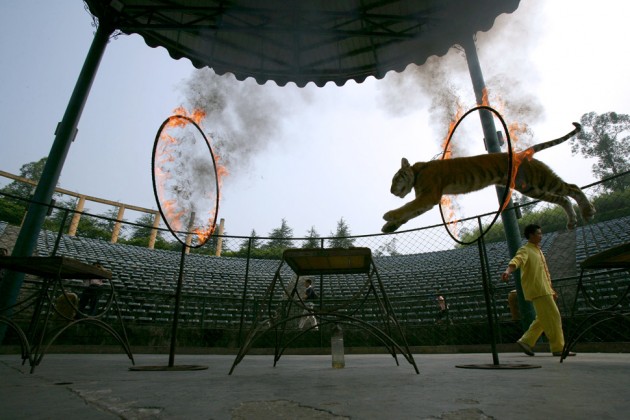
A tiger performs at Chongqing Safari Park in China. China Photos/Getty Images

If this legislation goes through, it could signal a major shift in great ape trafficking to China, saving hundreds of chimpanzee and orangutan lives in the next decade alone.

Bloomberg reports:

It’s getting a little easier to be an animal in China. The country’s fledgling animal-rights movement this week received a double boost, with an animal-welfare law in the works and a prominent zoo taking action to stop animal performances.

On Wednesday, Dec. 17, the Global Times, the tabloid affiliated with the official Communist Party mouthpiece the People’s Daily, reported that that the National People’s Congress is moving ahead on a plan to pass landmark legislation to protect animals, both in the wild and in captivity. Lawmakers have just completed a draft of the proposal, Chang Jiwen, vice director of the Research Institute of Resources and Environment Policies under the Development Research Center of the State Council, told the newspaper.

There’s still a long way to go before the proposal becomes law: China’s parliament isn’t likely to take up the amendment until late in 2015. But given China’s track record, we should take progress wherever we can get it. Or, as the Global Times reported, “Shi Kun, director of the Wildlife Institute at Beijing Forestry University, told the Global Times that China has long been criticized for not treating wild animals humanely, but with legal recognition of animal welfare, the country should be able to make progress on curbing phenomenon like overtime performance by zoo animals and harsh living conditions for wildlife on farms.”

Chinese zoo animals need the help. The country has about 180 zoos, and almost all of them feature performances by animals, according to the Animals Asia Foundation, an NGO that has been lobbying Chinese zoos to stop the practice. There are also about 50 safari parks that include animal performances, said Dave Neale, animal welfare director at Animals Asia. “They have black bears riding bicycles, macaques on bicycles, tigers doing circus tricks,” he said. “A lot of the big cats—the tigers and the lions—have had their teeth removed.”

In the spring, the Beijing zoo joined the foundation’s campaign against animal performances. Now the zoo in Hangzhou—the eastern Chinese city that is home to e-commerce company Alibaba (BABA)—has said it will stop animal performances after lobbying by the Animals Asia Foundation, the NGO announced on Tuesday.

Unfortunately, the World Association of Zoos & Aquariums (WAZA), which represents zoos worldwide, can’t be much help in China. The group includes two Taiwanese zoos, as well as a Hong Kong marine park and zoo, but no zoos from the mainland belong to WAZA. “That may change over time,” said Neale. “A lot of the individual zoos [in China] are interested in becoming members.

Read the original article here.
What do elephants going to China have to do with great ape trafficking?

(CITES has issued a response to the widely reported Zimbabwe elephant capture-for-export story. An update discussing their response can be found below this post.)

A story broke a few days ago reporting that more than 30 baby elephants had been captured from their mothers in Zimbabwe’s Hwange National Park, destined for China. A subsequent story reported that a Zimbabwean government spokesperson stated that the elephants were bound for the United Arab Emirates, which was confirmed by the UAE; they aim to import seven elephants for an unnamed facility. But PEGAS has obtained reliable information that a zoo in Guangzhou, China, intends to import 50 elephants from Zimbabwe. In preparation, the government hired a conservation consulting firm to prepare a study entitled “Guidelines for Translocation of African Elephants”. The study recommended that no wild, young elephants be transported, but those concerned should monitor the situation closely to see what actually happens.

1China Jan2013 Sunday Express

A baby elephant caged up awaiting shipment to China. (Photo courtesy of Sunday Express)

This is a repeat on a larger scale of a story that broke in early 2013 about baby elephants going to China. A few elephants actually were shipped, arriving in November 2012, where one died soon after arrival at the Taiyuan Zoo in freezing weather. The CITES Trade Database reports that eight live elephants were imported by China from Zimbabwe that year. Further shipments were temporarily stopped after campaigns were launched by the Zimbabwe Conservation Task Force and Born Free-UK.

Since 2000, the CITES Trade Database indicates that China has imported 54 live African elephants, most of them from South Africa and Tanzania, so this practice is nothing new. PEGAS conducted an extensive Google search, and could only find mention of three African elephants in China, two females at the Nanning Zoo and one male at Beijing Zoo. Either all those imported died, or they are only written about in Chinese, or not at all.

2Nanning Zoo ele

A female African elephant at Nanning Zoo in 2013. (Photo courtesy of China Daily)

3China elephant permit

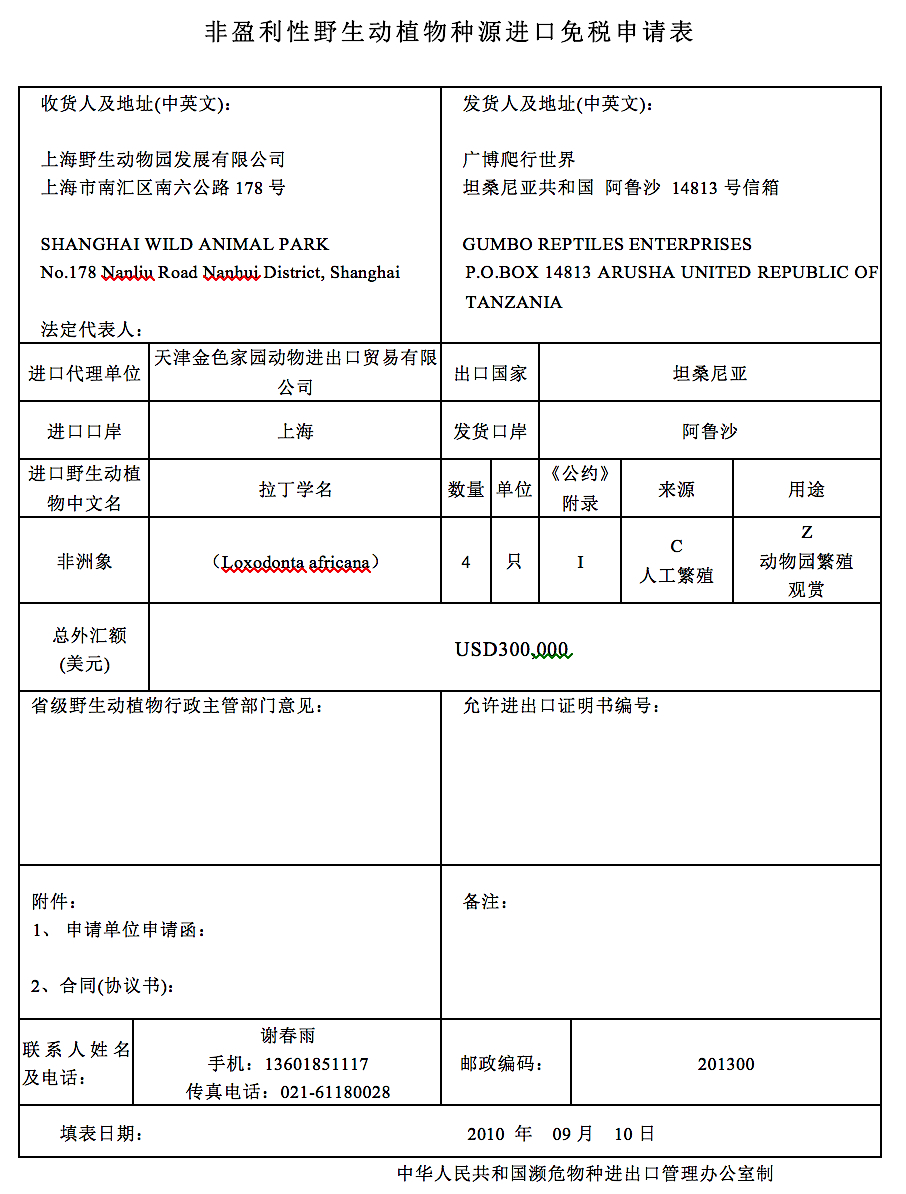
(Click to enlarge) A Chinese translation of an English-language CITES trade permit indicating that the Shanghai Wild Animal Park imported 4 elephants from Tanzania.

The relevance this case has for great apes is that African elephants and apes are sent to the same facilities in China using similar abuses of the CITES trade permit system. In 2011 China imported 7 elephants from Tanzania, according to the CITES Trade Database. PEGAS has obtained a copy of a Chinese translation of the CITES export permit used to send 4 elephants from Tanzania to the Shanghai Wild Animal Park (see picture at left). The date of the permit is September 2010, and since permits have a six-month period of validity these four may have made up part of the 7 reported in 2011.

4China chimp permit

(Click to enlarge) A copy of a CITES trade permit for 8 chimpanzees sent from Guinea to the Shanghai Wild Animal Park.

In the same month, the Shanghai Wild Animal Park was also indicated on a CITES trade permit as the destination for 8 chimpanzees exported by Guinea (see picture at right). Note on both permits the two boxes next to each other containing a C and a Z. The C source code signifies that the animals were at least second generation bred in captivity and that the purpose Z is a zoo. The Guinea permits are known to be fraudulent, as it has no breeding facilities of any kind, and CITES sanctioned the country in 2013 with a commercial trade ban. China was cleared of any wrongdoing by CITES, a gross miscarriage of justice in the eyes of many observers (see The Story of the Shanghai Eight for details).

The CITES Trade Database does not report any elephants imported by China with a C source code. However, an Appendix I specimen with a C source code is treated as an Appendix II specimen by CITES regulations, which requires no import permit. The Chinese language permit above, therefore, is probably a translation of the Tanzanian export permit. In any case, Tanzania has no breeding facility for elephants, so the permit is fraudulent in the same way that the Guinea chimpanzee permits were. CITES should investigate to establish the truth of the matter.

The Shanghai Wild Animal Park is not a zoo as defined by any credible zoo association such as the World Association of Zoos and Aquariums (WAZA) or the European Association of Zoos and Aquaria (EAZA), and in fact is not accredited by any zoo association. The facility is a commercial amusement park that trains the animals for use in circus performances.

5SWAP-Nature University

A chimpanzee infant performs as a “bull” in an animal show at the Shanghai Wild Animal Park. Is this an educational zoo activity? (Photo courtesy of Nature University)

This is possibly what awaits the elephants from Zimbabwe destined for Guangzhou, which has two enormous safari park type “zoos”, the Chimelong complex and the Guangzhou Zoo. Both of these parks use great apes in commercial performances in contravention of CITES regulations, but CITES has taken no action on the practice.

Zimbabwe and China must be compelled to disclose transparently the details of where the elephants are destined and for what purpose they are intended. They should also make public the CITES import and export permits – we already know that the elephants were not bred in captivity, and they were stolen from their mothers. Appendix I African elephants captured from the wild cannot be used for commercial purposes. Common sense would indicate that a multi-million dollar deal involving 50 elephants could be nothing else but commercial.

Will the CITES Secretariat guide appropriate action, or will it maintain its usual pose when China is involved?

6seenoevil

In the issue of illegal imports of chimpanzees to China, the CITES Secretariat has seen, heard or spoken no evil concerning the country. Will it be the same for African elephants?


Update: The CITES Secretariat makes a statement on the Zimbabwe elephant case (December 20, 2014)

The CITES Secretariat has issued a statement  that clarifies some aspects of the news reports that baby elephants have been captured in Zimbabwe for export to the UAE and/or China, but adds a new element that contributes to the muddle. It appears that Zimbabwe is perfectly within its legal rights to export live elephants, as elephants in the country are listed in Appendix II, which allows restricted trade. As long as the elephants are transported humanely in accordance with the Live Animals Regulations of the International Air Transport Association (IATA), and they are traded to “appropriate and acceptable destinations”, the trade is allowable. “Appropriate and acceptable destinations” is defined in Resolution Conf. 11.20 of the Conference of the Parties to CITES. Much of this information was released in 2013 when the 2012 elephant exports from Zimbabwe to China came to light.

The new muddle is that the UAE claims that it is importing “seven elephants as a family group that has been in captivity in Zimbabwe for more than 10 years.” So where does this leave the captured babies allegedly held in a stockade in Hwange National Park? Could they still be destined for China? News reports have linked Hank Jenkins, an Australian, with the elephant exports to China. PEGAS has obtained personal email correspondence from Jenkins stating that he is not involved with the current elephant captures. The press reports were also inaccurate in describing Jenkins as “a former top official from Cites”. The CITES Secretariat stated that “He was never an official of the CITES Secretariat and has no association with the Secretariat.” It seems that we cannot believe everything we read in the press. Jenkins’ disassociation with the current elephant brouhaha, however, does not mean that he will not be involved in future elephant exports from Zimbabwe to China.

For those (like PEGAS) who believe that wild animals should not be put in captivity for use to entertain humans, the only legal recourse to stop the exports would be to demonstrate that they were not headed to “appropriate and acceptable destinations”. (The transport angle would only be temporary.) That is difficult to do without knowing the destination. CITES defines the term “to mean destinations where the Scientific Authority of the State of import is satisfied that the proposed recipient of a living specimen is suitably equipped to house and care for it.” The Secretariat described it as a “private park”. That eliminates public zoos, but there are many private parks and zoos in oil-rich UAE. The purchaser should allow an independent inspection of the facility to verify that it is appropriate for seven African elephants, and to pledge that they will not be used for commercial purposes. Investigations should also be carried out to verify that the seven elephants have indeed been in captivity for ten years.

To return to great apes, there are no Appendix II apes in Africa. Any export of them currently (or in the recent past) would be illegal. PEGAS saw great apes in captivity in a recent visit to the UAE, and media stories have reported them in private collections. We will continue investigations as to how they got there, resources allowing. If any are demonstrated to be the result of illegal trade, PEGAS will campaign to have them confiscated and repatriated to their country of origin or, if unknown, to an appropriate facility such as a sanctuary.

Veterinarians for Animal Welfare in Zimbabwe have clarified the mystery of the captured baby elephants by stating that 27 of them are bound for China. So now we have come full circle from China to UAE and back to China as the destination. Director for Conservation at the Zimbabwe Parks and Wildlife Authorities, Geoffreys Matipano, said in a December 18 interview at Hwange:

“We are pursuing it [the export] aggressively as part of conservation efforts because we have plenty of elephants here. We don’t receive state funding and we rely on selling animals for our day to day operations, we are nowhere near what we want.”
It would appear that eight more elephants, in addition to the seven announced, will go to the UAE, and France intends to buy and import 15 to 20. PEGAS believes that at least 20 more than the 27 babies will be bound for China. Stay tuned…

Visit to Dubai

PEGAS made a brief two-day visit to Dubai on November 27-28 to meet with journalist Vesela Todorova, who has written several articles on wildlife trade in the United Arab Emirates, and Dr. Ullrich Wernery, Scientific Director of the Central Veterinary Research Laboratory in the UAE (see Dark side of UAE’s exotic animal fascination). Dr. Corina Berners, a taxidermist at the laboratory, also attended the meeting.

1Wernery

Dr. Ulli Wernery, director of the CVRL in the UAE. (photo by Lee Hoagland of The National)

PEGAS requested a meeting with Dr. Elsayed Mohamed, head of IFAW’s Middle East office, but after several rounds of emails with their campaigns officer was told that IFAW did not know anything about great apes, but that “…we welcome questions related to trade in big cats, birds and ivory.”

The UAE has long been known for its position both as destination and transit point for wild animal trade. Many wealthy Emiratis keep private menageries and there are several zoos and animal parks in the country.  PEGAS wanted to find out if great apes were in demand in the UAE for these facilities.

2Paris&gorilla

At least one wealthy Emirati has a siamang (gibbon), as this recent photo of Paris Hilton in Dubai shows. (courtesy The Daily Mail)

In the many years that the two veterinarians have been treating and performing post-mortems on dead wild animal pets, they have yet to see a great ape. While conducting her wildlife trade journalistic investigations, Todorova had not encountered great ape trafficking. They had all heard of great ape pets, but think that the number of cases is quite small. Dr. Berners knew a woman who had recently received an orangutan as a pet and tried to arrange an appointment for PEGAS to meet her, but the woman declined the invitation. From press and media accounts that PEGAS has seen, orangutans appear to be the ape of choice for Emiratis.

The private zoos are very difficult to visit, unless you happen to be a multi-millionaire or celebrity. What goes on behind high walls is unknown to the average person, except for the veterinarians and keepers who look after the animals.

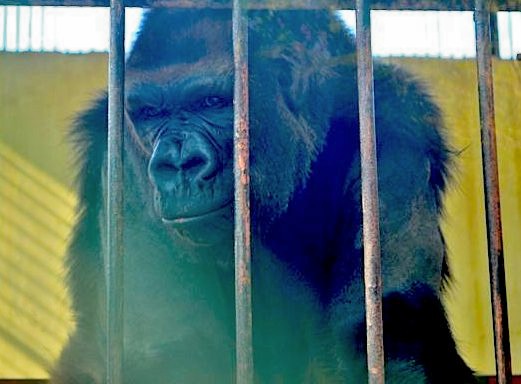
PEGAS also visited the Dubai Zoo, which held a pair of eastern lowland Grauer’s gorillas (named Digit and Diana) and three chimpanzees in two cages. One empty cage had a plaque indicating it should contain a chimpanzee, but it was empty.

4Dubai Grauer2

(Above and below) This gorilla does not appear too happy to be locked up. (photos: Dan Stiles)

3Dubai Grauer1

While PEGAS was in Dubai, the Sharjah government announced that exotic pet owners had 30 days in which to surrender their illegally imported exotic animals. (Sharjah is one of seven emirates comprising the UAE.) However, public and private zoos, scientific and research centres and universities which obtained licences from the Environment and Natural Reserves Agency in Sharjah are exempted. It is unclear whether this will apply to other parts of the UAE.

5Dubai chimp

Grin and bear it, this chimpanzee in Dubai Zoo seems to be saying.

PEGAS plans to return to the UAE to conduct follow-up work in 2015.

Developments in Egypt: signs of hope

Egypt has long been a major problem country of great ape trafficking (see Africa’s Lost Apes). Chimpanzees, gorillas and orangutans have over the years mysteriously turned up at the National Circus, various public zoos, private safari parks and tourist hotel wildlife facilities. Not a single import has been reported to the CITES Trade Database, indicating that all of the imports have been illegal. The CITES Secretariat has felt compelled to make two visits to Egypt (2007 and 2010) to look into charges of improper imports of great apes. They found many irregularities and recommended that several remedial measures be carried out.

1 Dina

Dina Zulficar spends her lunch hour every day feeding Cairo street cats and dogs, such is her dedication to improving the lives of animals (photo: Dan Stiles)

The PEGAS Project Manager visited Egypt on November 13-26 to ascertain the current status of the number and location of great apes in the country and to assess the possibility of rescuing and relocating any of them to their home countries or to a suitable sanctuary closer to home. PEGAS was greatly assisted by Dina Zulficar, one of Egypt’s leading animal rights activists, who has a history of driving change and advancing animal welfare and protection that spans decades.

PEGAS and Dina Zulficar met with senior officials of the Egyptian Environment Affairs Agency, Dr. Khaled Allam, General Manager of Biodiversity, and Dr. Ayman Hamada, Director-General of Species Diversity, in the Ministry of State for Environment. After discussion, we agreed that a short-term holding facility would be created on Ministry of Environment property near the Cairo airport for great apes confiscated in future trafficking incidents. PEGAS would assist in providing both the design plans and funding for this facility. CITES-Egypt would need to agree to its operation and Environment said that they would attempt to establish a Memorandum of Understanding with CITES-Egypt, which would include a step-by-step protocol of procedures to follow in the case of an illegal trade great ape seizure.

PEGAS tried for over two weeks to obtain a meeting with CITES-Egypt officials, but they refused to grant an appointment. The Egypt CITES Management Authority has a long history of lack of cooperation and transparency with international organizations and NGOs interested in controlling illegal wildlife trade and promoting conservation.

PEGAS visited or obtained information about several facilities known in the past to have held great apes to assess the current status on numbers. These were:

The Tower Hotel Country Club

Reports by Karl Ammann/Pax Animalis and PASA have pointed to the Tower Hotel and its associated animal breeding centre, owned by businessman Gamal Omar, as a hotspot of illegal great ape trading. The Hotel used to display chimpanzees, but this has ceased, and the apes are kept out of public view now in the breeding centre located near the hotel. Gorillas and chimpanzees have been circulating through these Sharm el-Sheikh facilities since the 1990s, fed initially by an infamous dual nationality Egyptian-Nigerian trafficker named Heba Saad.

2.Tower-PASA_1

There were purportedly four gorillas at Tower Hotel in 2009 (photo courtesy of PASA)

The first actual count, reported by PASA in 2009, stated that there were four gorillas and six chimpanzees at Tower, but this number was provided by CITES-Egypt and could not be verified by visual inspection. Ammann/Pax Animalis reported a visual inspection count made by Claudia Schoene in January 2012 of five gorillas and 11 chimpanzees, with a minimum of two females and three too young to breed.

3. Tower buy

Addax being transported from the Tower Hotel breeding centre. (photo: Dan Stiles)

4. Tower list

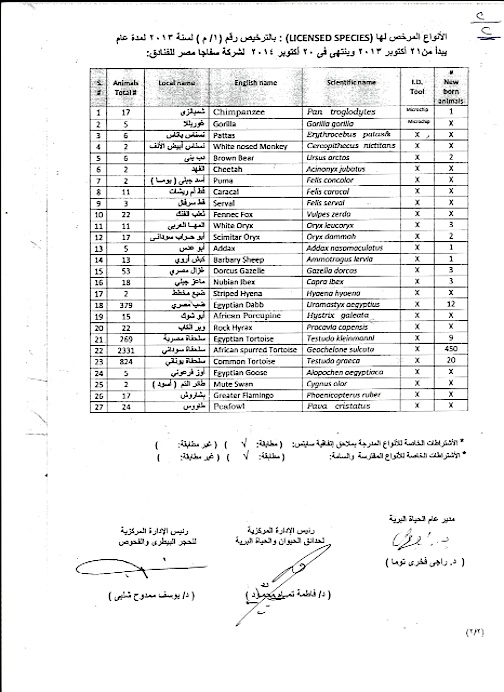
(Click to enlarge) The Tower Hotel permit list indicates that in early 2014 there were 17 chimpanzees and 5 gorillas in the breeding centre. Now there are 25. (photo courtesy of Dina Zulficar)

PEGAS visited the breeding centre and witnessed a transaction in which addax were sold and packed into a transport crate, but the great apes were intentionally kept from view (despite an earlier promise that they could be visited). PEGAS did however receive numbers from three sources, including the veterinarian at Tower, that in November 2014 there were five gorillas and 25 chimpanzees (8 newborns and other youngsters). Their 2014 permit to hold animals indicates that in early 2014 there were 17 chimpanzees in residence. The November 2014 numbers indicate that chimpanzees have been added that have not been bred at Tower. The 2014 CITES Trade Database won’t be published for several months, but it is unlikely any legally imported chimpanzees will be reported for Egypt, so it appears that in spite of severe criticisms by CITES and others, great ape trafficking is continuing.

The Hauza Hotel and Breeding Farm

The Hauza Hotel, also in Sharm el-Sheikh, operated very much like the Tower Hotel in that chimpanzees were kept on public display and the owner, Ashraf Enab, retains an animal breeding farm, which is located off the road connecting Cairo with Alexandria. The first count was again reported in the 2009 PASA report as provided by CITES-Egypt, which stated that chimpanzees were no longer kept at the hotel and that five were at the breeding farm, but this could not be verified. In earlier years, Karl Ammann and associates had seen and digitally recorded several chimpanzees, which appeared to be changing inconsistently in age over time, suggesting that some were leaving and others arriving.

5. Hauza

The Hauza Hotel no longer keeps great apes on the premises. (photo: Dan Stiles)

PEGAS visited the hotel and spent a great deal of time with the owner, who shared a considerable amount of information, which will be conveyed in a subsequent report. Concerning numbers, Mr. Enab reported that he started in 2006 with CITES-Egypt asking him to keep first two and then another four seized chimpanzees at the hotel zoo. He later moved them to the breeding farm (2009?). Two offspring have been born, so there are now eight at the breeding farm, with none at the hotel.

6. Enab

The new safari park under construction near Sharm el-Sheikh that is planned to hold hundreds of animals of wild species, including chimpanzees. (photo: Dan Stiles)

Ashraf Enab is building a new safari park in Sharm el-Sheikh that eventually will host 800 animals, including four chimpanzees, lions, cheetahs, giraffes and many more transferred from the breeding farm.


African Safari Park

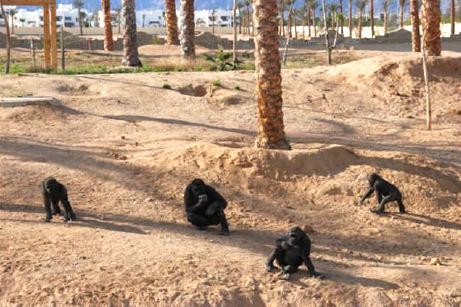
This drive-through facility is located off the Cairo-Alexandria road about 165 km from Cairo and currently costs 400 Egyptian pounds (US$57) to enter. Chimpanzees have also been coming and going from it over the years, but the only count was provided by PASA in 2009, which viewed a total of seven. PEGAS visited the safari park in November and saw two adult chimpanzees on a rock island, which appear to have been there for many years based on earlier accounts, and a single adult on another island. The two chimpanzees, unfortunately, seem to have an “Odd Couple” sort of relationship and fastidiously avoid each other. Apparently five or six others were on the second island in 2008/2009, but progressively they fell (or were pushed) off the island and drowned (sources: personal communication, Dina Zulficar and an anonymous informant who worked there).

7. ASP

(Above and below) The three chimpanzees currently on display at the African Safari Park. (photos: Dan Stiles)

8. ASP

The chimpanzees are kept on these tiny islands year-round with temperatures ranging from 9 C (57 F) to 45 C (113 F), with no enrichment provisions, which clearly qualifies as mistreatment.

Giza Zoo

Great apes have been moving in and out of Giza Zoo on a regular basis over the years and it appears that it serves as a holding station for CITES-Egypt, which is headquartered at the zoo, to enable it to temporarily keep illegally traded apes, and then distribute them to “rescue centres” such as the Tower, Hauza and African Safari Park operations. The same scheme is used to import and distribute other species.

9. Giza Zoo

The Giza Zoo map with the location of the chimpanzee cages on the left and the orangutan cage on the right (circled in red). (photo: Dan Stiles)

For example, PASA saw three infant chimpanzees in the Giza Zoo in March 2009 that supposedly were “confiscated”, but there were no documents associated with it, nor were the confiscations reported to the CITES Trade Database, as required by CITES Parties. A month later, Ian Redmond of Ape Alliance visited the Giza Zoo and found only two infants. One infant had already been removed. Also, when an ape is no longer of use to a private facility because of age or poor health, it is sent to the Giza Zoo. An example of this is the case of Moza, a female transferred from Tower to the zoo because she has a recurrent tumor.

10. Giza

Two adult chimpanzees at Giza Zoo. Note the two right hands, one of them thought to belong to Moza, who must have been lying on the ground. (photo: Dan Stiles)

PASA observed eight chimpanzees at the Giza Zoo in March 2009, while Ian Redmond counted seven in total a month later. PEGAS saw five chimpanzees in two cages and two orangutans in another location. Dina Zulficar indicated that there are seven chimpanzees in total at the zoo, which if so means that two were hidden from view inside the sleeping chamber. There was an empty cage in the chimpanzee cage cluster no doubt awaiting the next illegal import.

Other facilities

In the past other facilities, such as the Alexandria Zoo, the Al-Arish Zoo, the National Circus, about 20 other smaller circuses, and pet shops in Cairo are all reported to have held or sold great apes, but none do today, according to Dina Zulficar, Ashraf Enab and an anonymous informant.

Rescue and relocation

First, it is imperative that the Ministry of State for the Environment be successful in establishing a holding facility to receive all future great ape confiscations. The system that currently exists involving placement of illegal ape imports in the Giza Zoo, from where they are passed on to private “rescue centres”, must be broken up. More will be said on this topic in a subsequent report.

Second, an initiative is underway by PEGAS, working with a private wildlife breeder and dealer, and government officials, to free and relocate to sub-Saharan Africa the chimpanzees held by the Tower Hotel breeding centre. More will be said on this as negotiations proceed.

DRC trip report: building alliances

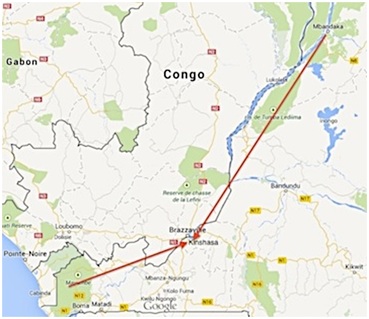
The PEGAS Project Manager visited the Democratic Republic of the Congo (DRC) on October 12-24, accompanied for the first three days by Jef Dupain, Director of the AWF African Apes Initiative. Jef introduced the Project Manager to the president of Juristrale, a local Congolese NGO that is collaborating with PEGAS in the area of great ape trafficking investigations. Aided by a Juristrale assistant, valuable information was gathered about the source areas of great apes that are trafficked in Kinshasa (the capital of DRC), the trade routes and transport methods (see maps at the bottom of this post), the people involved and sample prices of the different species.

Wildlife dealer

Trafficking location on a main road, where middlemen dealers are protected by soldiers (circled in blue). Monkeys for sale are circled in red.

Accompanied by Jef Dupain, PEGAS also met with Cosma Wilungula, the Director General of the Institut Congolais pour la Conservation de la Nature (Congolese Institute for Nature Conservation), which manages DRC’s protected areas and serves as the CITES Scientific Authority. The Project Manager briefed the DG on the objectives of the PEGAS project and received assurances of full cooperation from ICCN. The DG stated that he was committed to ending the trafficking of great apes and the illicit use of fraudulent CITES export permits.

Boma, a bonobo rescued in 2013

Boma, a bonobo rescued in 2013 and now living at Lola ya Bonobo

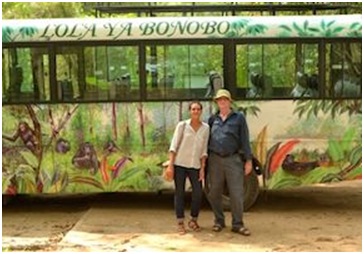
A visit was also made to Lola ya Bonobo where Fanny Minesi, daughter of Lola founder Claudine André, gave the Project Manager a guided tour of the bonobo sanctuary. Lola stands ready to provide long-term care for any bonobos that can be rescued from captive slavery.

The mission to DRC has resulted in a number of follow-up actions that will be announced in future posts.

Lola ya Bonobo's Fanny Minesi, pictured with Dr. Dan Stiles of PEGAS.

Lola ya Bonobo’s Fanny Minesi, pictured with Dr. Dan Stiles of PEGAS.

Map 1: Dealers indicated that the two main sources for great apes were the Mayombe Forest in the west and Equateur Province to the northeast, with Mdandaka being the staging point for shipment down the Congo River

Map 1: Dealers indicated that the two main sources for great apes were the Mayombe Forest in the west and Equateur Province to the northeast, with Mdandaka being the staging point for shipment down the Congo River

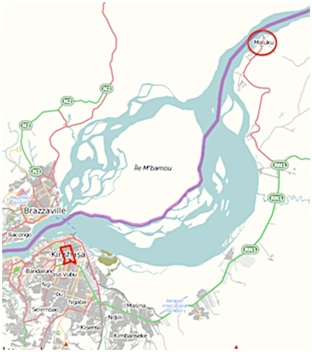
Map 2: The apes are offloaded at Maluku before transport to Kinshasa

Map 2: The apes are offloaded at Maluku before transport to Kinshasa

AWF’s Dupain testifies in Washington, calls for Great Ape Working Group

At a meeting of the US Presidential Advisory Council on Wildlife Trafficking at the US Department of the Interior, African Wildlife Foundation’s (AWF’s) Director of the African Apes Initiative, Jef Dupain, testified before council members and the general public on the growing threat of great ape trafficking and the impact this illicit industry poses to wild populations of bonobos, chimpanzees and gorillas in Africa.

The testimony came as the President’s Advisory Council met to draw attention to species – other than elephants and rhinos – impacted by the multi-billion dollar illegal wildlife trade.

“Ape trafficking is growing as demand abroad for exotic pets and zoo and entertainment animals grows,” said Mr. Dupain. “The nightmare for many of these victims does not end with their capture in the wild but instead – if they don’t die in transit – continues for the rest of their life, sometimes 40 years.”

AWF made several recommendations to the Advisory Council about the role the US government could and should play to combat the illegal trade in great apes, including: “Urge CITES at the next Standing Committee meeting to establish a Great Ape Working Group, which will permit more detailed discussion around CITES regulatory processes and how to make it more effective at controlling fraudulent use of CITES permits.”

“It is time the trade in great apes is exposed and closed,” Dupain said.

The PEGAS Project Manager assisted in the preparation of the AWF testimony.

Congo-Brazzaville trip report: conference and sanctuary visit

The PEGAS Project manager attended the 14th Anchor Conference of the Congo Basin Forest Partnership (CBFP), held in Brazzaville, Congo on October 6-10. The purpose was twofold: to meet people and organizations that could be useful to the PEGAS objectives; and to visit the Tchimpounga Chimpanzee Rehabilitation Centre, managed by the Jane Goodall Institute, to discuss great ape trafficking, assess the facility as a possible site for relocation of confiscated chimpanzees and learn about sanctuary operations.

Oct12_1The conference was largely a talking shop with many complicated, theoretical presentations of little relevance to what is actually happening on the ground in Central African forests. No one seemed to think it odd that not a single Asian government, NGO or private sector entity was a partner in the CBFP, nor were any Asians amongst the participants (except for one Japanese). Since Asian extractive industries (mining, logging, oil and gas) are causing devastating damage to Central African biodiversity, it calls into question the whole purpose of the CBFP. See Flying under the radar for a case study involving Chinese extractive industries in great ape habitats.

The CBFP, whose objectives include conserving forest habitats and biodiversity, while maintaining an important carbon reservoir, apparently forgot to include any partners from Asia. Asian extractive industries operate largely outside initiatives aimed at conserving biodiversity.

The visit to Tchimpounga was a delightful experience. Rebeca Atencia, the manager, and her husband Fernando Turmo, shared a wealth of information on the admirable work that they and staff are carrying out there. The centre’s 166 chimpanzees and about 20 mandrills are receiving the highest standard of care. Of particular interest are plans and preparations to begin a program of release into the wild of Tchimpounga chimpanzees. Three islands in the Kouilou River, which offer ideal forest habitat, are receiving chimpanzees that will undergo pre-release training to teach them how live off wild resources. Once they are Oct12_3ready, they will be released in groups in an area already selected in the nearby Conkuati National Park. Tchimpounga is also carrying out an effective campaign of creating awareness amongst the public aimed at reducing great ape hunting, bushmeat trade and the trafficking of orphans.
Oct12_2Oct12_4

Partnering with African Wildlife Foundation

PEGAS and the African Wildlife Foundation (AWF) have agreed to a collaborative working relationship to cooperate in fighting great ape trafficking. The PEGAS Project Manager met in August with AWF’s Philip Muruthi, Chief Scientist, Landscape Conservation Programs, and Jef Dupain, Director, AWF African Apes Initiative, at AWF’s office in Nanyuki, Kenya. We agreed to collaborate in three main areas:

  • Great Apes Working Group in CITES
  • Initiating great ape repatriation procedures in illegal trade import countries
  • Ascertaining great ape trafficking networks and trade routes in Central Africa

Aug25_1          Aug25_2

The continuing fight to put great apes on the CITES agenda

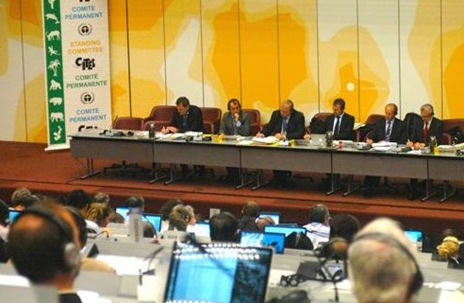
The PEGAS Project Manager attended the 65th CITES Standing Committee meeting held in Geneva on July 7-11, representing Ol Pejeta Conservancy. The CITES Standing Committee “…provides policy guidance to the Secretariat concerning the implementation of the Convention and oversees the management of the Secretariat’s budget. Beyond these key roles, it coordinates and oversees…the work of other committees and working groups; carries out tasks given to it by the Conference of the Parties; and drafts resolutions for consideration by the Conference of the Parties.” The Standing July12_newCommittee also initiates action to suspend trade as a sanction against Parties (ie. countries) that egregiously break the rules.

This was a particularly important Standing Committee meeting as there were several significant agenda items concerning various species and issues. Over 400 participants attended, the largest in history. As usual, most of the discussion was devoted to elephants, rhinos and big cats, with pangolins making a breakthrough as a big issue as well. Great apes languished in obscurity, as usual, although several NGOs and UNEP tried to bring more discussion to the floor.

The CITES Secretariat, ably assisted by the Standing Committee chairman Øystein Størkersen, managed to prevent the requested formation of a Great Apes Working Group. Only through a working group could the evidence related to great ape trafficking be adequately examined and remedies proposed. The Secretariat continues to try to minimize the issue and thus avoid taking action. See Why are great apes treated like second-class species by CITES? and a PEGAS report addressing the issue for more details.

The PEGAS Project Manager met and networked with many representatives of governments, the UN and NGOs, but attendance was principally a learning experience in how best to plan strategies to get something effective achieved in future with CITES for great apes. Plans are accordingly in the works for the 66th CITES Standing Committee meeting to be held in January 2016, followed by the crucial 17th CITES Conference of the Parties to be held later that year in South Africa.

PEGAS holds media briefing on ape slavery

July1

Mwanzo and her baby Angela at the Sweetwaters Chimpanzee Sanctuary

PEGAS hosted a media event at Serena Sweetwaters Tented Camp on the Ol Pejeta Conservancy. Several journalists attended and were briefed on the trafficking crisis facing great apes and the objectives of PEGAS to put an end to it. Here are two of the articles the media event produced: “Slavery” driving apes to extinction, conservationists say and The story of the traffic in Africa’s great apes.

GRASP warns illegal ape trade remains active

GRASP published the following alert [edited] on its press release webpage in June 2014:

The illegal trade in live chimpanzees, gorillas, bonobos and orangutans showed no signs of diminishing – and may actually be getting worse – since the Great Apes Survival Partnership (GRASP) published the first-ever report to gauge the global black market in great apes in 2013.

Three chimpanzees captured in Ghana before transport.

Three chimpanzees captured in Ghana before transport.


The three chimpanzees in Dubai after shipment. (photos captured from Instagram)

The three chimpanzees in Dubai after shipment. (photos captured from Instagram)

“The number of apes being trafficked and confiscated indicates that serious threats remain to wild populations,” said GRASP coordinator Doug Cress. “Either the illegal trade is increasing or law enforcement is improving, but it’s clear there is still a significant population of [great apes] being captured and sold.”

Unlike wildlife contraband such as elephant ivory or rhino horn, the overwhelming majority of great ape confiscations occur within national borders. Only 5 percent of the total confiscations in 2013 and 2014 crossed international borders.

ARCUS releases “State of the Apes” book

The Arcus Foundation compendium State of the Apes: Extractive Industries and Ape Conservation was released in a press conference at the UNEA. This book is June28an excellent introduction to entirely new initiatives being launched by governments, extractive industries, financing institutions and biodiversity conservation organizations to introduce extensive planning and implementation of project management and biodiversity offsets involved in mining, logging and oil & gas exploitation. See Extractive industries and apes for more details. Chapter 10 deals with the causes leading to the illegal trade of great apes.

PEGAS lobbies UN on ape trafficking

The PEGAS Project Manager attended the first United Nations Environment Assembly at the UNEP headquarters in Gigiri in late June. What previously was known as the Governing Council, which the Project Manager remembers well from his days as a staff member of UNEP in the 1980s and consultant in the 1990s, has grown considerably from a gathering mainly of Permanent Representatives and United Nations organizations into a full-blown global forum bringing together various government, IGO, NGO and civil society stakeholders. Wildlife and natural resource trafficking was a main consideration of this Environment Assembly. A UNEP-INTERPOL Rapid Response Assessment on Environmental Crime was released.

The PEGAS Project Manager liaised with many of the assembly participants to introduce the new PEGAS initiative to them and raise the profile of great ape trafficking, which remains a largely ignored issue when compared to elephant, rhino and big cat poaching and illegal trade.

unea

Our new site is live

Welcome to the new, dedicated website for the Project to End Great Ape Slavery (PEGAS). We are entering a busy phase in our campaigns to disrupt the illegal flow of great apes from Africa to the major overseas markets, to repatriate them where possible, and to continue caring for rescued apes at our home base at Sweetwaters Chimpanzee Sanctuary at the Ol Pejeta Conservancy in Nanyuki, Kenya.

We will be bringing you regular updates on our activities in the feed below. We also maintain a Facebook page and invite you to join us there. In addition, we offer a selection of articles and publications by Daniel Stiles and other figures in the conservation field. Click on the Reports and Publications tabs to access this material.

Please support this critical venture by telling others about us.