Great ape trafficking to Qatar for pets – and safari parks?

A story published on 16 March 2016 in the Doha News reported that a man was apprehended trying to sell a baby chimpanzee by a patrol from the Department of Environmental Protection. No details were given, but if a patrol saw it the man must have been trying to sell it outdoors. A person commenting on the story said that he had once seen it at the Wakra roundabout in Doha.

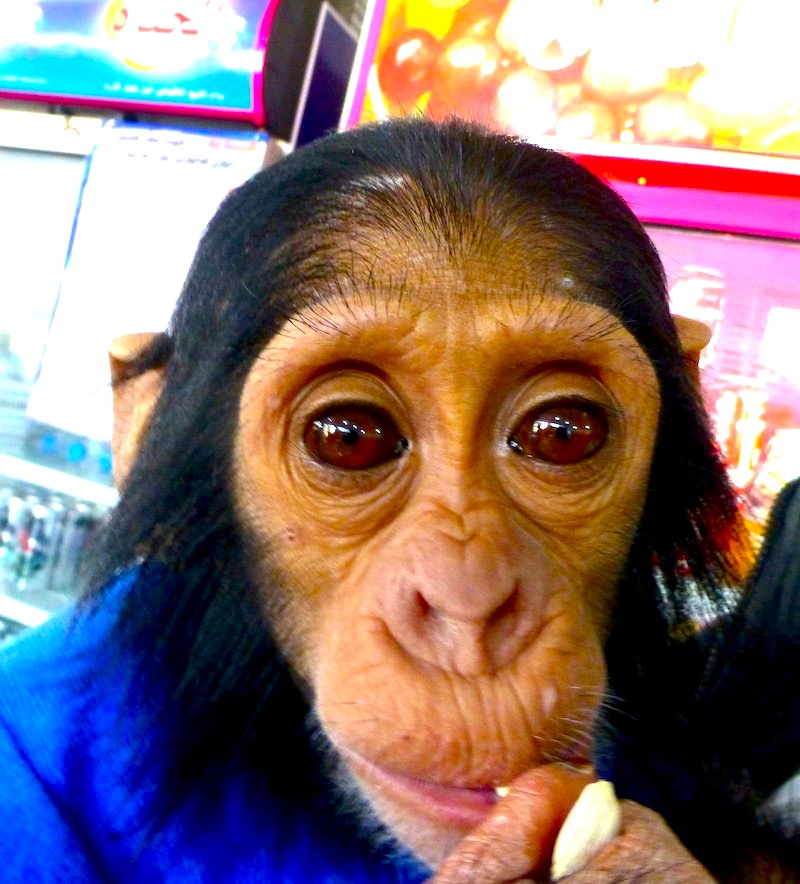
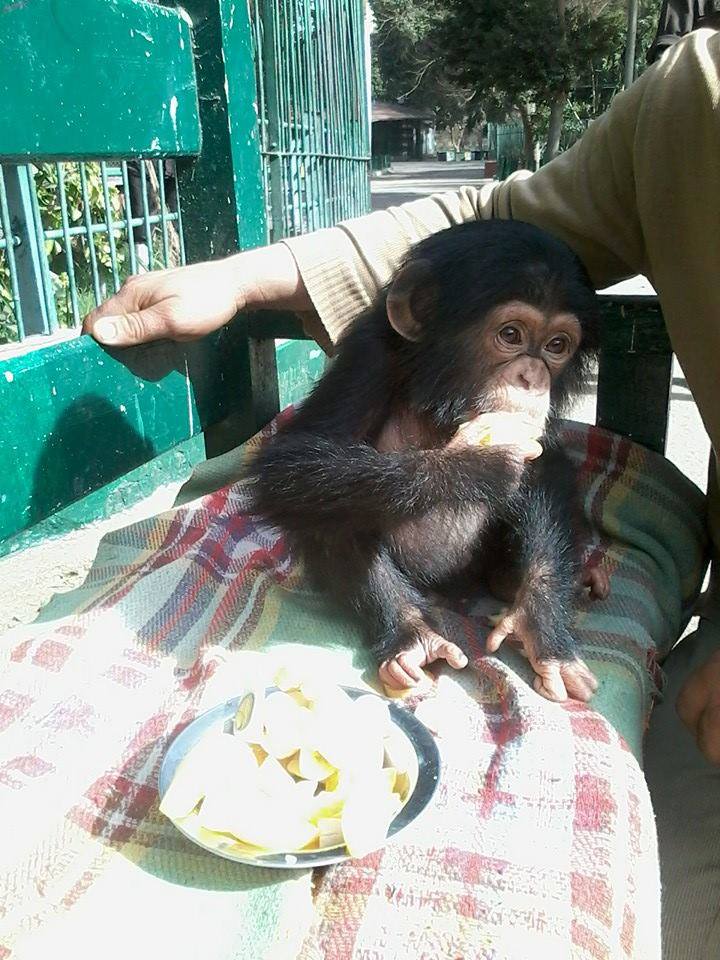
A photograph accompanying the story showed a miserable baby chimpanzee on a car seat wearing a child’s pajamas. The pajamas looked familiar.

One of the online traffickers PEGAS has been monitoring, located in Qatar, posted a video on 18 February of the baby chimpanzee that was later seized. The pajamas are identical with those in the newspaper report and the size and facial characteristics of the infant in the photograph and video are the same.

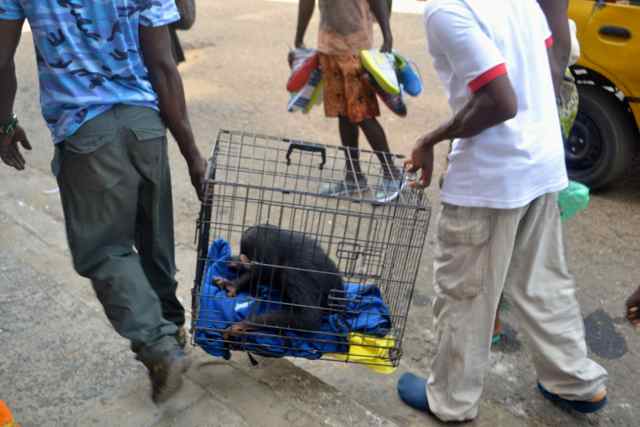
1Qatar seized chimp

The baby chimpanzee seized in Doha in mid March 2016


2 18.2.16 copy 2

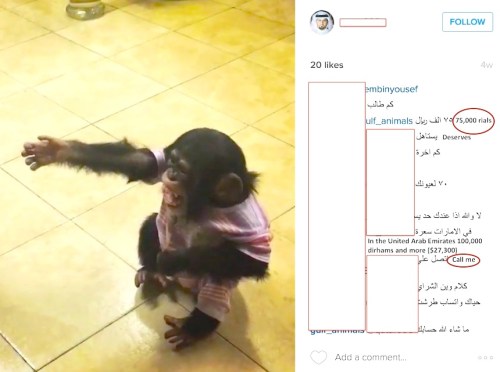
This is the seized chimpanzee. This video post from 29 February demonstrates that a dealer was offering the chimpanzee for sale online for 75,000 rials, about USD 20,600.

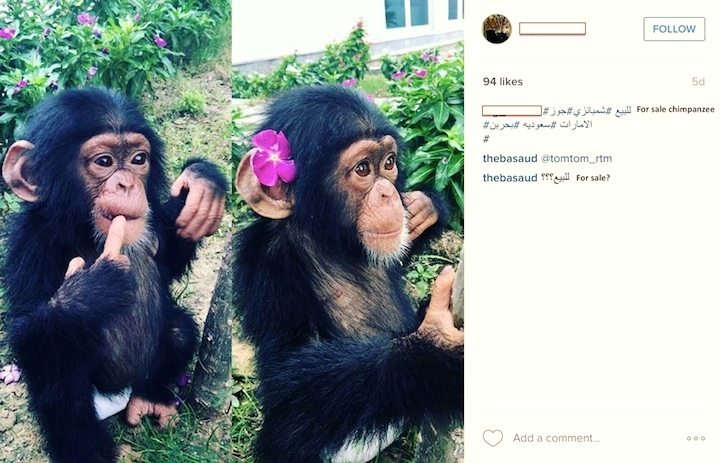
The commentary displayed on the video post shows that the man was offering the chimpanzee for sale for 75,000 Qatar rials (about USD 20,600). It looked like he had a buyer, as one commentator asked that the dealer call him at a number provided. Apparently, the deal was not concluded. He also advertised it for sale on a Kuwaiti traffickers post on 29 February.

3

The dealer in Doha posted that he had a chimpanzee for sale on an Instagram page of a trafficker based in Kuwait.

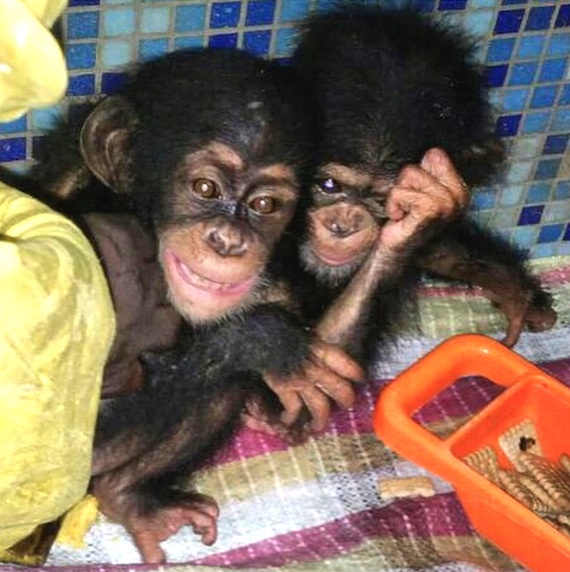
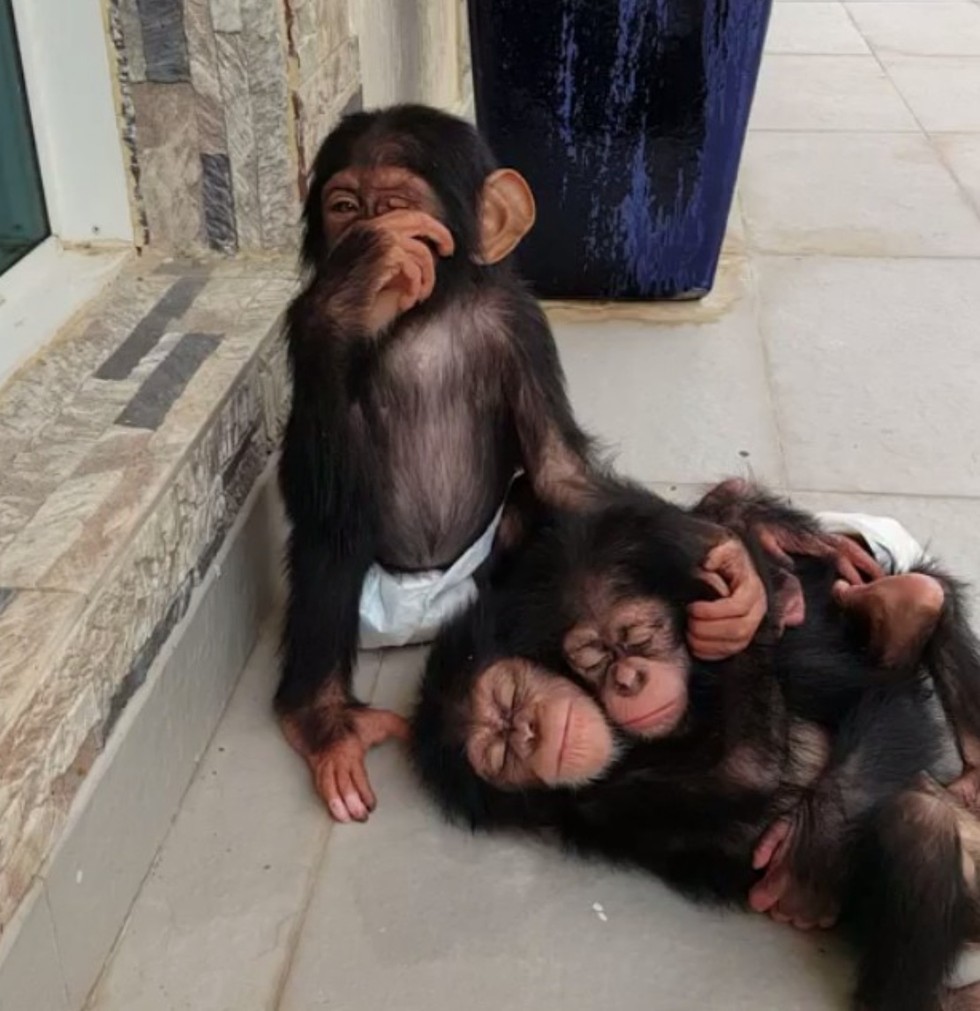
Another infant chimpanzee was seized in November last year in Doha and the trafficker was arrested, though no further information is currently available on what has happened to the accused or the chimpanzee. The article said that the chimpanzee was sent to the Doha Zoo, but the zoo closed in 2012. Some animals are being moved to the Al Khor Park, and others were supposed to be moved to shelters in Rawdat Al Faras farm, but the fate of the two infant chimpanzees is unknown.

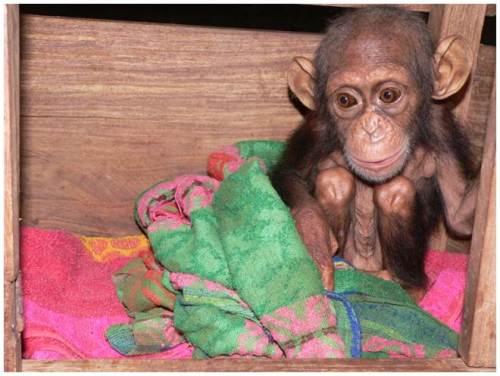
4Qatar seizure 11.15

Another infant chimpanzee seized in Doha in November 2015. (Photo: The Peninsula newspaper)

There were three other adult chimps already living in Doha Zoo (Rita, Timmy and Tina) and what has become of them is also unknown. PEGAS is making enquiries.

5Rita, Timmy&Tina

Rita, Timmy and Tina, three chimpanzees about 15 years old in Doha Zoo. (Photo: Hilda Tresz)

Qatar is currently constructing a new zoo and safari park that is supposed to be the biggest in the region. The new zoo will cover 75 hectares, seven times the size of the current facility, and it will be divided into several regions representing the natural and climatic features of three continents, with a planned 3,000 animals. There will be a combination of drive and walk through exhibits and other facilities. It is expected to open at the end of 2017.

6zoo

Schema of the new 75-hectare Doha Zoo planned to hold 3,000 animals. How many will be great apes and where will they come from?

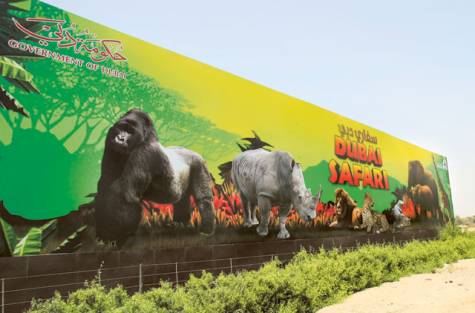
This joins the safari park type expansions of the Dubai and Al Ain zoos in the UAE. Thousands of wild animals are pouring into the Gulf region to supply these new developments. Conservationists concerned about illegal wildlife trade need to monitor the sourcing of these animals carefully.

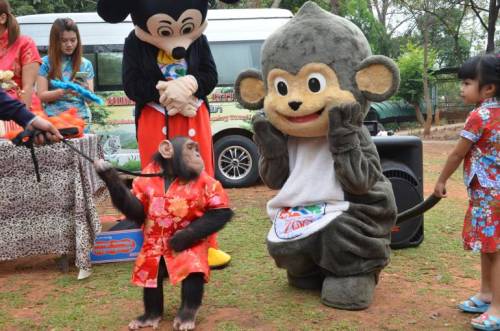
A government spokesman said that the new Doha Zoo “will be an entertainment outlet for the country’s residents and tourists”. PEGAS hopes that the “entertainment” does not take after what is seen in some places in East Asia, where great ape infants are used as photo props with visitors and juveniles are trained to perform in front of fee-paying audiences. Will this be the fate of the two chimpanzee infants?

PEGAS has written to the Qatari CITES office enquiring about the possibility of relocating the chimpanzees to Sweetwaters Chimpanzee Sanctuary, but has yet to receive a response. There is precedence. In 2001 two baby chimpanzees smuggled in to Qatar with a shipment of birds from Nigeria were sent to Chimfunshi sanctuary in Zambia.

If you would like to help, please write to:

Mr. Fawaz Al-Sowaidi
Director of Protected Areas and Wildlife Department
Head of CITES Management Authority
P.O. Box 7634
Doha, QATAR
Email: fasowaidi@moe.gov.qa

Politely enquire about the fate of the two seized chimpanzee infants and respectfully suggest that they should be sent to an appropriate facility that can offer secure and nurturing care in the company of other chimpanzees. Ol Pejeta Conservancy is one of the few wildlife establishments in the world that can offer to cover all transport costs, through the PEGAS project, and lifetime care for chimpanzees in need of a home.

Stay tuned.


Thailand not a ‘Land of Smiles’ for great apes

Thailand tourist promos advertise the country as the Land of Smiles, because the people are so welcoming and friendly. But a recent visit to Thailand by the head of PEGAS (the Project to End Great Slavery) turned up dozens of great apes that definitely were not in the mood to smile.

PEGAS found chimpanzees, orangutans and a gorilla held captive in appalling conditions, and many were being used in commercial activities such as circus type performances and props in pay-for-play photo sessions with visitors.

Top of the list of great ape horror shows were Safari World, Samut Prakarn Crocodile Farm and Zoo and Pata Zoo. None of these privately owned facilities are strangers to criticism and bad publicity. Many press articles and NGO reports and campaigns have been directed at them. What is surprising is that they continue to operate as if nothing had happened.

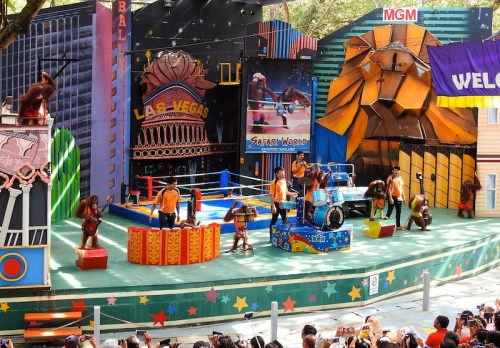
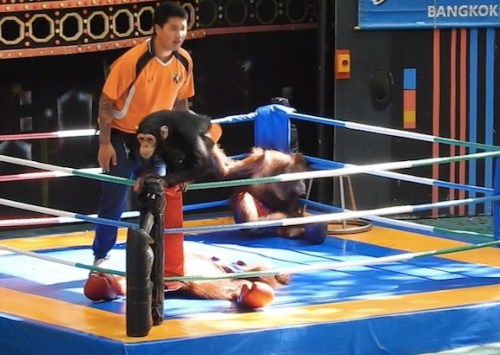
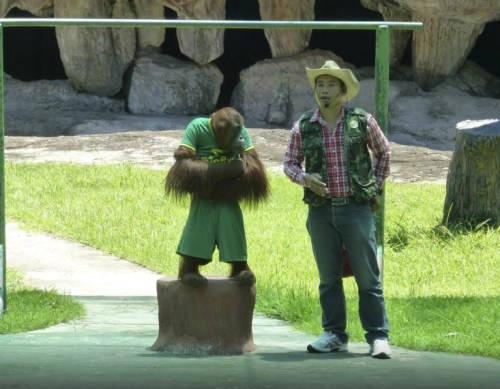
Safari World, for example, located less than an hour from downtown Bangkok, puts on a daily Orang Utan Show that gathers large crowds. Seven juvenile orangutans dress up as rock stars and pretend to play instruments while a young female obscenely go-go dances to blared music. Following the music show, orangutans engage in a boxing match, while a very young chimpanzee rushes in and out acting the clown.

1

Hundreds of people pay to watch captive great apes perform at Safari World.

2

Where did these apes originate? Not a single one could have been legally imported, according to the CITES Trade Database. Just as important, performances like that are illegal under Thai law. In 2004 the government seized 48 orangutans at Safari World for exactly the same offense and returned them to Indonesia, where they were met at the Jakarta airport by the Indonesian president’s wife.

“We are very happy to get the orangutans back,” Kristiani Yudhoyono said at a ceremony. “They belong to our vast nation…”. Now about ten more orangutans are back at Safari World.

3

A young chimpanzee plays the clown

In November last year, 14 orangutans confiscated at a Phuket island zoo were repatriated to Indonesia for doing the same things as seen at Safari World. No one was charged with a crime, even though obviously one had been committed.

Edwin Wiek of the Wildlife Friends Foundation Thailand, who was instrumental in having the Phuket orangutans confiscated and repatriated, said in August 2015 that “[the Department of National Parks] decision has sent a clear message to wildlife smugglers and zoos in Thailand that smuggled apes will never end up in the trade again.”

3a

Fourteen orangutans were returned to Indonesia in November 2015. Will it be a deterrent? Photo: Claire Beastall, TRAFFIC

Apparently Safari World and the traffickers who supply them did not receive the message.

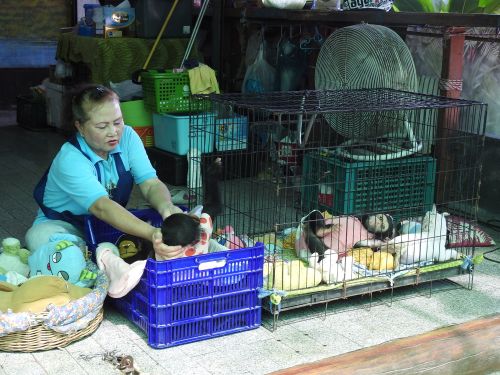
The owner of Samut Prakarn Crocodile Farm and Zoo missed the message as well. As soon as visitors enter they encounter baby chimpanzees, orangutans and tigers lined up in cages or cribs, there to be photographed. The zoo charges 200 baht (USD 5.60) for a framed photo with Meiya, a 5-month old female chimpanzee. Commercial use of great apes is supposedly prohibited if they are imported, as they are CITES Appendix I. If they are captive born, the facility must be registered with the government and receive authorization to breed that species, according to Section 17 of the Wild Animal Reservation and Protection Act of 1992. Permission to breed crocodiles does not extend to great apes.

4

5

Entering Samut Prakarn Crocodile Farm and Zoo one finds baby great apes kept there to make money in photo sessions

6

It costs 200 baht to take a photo with Meiya

On the edge of the farm and zoo, away from where the crocodile and elephant shows take place, PEGAS found some rusting cages that housed a pitiful orangutan and several adult chimpanzees. Five were visible and an employee said that eight more were kept in cages out of sight. A recent animal welfare law prohibits cruelty to animals. It unfortunately does not define cruelty. Many would think that cooping up intelligent creatures in such deplorable conditions constitutes cruel imprisonment.

7

8

An orangutan and several chimpanzees are kept in old, rusting cages at Samut Prakarn

The last of the terrible three is the infamous Pata Zoo, opened in 1984 on top of a Bangkok department store. Its biggest celebrity inmate is Bua Noi, a female gorilla that according to the International Gorilla Studbook originated in Guinea – a country that has no gorillas. What Guinea does have, however, is a notorious reputation for illegal great ape trade. The CITES Trade Database has no record of a gorilla import from any country to Thailand, thus it appears Bua Noi was illegally acquired. She lives in solitary confinement and tourists have even reported seeing her gripping the cage bars and shedding tears.

9

Bua Noi exists solely to earn money for the zoo owner

The Pata Zoo also holds five orangutans and three chimpanzees in cramped cages, a long-standing animal welfare issue. It, too, puts on an illegal show, which includes an orangutan that lifts barbells, and young orangutans sit with minders outside waiting for tourists to pay money to have their photo taken with them.

10

Young orangutans of unknown origin sit outside the Pata Zoo to be used as money earning photo props

PETA Asia claims that “the conditions at the Pata Zoo are some the worst that PETA has ever encountered… The cages are extremely small and barren, and the animals are deprived of everything that is natural and important to them.” PETA has a campaign to close the zoo, but its license was recently renewed, and the zoo director Kanit Sermsirimongkhon said, “We have complied with all relevant laws”. Have they? Bua Noi and other great apes there were probably illegally imported, as they do not have CITES documentation.

11

PETA Asia has a campaign to close Pata Zoo

PEGAS visited several other zoos in Thailand as well, including Dusit, Lopburi, Khao Kheow and Korat. The seven orangutans and three chimpanzees found at Lopburi were living in dreadful conditions and are being used in illegal performances, but those at the other zoos were situated in well-designed enclosures with landscaping and amenities.


14

Lopburi Zoo keeps orangutans in a dark dungeon, except when they bring them out for weekend and holiday shows

In all, PEGAS estimates that there are at least 41 orangutans, 38 chimpanzees and one gorilla in nine facilities. In some, the animals could not be seen at the time of the visit. There are other great apes located in facilities not visited. Judging by records in the CITES Trade Database, some of the apes were probably illegally imported, although some were born in Thailand. Unless the facility has obtained express permission to propagate a species, even locally born apes could be illegal to possess.

15.JPG

Khao Kheow has a pleasant environment for the great apes

16

But a 6-year old female orangutan is kept outside for the money-making photo sessions

Why can’t the illegal exploitation of these sentient animals be stopped?

Because, as Edwin Wiek says, “It’s big business. Influential people.”

“There are ex-prime ministers that have chimpanzees and orangutans in their backyard. These are the kind of people that are opposing us,” said Wiek.

Just as with the problem of online wildlife traffickers in the Middle East, the solution has to start at the top. If the decision-makers in power are complicit with the crime, little can be achieved. Campaigns need to be directed at those at the very top of government. Only they have the power to change anything.


PEGAS attends CITES 66th Standing Committee meeting

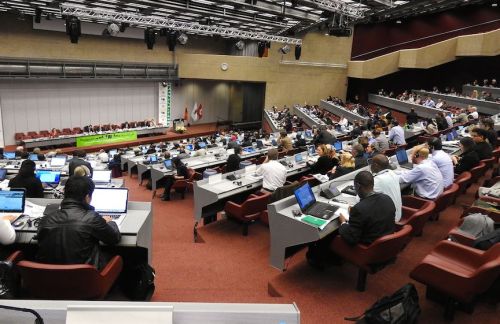
The 66th meeting of the Standing Committee of CITES was held 11-15th January 2016 in Geneva, Switzerland. The Standing Committee is an important body in the functioning of CITES. It “provides policy guidance to the Secretariat concerning the implementation of the Convention and oversees the management of the Secretariat’s budget. Beyond these key roles, it coordinates and oversees … the work of other committees and working groups; carries out tasks given to it by the Conference of the Parties; and drafts resolutions for consideration by the Conference of the Parties.”

1

The 66th CITES Standing Committee meeting had over 400 participants

The Standing Committee (SC) also initiates action to suspend trade as a sanction against Parties (i.e. countries belonging to the Convention) that do not comply with important recommendations. Certain ‘recommendations’ contained in Resolutions and Decisions are in fact requirements, but CITES does not use undiplomatic words such as ‘require’ or ‘command’.

The SC is the best place to initiate any new actions within CITES to address the illegal trade of great apes or any other species. The entire membership of CITES is now 182 Parties, while the SC is made up of only 35 Parties (including the SC host country, and previous and next Conference of the Parties host countries), most of which rotate. It is more efficient to get things done with 35 SC Party members than with 182 at a Conference of the Parties (CoP), which is held every 2-and-a-half to 3 years. Fewer than 500 participants attend a SC meeting, thousands attend a CoP.

The preparatory work of examining illegal trade evidence, identifying the primary perpetrators of illegal trade, and the supply and demand countries, the methods employed in trafficking and trade routes, and related information can be carried out in the SC meeting in order to formulate strategies and actions to address the problems.

Once actions have been agreed upon, wording must be formulated to either produce a new Resolution or Decision, or revise an existing one, to provide ‘recommendations’ (i.e. instructions) to Parties, the Secretariat and the Standing Committee respectively for action.

This process of examination and discussion cannot be carried out in the plenary meeting because there simply is not enough time (see Sellar’s recent commentary on it). The usual procedure is for a SC member or observer Party to request from the Chair that a working group (WG) be created. If other Parties support the request, the Chair invites expressions of interest from Parties and observers, including NGOs. The WG usually numbers 20 or fewer Parties, international organizations and NGOs. They then schedule meetings to take place in rooms adjoining the main conference hall, and report their findings back to the plenary.

The proposed new or revised Resolution or Decision is submitted as a working document at the next Conference of the Parties as an agenda item to be discussed, possibly revised further, and then either accepted or rejected by the full CITES membership. The WG, possibly with additional members now, is essential in this process.

All of the major species groups, and some not so major, at some time or other have had a WG formed to discuss important trade issues (e.g. elephants, rhinos, Asian big cats, cheetahs, pangolins, sharks and rays, snakes, various plant and timber species, even sturgeons and paddlefish).

Great apes, oddly, have never had a WG, even for discussion of the formulation of CITES Resolution Conf. 13.4 Conservation of and Trade in Great Apes, produced by the CITES Secretariat in 2004. The Secretariat also prepared on its own the only revision to RC 13.4, made at the 16th Conference of the Parties (CoP) in March, 2013.

At the 65th SC meeting in July, 2014, a SC member did request formation of a great apes working group (GAWG), supported by another Party and several NGOs. The discussion was abruptly cut off by John Scanlon, the CITES Secretary-General, when he initiated a closed-microphone consultation with the SC Chair. See this Mongabay article for a description. In the report on great apes submitted to the 65th SC, the Secretariat stated in part, “data from official sources suggest that the illegal international trade in great ape specimens is currently limited” and “there is very little illegal international trade in great ape specimens”.

The key words in this statement are “data from official sources,” which apparently consist of its own Trade Database and reports compiled by INTERPOL and the World Customs Union. “Official sources” seemingly do not include its sister organization within the UN Environment Programme, the Great Apes Survival Partnership (GRASP), which is charged with great ape conservation. At the last CITES Conference of the Parties, held in Bangkok in March 2013, GRASP released a report entitled Stolen Apes. This report found that between 2005 and 2011, approximately 22,200 great apes were lost in trafficking related incidents. The report estimates that every year approximately 5% of the total great ape population on Earth is lost due to trafficking and related killing. Is that really “limited” and “very little”?

2

The situation has not improved since then. In June 2014 GRASP released a press statement asserting that “The illegal trade in live chimpanzees, gorillas, bonobos and orangutans showed no signs of diminishing – and may actually be getting worse.” In an October 2015 webcast the GRASP coordinator said that seizure rates of illegally traded great apes were higher than previously.

3

Great ape illegal trade seizure rates have increased since the Stolen Apes report was written, according to GRASP

The findings on trafficking from unofficial sources such as media reports and NGO investigations are not included in the Secretariat’s reports, nor up to the present is GRASP’s information included, although there are plans for GRASP to begin reporting officially, probably in cooperation with the Section on Great Apes (SGA) of the IUCN/SSC Primate Specialist Group. The intended contents and format of the reports are currently being developed.

Recognizing that there was a glaring need for a more complete set of information on great ape trafficking to be presented to CITES Parties, PEGAS devised a plan to achieve this at the 66th SC meeting. The plan was composed of three parts: (1) persuade one or more Parties to submit a Working Document containing a call to revise RC 13.4 to deal with increasing levels of great ape trafficking, (2) induce a Party or Parties to submit an Information Document that contained highlights of the excluded media and NGO investigation findings and (3) call for the creation of a GAWG to examine the new (to CITES) information and discuss the RC 13.4 revision.

PEGAS met with the Kenya Wildlife Service – Kenya’s CITES Management Authority – in 2014 after the 65th SC meeting to present the plan and seek their support, which was obtained. PEGAS and Ol Pejeta Conservancy CEO Richard Vigne met with GRASP staff on 28 August 2015 to discuss a number of issues of mutual concern regarding great ape illegal trade. At that meeting PEGAS brought up the need for a GAWG in order to create a forum within CITES for examining the full range of information available that reported on great ape trafficking. GRASP did not think that a GAWG would achieve anything, because the Secretariat’s position was firm, but GRASP did not say anything opposing the creation of a working group.

PEGAS in 2015 then drafted a Working Document and Information Document and shared it with Doug Cress of GRASP, Ian Redmond of the Ape Alliance and Mark Jones of the Born Free Foundation for their comments. After making the advised revisions by the reviewers the documents were submitted to KWS for their review.

The plan was also presented and discussed at an Information Exchange Meeting held at the GRASP offices in the United Nations headquarters in Gigiri, Kenya, on 9th November 2015. The organizations attending were PEGAS, GRASP, KWS, Ape Alliance, Born Free Foundation, PASA, UNODC, EAGLE, Jane Goodall Institute, Humane Society of the United States and WildlifeImpact. The Wildlife Conservation Society was also supposed to attend, but the person came down with the flu and gave his apologies.

Not everyone expressed their full support for the plan, but none of the participants openly opposed it. The main doubts were that the objectives of a revision of RC 13.4 could be achieved by other means, and if the GAWG was again rejected it would constitute a major setback for the eventual creation of one. A main concern of PEGAS, however, was not just the revision of RC 13.4, but also the presentation of the ‘non-official’ information on the scale of great ape trafficking, and the details of it, to CITES Parties. Without a GAWG, there was no way to accomplish this officially and get it into the CITES record. The Secretariat could continue to assert its claims that “there is very little illegal international trade in great ape specimens”.

KWS, with the assistance of the Ape Alliance, obtained the co-sponsorship of the Uganda CITES Management Authority to submit the Working Document, which was done as SC66 Doc. 48.2. Uganda is a great ape range State and a member of the Standing Committee, so this was an important accomplishment. PEGAS would like to thank sincerely Patrick Omondi and Solomon Kyalo of KWS and James Lutalo of the Uganda CITES M.A. for their assistance and cooperation.

In the end no sponsor of the Information Document could be found, even though revisions were made to water it down. There was simply too much evidence of malfeasance on the part of certain named Party countries by non-official sources for another Party to attach their name to it. The Information Document, in CITES format, can be viewed here. Information Documents are limited to 12 pages of text, so not everything could be put in. There is quite a bit of history given of great ape activities within CITES because it is important to establish continuity of the past with what is occurring today. CITES has not solved the great ape trafficking problem, in spite of trying to create the impression that it has.

4Ian chimpanzee box 2 copy

CITES has not solved the great ape trafficking problem, in spite of trying to create the impression that it has.

PEGAS investigations of online wildlife trafficking, particularly in the Middle East, and a recent visit to Thailand, Vietnam and China, have shown that great ape trafficking and misuse in commercial activities are more common than even PEGAS believed a year ago.

8

Online trafficking in the Middle East is out of control

6.jpg

7

East Asian zoos and safari parks import dozens of young great apes annually for performances and use in fee photography with visitors

The plan to get a GAWG created at SC66 was undone by two main factors – agenda scheduling and lack of support for SC66 Doc. 48.2 from the Secretariat, GRASP and certain NGOs. GRASP claimed that certain great ape range States and NGOs did not support 48.2 because they had not been involved in the process. The Ape Alliance had, however, written to all SC members prior to the start of the meeting to inform them of the contents and reason behind 48.2 and requesting their support for it.

The Species Survival Network, which coordinates the activities of dozens of “conservation, environmental and animal protection organizations around the world to secure CITES protection for plants and animals affected by international trade”, recommended that SC66 agree to establish the proposed Working Group. Nevertheless, GRASP requested Kenya and Uganda to withdraw the document, which with considerable consternation they felt they had to do if GRASP did not support it.

The scheduling was also a major factor. The Great Apes item on the agenda was originally scheduled for Thursday afternoon (which wasn’t known when the document was drafted), the penultimate day of the meeting. Even if a GAWG had been formed, it would not have had the time to meet, adequately discuss revision of RC 13.4, and report back to the plenary. As it turned out, because of delays, Agenda item 48, Great Apes, did not come up until mid morning on Friday, the last day.

The solution could have been for Uganda and Kenya to request that the GAWG be formed, which would only have taken about 10 minutes, with the instruction from the Chair to meet electronically after the meeting, as other working groups do. A draft revision of RC 13.4 could have been discussed and agreed upon in a Google Group or similar forum, and submitted as a draft resolution revision Working Document to CoP17 before the 27 April deadline. Presumably GAWG members who were Parties would co-sponsor the submission. The Information Document could also have been circulated to the GAWG members for their review. If this course had been taken, the GAWG could have met early on during CoP17 to finalize the presentation to plenary under the Great Apes agenda item.

So what happens now?

An informal group of NGOs is working on a draft RC 13.4 revision by email, which eventually will be reviewed by GRASP and selected Parties, and Party sponsors will be solicited to submit it before the 27 April deadline. If the Great Apes agenda item is scheduled on a Thursday again, the same thing that happened at SC66 could occur again. No time for a GAWG to be formed, to meet to review the revision, and report back to plenary. The Chair would no doubt put consideration of it off until a subsequent Standing Committee meeting.

In the meantime great ape trafficking continues, and CITES is still doing little about it, with lack of support from organizations that should be helping.

5

Eight young orangutans used in a band at Safari World, just outside of Bangkok. This is illegal according to Thai law.

Great Ape Illegal Trade Information Exchange Meeting

On 9th November, 2015, PEGAS organized a meeting with several key people involved in great ape conservation and welfare. The purpose was to exchange information with a view to enhancing synergy and cooperation in all of our respective activities. The meeting elicited unexpected – for PEGAS – differences of opinion on the best way forward. More on this will be presented in future posts.

Please see below a summary of the discussions, which was sent for review to all of the participants.

REPORT OF MEETING

Great Ape Illegal Trade Information Exchange Meeting 

9 November, 2015 

Introduction and purpose of the meeting 

GRASP and PEGAS welcomed the participants to the meeting.

The names of individuals who expressed various points of view or who shared items of information will in most cases not be given, and only a very general summary will be presented here.

PEGAS organized the meeting with considerable assistance from GRASP, for which we are most grateful. It was held at the United Nations Office in Nairobi on 9th November 2015 from approximately 9 a.m. to 5 p.m.

The meeting participants (list in the annex) introduced themselves and briefly summarized their interest in great apes.

The purpose of the meeting was to exchange information related to illegal great ape trade: how and why it persisted – supply and demand drivers; what the scale of it was and the trends; what measures could be taken at the national and international levels to halt it; the issues of corruption and law enforcement; where and how many great apes were in captivity and in need of relocation to a sanctuary; the question of sanctuary space and capacity to care for new arrivals; policy related to relocating captive great apes; databases to capture, analyze, store and report information on illegal trade and sanctuaries; CITES enforcement issues; and future plans.

Great Apes in need of rescue and relocation

It was proposed that a database containing the following information be established: the location and number of great apes in need of sanctuaries by species, the capacity and willingness of sanctuaries to accept or not new arrivals by country and species, and the policy that would apply to relocating great apes from one country or region to another.

The final outcome was that no database of this kind will be produced, there was insufficient support from participants.

GRASP has a list of captive great apes in need, but it is not freely available. Many of the participants spoke of large numbers of great apes known to be in deplorable conditions. PASA has protocols and guidelines of how to deal with such cases, but these do not seem to operate in practice. Each case has its own individual characteristics, and efforts to relocate apes can be very time-consuming and expensive to achieve. The case of the Taiping Four gorillas was presented as an example, which took several years and considerable effort and expense to complete. CITES stated in 2007 that it should stand as an example and act to prevent a repeat occurrence – which has not been the case. [The Guinea to China C-scam began in 2007, the same year.]

The consensus opinion of the group seemed to be that relocation should be attempted only in extreme cases. In most instances, because of multiple factors – expense, difficulty, opportunity costs (more important things could be done with the time and money), sanctuary limitations – the apes would regrettably have to remain where they were. The PASA policy, however, was that if great apes were seized or otherwise acquired in a country and presented to a sanctuary in that country, the sanctuary was required to take the ape(s) in; lack of space and funds was not an excuse to reject acceptance.

Repatriation of internationally seized apes would preferably only be done soon after seizure. Those apes trafficked years ago and held in captivity abroad for long periods are not high priority for limited sanctuary space in Africa, except at a non-range country sanctuary such as Sweetwaters. Chimfunshi was suggested as being included, but some felt that this sanctuary was not up to standard. If a relocation was proposed from outside Africa to a PASA sanctuary, it would have to come with sufficient funding attached to cover the expense of caring for the ape over the course of its expected life span.

More sanctuaries are needed in range State countries that do not have them (e.g. Côte d’Ivoire, Liberia and CAR), and existing sanctuaries need to expand, but there was no master plan of how to achieve it. Each country and sanctuary seems to operate independently.

Status and trends of illegal great ape trade

GRASP is keeping records of seizures with various partners reporting to it. The average rate over the past 18 months (?) was 2.11 apes a week seized, which is a higher rate than the period before the Stolen Apes report (2005-2011). Anecdotal reports from the media and informed individuals suggest that trade, particularly of orangutans, is at a high level. A high level for apes, however, was still very low compared to many other species. This, and the fact that CITES only accepts formal seizure data from governments, the WCO, INTERPOL and other official sources, was suggested as one reason why the CITES Secretariat does not accord priority to great ape trafficking.

Considerable discussion ensued about the motivation behind lack of action by CITES in regard to great apes and its reluctance to allow creation of a WG within CITES. The following were offered as explanations: (1) CITES has 35,000 species to deal with, only those with high levels of illegal trade and economic value are accorded concerted attention. Great ape trade does not cross the threshold; (2) related to (1), since CITES only accepts official trade records, it misses much of the informal reporting on trafficking and defends its actions based on the official data; (3) CITES does not want to tackle great ape trafficking because it does not want to enter into conflict with influential import countries such as China, Russia and the wealthy Gulf states, and (4) most of the informal sector reports presenting data on the trafficking have been presented in such an aggressive manner that the Secretariat is biased against according the data a platform in a WG.

It was pointed out that the main demand motivations for great ape trade persisted: (1) pets, (2) entertainment, (3) private menageries for the wealthy, (4) commercial zoos and safari parks.

Pegas announced that Vietnam, China and the Middle East (Egypt and the UAE) were developing new safari parks, the former USSR countries and eastern Europe were emerging as markets for great apes in the pet and private menagerie area, the Middle East had many online great ape traffickers, TRAFFIC had found many great apes in commercial and private ownership in SE Asia, and even India was now implicated in illegal trade [one of the Dubai online traffickers operates in India and is Indian]. The Indonesian land-clearance fires were creating increased opportunities for orangutan trafficking.

Views were divided on whether the best approach to address illegal great ape trade was at the national level or internationally through CITES. CITES was recognized as being ineffective and there were loopholes in using CITES permits and government-to-government ‘Ambassador’ gifts. Some felt it was generally impossible to improve CITES enough, so the national level law enforcement and community education approach was the preferred course of action, while others thought that CITES could be reformed enough to be effective.

Corruption was recognized as the biggest hurdle to achieving effective national action. In Africa, EAGLE had made corruption the keystone of its law enforcement strategy. They had found that approaching high-level government officials to back their work had led to successes down the line through the courts and police. But it was a constant battle with the accused attempting to bribe their way out at every level. Prosecutions could not always be successfully completed, or even if they had been, keeping convicts in prison needed constant monitoring and action, as there were cases where they were let out in irregular fashion. In high-level cases, influential people could intervene to sway the police or the courts to drop cases. The Doumbouya case in Guinea was offered as a ‘success’ example. Will it succeed in the long run against efforts to divert justice? Will it serve to deter others? Time will tell, but it is an excellent example to break the common impression that impunity prevails with ‘connected’ individuals.

Some felt that creating awareness and education at the local level worked effectively to reduce bushmeat hunting, the consequent creation of ape orphans, and the resultant trafficking. JGI offered parts of eastern DRC and Congo-Brazzaville as examples of places where billboards, a TV programme and community meetings had reduced cases of ape orphans significantly.

A participant pointed out that as long as the demand remained, and end-users were willing to pay USD 20,000 for a chimpanzee and USD 150,000 or more for a gorilla, traffickers would operate a market for great apes that no amount of supply country law enforcement or community work alone could effectively deal with. The demand had to be cut off, which posed an equally huge challenge. There were signs in China that the young generation was producing people that could change attitudes towards wildlife exploitation from within, and this should be encouraged. Partnerships could be established to work with Chinese NGOs and the media to campaign against illegal great ape trafficking. EIA and WildAid had been approached about undertaking great ape work, but neither had shown much interest.

Some expressed the view that better data were needed on the trade. An inventory of great apes in captivity in various countries and their uses would be extremely useful. A baseline of numbers was needed from which to monitor future activity. Age and sex was needed and ideally some form of identification – DNA profiles, microchips, facial recognition from photos, fingerprints, were all suggested.

DNA data could indicate not only source area, but also the presence of international trade in Africa, which was of relevance to CITES. The numbers of illegally traded apes could be increased substantially by DNA data indicating the movement of great apes from one country to another, which CITES could not ignore. Some asked, who would pay for it? Others pointed out the difficulty of obtaining permission to take DNA samples.

GRASP great ape illegal trade database

GRASP briefed the meeting on the status of the database they intend to launch. It was consulting with various partners on how the database should be structured, what variables would be included and so on. The World Conservation Monitoring Centre will host the database. It should enter into operation in 2016. GRASP stated that it would consist mainly of seizure data, similar to ETIS. A participant advised that it should be compatible with other relevant databases as much as possible. Some participants would like to know the format and how best to report instances of illegal trade they knew of to GRASP. GRASP stressed that illegal trade reports it received would be closely vetted to establish accuracy and to eliminate multiple source reports of the same case, which it had already experienced in Indonesia, for example. There was some uncertainty about how non-seizure trafficking reports would be dealt with, for example the online great apes seen for sale or great apes turning up in safari parks from unknown sources with no CITES paper trail. These issues would be resolved over the course of the next few months.

GRASP would in future be reporting to CITES on great apes jointly with the IUCN Section on Great Apes, which should provide a higher profile for great ape trafficking. It was signaled that the CITES-MIKE illegal killing of elephants programme had been expanded in the new MIKES programme to include great apes in some monitoring sites. GRASP could perhaps liaise with them to see if any relevant data might emerge.

Plans to ensure that a Great Ape Working Group be created at CITES SC66

PEGAS has prepared a Working Document and an Information Document to appear on the Agenda item ‘Great Apes’ at the 66th CITES Standing Committee meeting in Geneva in January 2016. Doug Cress of GRASP, Mark Jones of Born Free, Ian Redmond of Ape Alliance and Solomon Kyalo of KWS have made valuable comments that are producing revised versions. The first recalls the history of great ape trafficking in CITES and demonstrates that it is still occurring. CITES measures to date to address it had been inadequate and the CITES Resolution Conf. 13.4 (Rev) that deals with illegal great ape trade needed review and strengthening. The Info Doc provided the detailed history in CITES of great ape trade and reports selected incidents that had occurred since CITES last took action and were still occurring. Both documents called for the creation of a working group to discuss the issue. The documents had also been sent to two NGO members who were part of the CITES delegations of Cameroon and Congo-Brazzaville (a Standing Committee member) respectively, asking if they might be able to co-sponsor the submission, but no response had been received.

KWS, which is the Kenya CITES Management and Scientific Authorities, spoke to explain how they supported the submission of the documents and that they were seeking the co-sponsorship of Uganda, since Uganda is a member of the Standing Committee and is a great ape range State. KWS hoped that after the issue was discussed in a WG at SC66 that a range State consultative meeting could be held well before the 17th Conference of the Parties in late September 2016. The range State meeting would formulate a joint position with recommendations of what revisions should be made to RC 13.4 and any other actions that could be taken to control the trade.

Suggestions for strengthening CITES Resolution Conf. 13.4 (Rev.) Great Apes

This topic was included with the previous agenda item in a joint discussion session. Meeting participants pointed out that many of the areas that needed addressing to strengthen measures to control great ape trafficking were included in other CITES working groups. These included fraudulent permitting, lack of timely monitoring of improper permits, lack of timely reporting of illegal trade, failure of the Secretariat and Parties to enforce Articles of the Convention and national law, and so on. It was suggested that the new electronic permitting system that CITES intended to establish might deal with many of these problems.

Various participants advised that suggestions for RC 13.4 revision should be specific to great apes and not overlap with topics that CITES was dealing with in other WGs. One participant stressed that the WG would be important to act as a forum for bringing non-official reporting of great ape trafficking into CITES documents and therefore permit Parties for the first time to examine their significance. Up to the present, most of the NGO investigations that have revealed the extent of illegal great ape trade have not been discussed in CITES meetings. Even the UNEP Stolen Apes report findings have not been admitted into official CITES documents. This lack of examination of unofficial data allows the Secretariat to continue to maintain that great ape trade is insignificant.

Some expressed the opinion that if the attempt to create a WG failed that political capital would have been wasted. The same objectives might be able to be achieved in the other WGs. However, none of the other WGs seemed to present a forum for presentation of the unofficial trade data that was in the Information Document and information that would be created as the result of investigations in future. It was anomalous that every major species group, and some not so major, had a WG, except for great apes. Was this simply a result of the Secretariat wishing to prioritize species by trade scale, a cost-benefit approach motivated by limited staff and time, or was there something else?

In spite of the risks of failure with this strategy, many if not most of the participants (no vote was taken) thought it was worth a try. If no WG was established, another attempt could be made at SC67 or CoP17.

Possibilities for continued information exchange to enhance cooperation

The Ape Alliance, a network of dozens of NGOs and individuals concerned with great ape welfare and conservation, announced that it had recently created a Great Ape Illegal Trade Working Group (http://www.4apes.com/working-groups/ape-trade). The WG had not yet formulated a Terms of Reference or work plan, but it could very well act as a forum for continued information exchange. PEGAS will consult with Ape Alliance and Born Free/Species Survival Network to formulate a ToR in the coming weeks and communicate the results to everyone.

GRASP also offers a forum for information exchange and is already a useful source of information dissemination through its Newsletter bulletins (email newsletter@un-grasp.org to sign up), Twitter (https://www.twitter.com/graspunep) and Facebook page (https://web.facebook.com/graspunep).

Recommendations for follow-up action

  1. Establish the ToR of the Ape Alliance Working Group on Illegal Great Ape Trade.
  2. Disseminate to participants.
  3. Engage other NGOs and interested parties in concerted action concerning illegal trade.

Participants were requested to send in any other recommendations they might think of (pegas@olpejetaconservancy.org).

PARTICIPANTS’ LIST

Great Ape Trade Information Exchange Meeting

9 November 2015

Daniel Stiles           PEGAS, Ol Pejeta Conservancy, pegas@olpejetaconservancy.org

Doug Cress             UN-GRASP, Douglas.cress@unep.org

Laura Darby           UN-GRASP, Laura.Darby@unep.org

Johannes Refisch UN-GRASP, johannes.refisch@unep.org

Theodore Leggett UNODC, Theodore.LEGGETT@unodc.org

Javier Montaño       UNODC, javier.montano@unodc.org

Mark Jones             Born Free Foundation, markj@bornfree.org.uk

Ofir Drori                 EAGLE, lastgreatape@yahoo.com

Gregg Tully             Pan African Sanctuary Alliance (PASA), gregg@pasaprimates.org

Franck Chantereau PASA, jack@lub.gbs.cd

Susan Lutter         PASA, sllutter@gmail.com

Becky Rose           PASA, rebeccar0214@gmail.com

Debby Cox            Jane Goodall Institute, dcox@janegoodall.org

Jim & Jenny Desmond Humane Society of the United States, jjdesmond@hotmail.com

Solomon Kyalo      Kenya Wildlife Service, cites@kws.go.ke

Ian Redmond        Ape Alliance (via Skype), ele@globalnet.co.uk

Julie Sherman      WildlifeImpact, julie@wildlifeimpact.org

Wildlife traffickers exposed to the authorities

We will call him FS. In November 2014, FS flew to Accra, Ghana, to meet with local wildlife dealers to set up a deal for three infant chimpanzees, no doubt captured in the forest after their mothers had been killed. It took some time to arrange their shipping to Dubai, where FS is based, as they arrived in March 2015. He soon found buyers, since baby chimpanzees are favoured pets in the Middle East. Buyers pay USD 20,000 and more for baby chimpanzees in the UAE. They arrive without CITES documents.

The places and dates were reconstructed by the Project to End Great Ape Slavery, which Ol Pejeta Conservancy sponsors. PEGAS and has been following this wildlife trafficker for almost a year by monitoring his Instagram and Facebook accounts, where he posts photographs of his travels – and the animals he trades.

An Instagram photo showing that FS was in Accra in November 2014. There were others as well.

An Instagram photo showing that FS was in Accra in November 2014. There were others as well.


The three chimpanzees FS came to Ghana to buy.

The three chimpanzees FS came to Ghana to buy.

The chimpanzees arrive in Dubai in March 2015, frightened and traumatized from the long journey.

The chimpanzees are held with the African trafficker in the ‘blue room’ before departure in March 2015, frightened and traumatized.


FS put the chimpanzees up for sale and no more posts of them appeared on his Instagram page.

After arrival in Dubai, FS put the chimpanzees up for sale and no more posts of them appeared on his Instagram page.

image002

Dozens of wild animals have appeared on FS’s Instagram and Facebook pages since March 2015, most recently a baby orangutan. PEGAS has traced FS’s travels to India, Thailand, Russia, Ghana, Kenya and possibly China. His Instagram account has now gone private.

FS is just one of many such wildlife traffickers that PEGAS has found, working in close collaboration with a Cheetah Conservation Fund investigator. Cheetahs and other big cats are even more popular than great apes in the Gulf.

Just knowing who the dealers are at the end of the trade chain is only part of the story, however. If the networks are to be shut down, the suppliers and transport routes and methods also need to be known.

PEGAS went to Kinshasa, Democratic Republic of Congo, in late 2014 to track down addresses that had been put on CITES export permits, to see if any could be verified as illegal great ape exporters.

Working with a local assistant provided by the environmental law NGO Juristrale, PEGAS set about finding the addresses. In the course of driving around the bustling and chaotic Kinshasa city, the team passed a stretch of roadside where primates, birds and other animals were displayed for sale. PEGAS ordered the taxi to pull over and soon two men approached to ask what they wanted. PEGAS recounts what transpired:

“I instructed Fiston, my assistant, to ask them if they knew where I could buy a chimpanzee. I told him to tell them that I was from Dubai on a buying trip. On such short notice it was the best cover story I could come up with. It seemed to work, as they said that, yes, they could get me one. We agreed to return the next day and took their names and mobile phone numbers.

“Further down the road we encountered three more wildlife dealers and repeated the routine. After several visits with the two sets of traffickers, some carried out by Fiston alone, we learned quite a bit about how they operate. I used undercover video recording during some of the questioning sessions.”

The roadside where the animals are displayed is located next to a military base. The traffickers are all middlemen who sell the displayed animals on behalf of officers in the military base. More important, they take orders for protected species that cannot be displayed openly and make arrangements for the animals to be procured. In the case of great apes, they may have to be captured in the wild, but on occasion chimpanzee infants turn up with itinerant traders visiting Kinshasa from the interior.

The red circles show monkeys and the blue ovals are around soldiers that protect the middlemen.

The red circles show monkeys and the blue ovals are around soldiers that protect the middlemen.

The middlemen were protected by soldiers from the base who patrolled in the vicinity of the traffickers. “In fact, soldiers came to look at us while we were speaking with the middlemen,” said PEGAS. “Making sure we weren’t trouble-makers.”

8

The middlemen are constantly on their mobile phones taking orders and putting out commands to their suppliers to bring in various species that they have received orders for. Note the soldier coming to see that everything is fine.

Chimpanzees and bonobos were usually shipped down the Congo River on boats from Mbandaka, and western lowland gorillas and chimpanzees were captured in the coastal Mayumbe Forest and driven to Kinshasa from Boma. A bonobo was even found in Boma and rescued by Ian Redmond in 2013. PEGAS saw her in Lola ya Bonobo sanctuary.

The red lines show the main trade routes from the Mayumbe Forest in the west and Mbandaka down-river in the north east.

The red lines show the main trade routes from the Mayumbe Forest in the west and Mbandaka down-river in the north east.

Prices for chimpanzees in Kinshasa ranged from USD 500 to 800, for bonobos USD1,000 to $2,500, and gorillas USD 2,500. Obtaining CITES export permits would be an additional USD 3,000-5,000, depending on species.

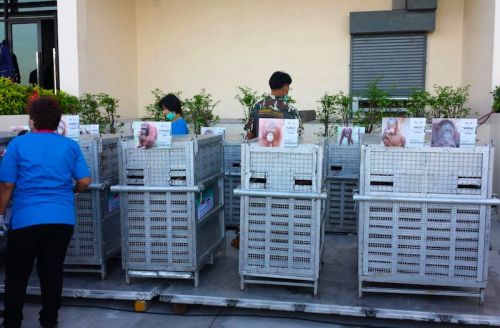
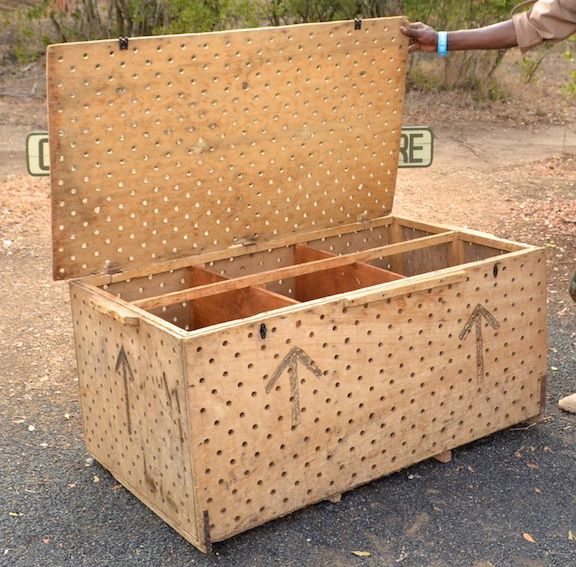
Great apes are shipped by air in crude boxes like this one. It is not uncommon for fatalities to occur during transport.

Great apes are shipped by air in crude boxes like this one. It is not uncommon for fatalities to occur during transport.

PEGAS found no chimpanzee during the brief visit to Kinshasa, as it takes two to three weeks to acquire one on order, but Fiston was notified of one that had arrived soon after PEGAS left the DRC. Before arrangements could be made to have it seized by the authorities, it was sold and disappeared. Perhaps it ended up in Dubai.

Fiston sent PEGAS a photo of the chimpanzee that was offered for sale in Kinshasa soon after PEGAS left the country.

Fiston sent PEGAS a photo of the chimpanzee that was offered for sale in Kinshasa soon after PEGAS left the country.


Perhaps the Kinshasa chimpanzee is a pet of a wealthy Emirati today.

Perhaps the Kinshasa chimpanzee is a pet of a wealthy Emirati today.


PEGAS has prepared a report naming some of the Gulf area online traffickers, including FS, and providing their contacts. The report has been sent to national authorities, the CITES Secretariat and to INTERPOL. Now to see what happens.

Chimpanzee mothers are very protective of their infants. The mothers always have to be killed or incapacitated to capture the infants for trade.

Chimpanzee mothers are very protective of their infants. The mothers always have to be killed or incapacitated to capture the infants for trade.

Chilling Photos Show What Happens To Baby Apes Stolen From Their Families

This article from The Dodo is based on PEGAS work…

By Sarah V Schweig 15 December 2015

Sometimes an exposé reveals a seedy secret world of animal exploitation and makes a huge splash.

And sometimes a dark world of horrific exploitation is hidden in plain sight.

luxurypetss2


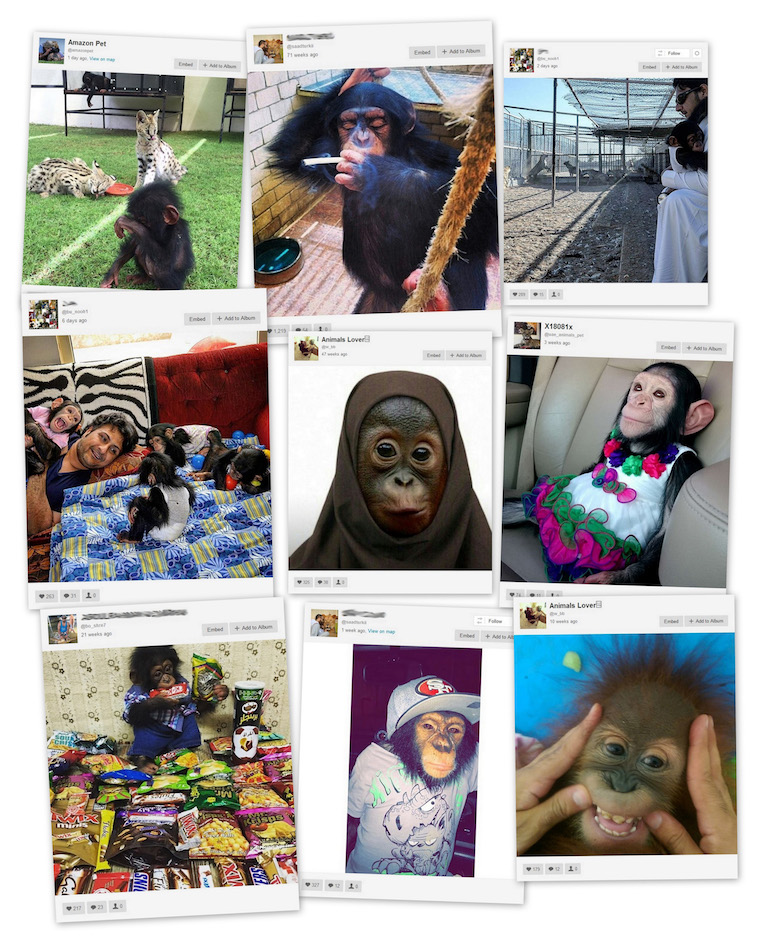
A quick look online reveals a terrifying truth about the lives of orphaned great apes, who are being illegally bought by wealthy people in the Middle East who want to dress them up and keep them as pets.

“Almost all of these animals have been captured as infants from the wild, and been bought online,” the Ol Pejeta Conservancy wrote in a press release provided to The Dodo.

10
Ol Pejeta has started the Project to End Great Ape Slavery (PEGAS) with support from the Arcus Foundation, which seeks to develop a better understanding of the illegal trade in great apes by investigating websites that advertise apes for sale or display photos and videos of great apes as pets.

PEGAS collected the photographs in this article from online sites open to the public.

1


All great ape species are listed under Appendix I of CITES (the Convention on International Trade in Endangered Species of Wild Fauna and Flora), an international agreement that is supposed to ensure that international trade of animals and plants does not threaten their survival. This means that any commercial trade of these animals is illegal.

Firoz Sama 25.3.15b
Illegal — and also horrifically wrong. According to Ol Pejeta:

The demand for great apes as pets, entertainment props, or for display in private zoos in the Middle East is fueling the large scale wild capture of infants in the forests of West Africa and Indonesia. In order to capture young chimpanzees, hunters kill the mothers and often the rest of the troop as well. Many of these infants die en route to their selling destination, as a result of rough handling, cramped transport conditions, stress and dehydration.

One such case was a baby chimp known as Little Doody.

Little Doody was discovered in the Cairo airport being smuggled into a plane bound for Kuwait.


1


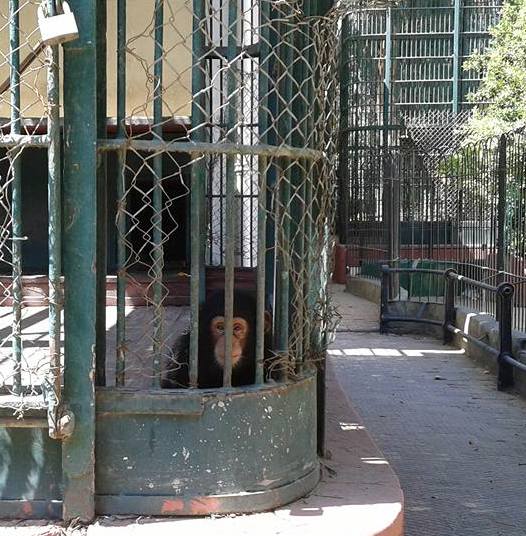
Even though PEGAS offered to relocate him to a sanctuary, the Egyptian CITES office did not respond to the offer.

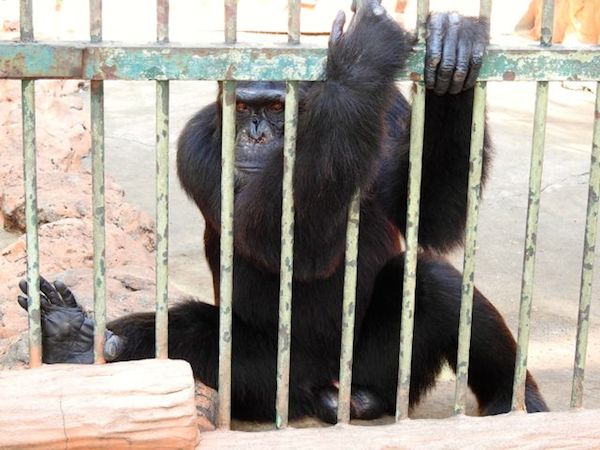
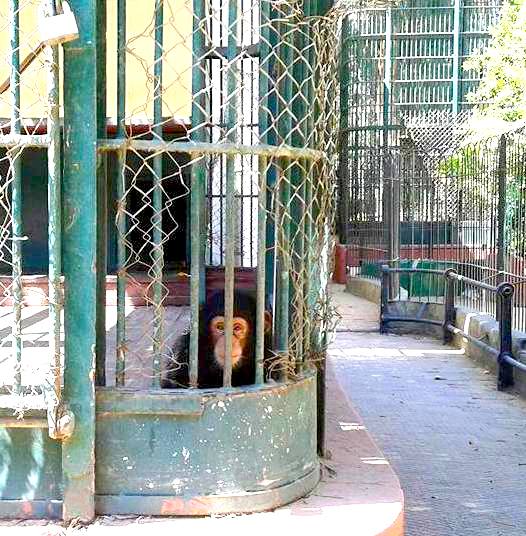
Little Doody was brought to the Giza Zoo. He now lives in a cage.

11223593_10155950662645611_1069515266357032241_n copy


PEGAS rescues two chimpanzee orphans in Liberia – Part II

In late April PEGAS assisted Phoebe McKinney, founder of the NGO ISPARE, to rescue two young chimpanzees in Liberia from truly appalling conditions of illegal captivity (see Part I).

Jackson, renamed Guey, was living on an abandoned VW bus before rescue. (Photo: P. McKinney)

Jackson, renamed Guey, was living on an abandoned VW bus before rescue. (Photo: P. McKinney)


Jacksy, renamed Sweatpea, receives a back-scratch from the PEGAS manager in her bleak, filthy cage before rescue. (Photo: P. McKinney)

Jacksy, renamed Sweatpea, receives a back-scratch from the PEGAS manager in her bleak, filthy cage before rescue. (Photo: P. McKinney)


They were both rescued and relocated to a temporary enclosure at the Libassa Wildlife Sanctuary, located in a patch of coastal forest about 40 km from Monrovia.

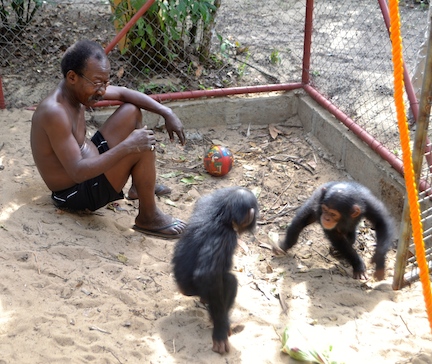
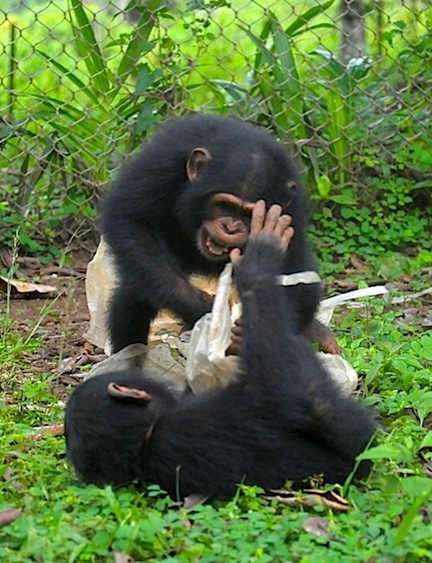
Guey and Sweetpea meeting for the first time in their new enclosure at Libassa Wildlife Sanctuary, free to run and play with another chimpanzee for the first time in their lives. Mbama, their caretaker, looks on. (Photo: D. Stiles)

Guey and Sweetpea meeting for the first time in their new enclosure at Libassa Wildlife Sanctuary, free to run and play with another chimpanzee for the first time in their lives. Mbama, their caretaker, looks on. (Photo: D. Stiles)


The Libassa sanctuary is not equipped to look after chimpanzees over the long term. As they grow into adulthood chimpanzee infants, who are friendly and unaggressive, become increasingly forceful and surprisingly strong. Rudolphe Antoune, owner of the Libassa Ecolodge and land on which the sanctuary is located, had witnessed a captive adult chimpanzee violently break out of a barred cage and knew that the wire mesh enclosure would not be adequate for very long. Even if a strong enough enclosure could be constructed to hold grown chimpanzees, the support was not there for long-term care, which needed a full-time manager, veterinarian and trained caretaking staff.

The only hope was to bring the chimpanzees to Sweetwaters Chimpanzee Sanctuary in Kenya. No other sanctuary in Africa had the capacity to accept them. The United Nations Great Ape Survival Partnership (GRASP) was aware that there were many chimpanzees in Liberia in need, but they had been unable to find a solution.

Before leaving Liberia the PEGAS manager met with the Liberian head of the national CITES office and obtained his agreement that they would issue a CITES export permit for the chimpanzees, on the condition that Kenya would issue the corresponding import permit. Veterinary health clearances would also be necessary.

PEGAS also visited the Kenya Airways office in downtown Monrovia and spoke with the Cargo Officer about the requirements for transporting chimpanzees from Monrovia to Nairobi. Because of the Ebola crisis, Kenya Airways had suspended its scheduled Monrovia-Nairobi flight via Accra. We would have to wait for them to resume service, or use other airlines, which required changing planes and airlines in a third country, another complication.

As the complexity and difficulty of the task ahead became more apparent, PEGAS decided to visit the ‘Monkey Island’ chimpanzee colony, located near the Robertsfield international airport, just down the coast from Libassa. The misnamed Monkey Island contained over 60 chimpanzees abandoned by the New York Blood Center, and PEGAS was aware that plans were afoot to seek long-term care for them. Might those plans be able to embrace chimpanzees languishing in squalid, lonely circumstances around Monrovia? And might Guey and Sweetpea be the first to go?

Map showing the location of Monrovia and the chimpanzee islands in the red oval.

Map showing the location of Monrovia and the chimpanzee islands in the red oval.

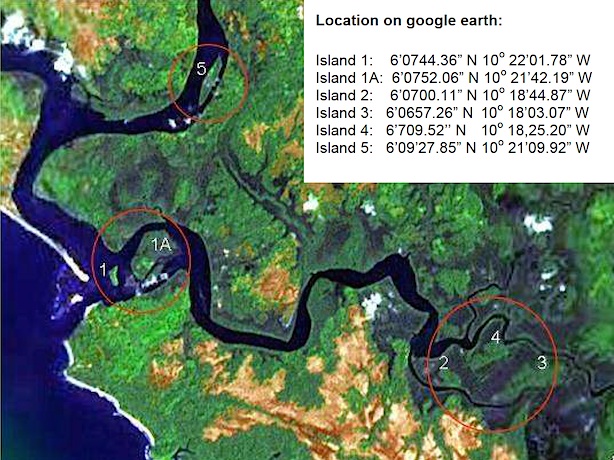
The so-called Monkey Island actually consists of six islands in the Farmington and Little Bassa rivers, very near to the Atlantic Ocean. At the time of PEGAS’s visit there were 66 chimpanzees on the islands, but because of the lack of funds contraception had not been practiced for a few years and there were now more than ten infants under the age of 5 years to contend with, and more would surely be on the way if nothing was done. There was no wild food to speak of on the islands and caretakers had to bring food by boat, so allowing breeding was not a good idea.

Location of the LIBR chimpanzee islands. (Photo courtesy of D. Cox, Jane Goodall Institute)

Location of the LIBR chimpanzee islands. (Photo courtesy of D. Cox, Jane Goodall Institute)

The history of how the chimpanzees came to be on the islands is long and tragic. To summarize briefly, in 1974 the Lindsley F. Kimball Research Institute of the New York Blood Center established a Laboratory of Virology (VILAB II) in Liberia for research with chimpanzees. They took over a defunct Liberia Institute for Tropical Medicine, which the Liberian government renamed the Liberian Institute for Biomedical Research (LIBR). The New York Blood Center (NYBC) staffed and managed the LIBR in cooperation with the government from 1975 to 2002. Chimpanzees were caught in the wild and brought to VILAB II for biomedical research.

During the years of Liberian civil wars (1989-1996, 1999-2003), NYBC staff remained at the site and continued research activities and care for the chimpanzees, at considerable cost to themselves. This prevented the chimps from being slaughtered[1]. Research at the LIBR facilities in Liberia by NYBC led to a Hepatitis B vaccine and also contributed to the validation of a sterilization method that eliminated transmission of Hepatitis B and C and HIV viruses through blood products, so the chimpanzees deserve considerable gratitude for their sacrifices to science.

Since 1986, the research carried on in Liberia by the NYBC at LIBR using chimpanzees is reported to have contributed to the receipt by the NYBC of more than USD 500 million in royalties. Even with a stipulated provision in the agreement with LIBR that “LIBR will receive 5% of such royalty income as shall accrue to NYBC resulting in part or in whole from NYBC operation in Liberia”, LIBR was never informed about or received its share of the more than USD 500 million – about USD 25 million! The NYBC also signed agreements with the LIBR in 1999 and 2002, but after that time did not continue to use chimpanzees in research. The chimpanzees were gradually moved from the LIBR facility in Charlesville, about 7 km from the Robertsfield airport, onto the islands.

The NYBC had provided for the care of these animals in “retirement” on the islands, where they are safe from human predators, and local people are also safe from the animals, which having lost their fear of people can be dangerous. Because there is little wild food on the islands, the chimpanzees have to be fed by caretakers whom they have come to know and trust and provided with other care at a cost of about USD 30,000 per month. The NYBC on 5th January 2015 unilaterally announced that it would cease all support for the chimpanzees. Without concluding any formal discussion of the transition, NYBC ceased support for the care of the chimps on 6th March 2015. Since then, the Humane Society of the United States (HSUS) and the Arcus Foundation have been providing funds to continue feeding the chimpanzees.

Joseph Thomas, with John Zeonyuway in the pick-up with food, two of the main staff in late April looking after the chimpanzees. (Photo: D. Stiles)

Joseph Thomas, with John Zeonyuway in the pick-up organizing food, two of the main staff in late April looking after the chimpanzees. (Photo: D. Stiles)


When PEGAS visited in late April 2015 the caretakers were taking food and milk to the chimpanzees, but because of a lack of funds the chimpanzees were being fed only every second day, which was barely keeping them alive. I joined a boat that had been arranged to take three visiting scientists from the Centers for Disease Control in Atlanta, the USA, who kindly allowed me to tag along.

John Zeonyuway on the left, setting off from the dock with three CDC scientists to visit the chimpanzee islands. (Photo: D. Stiles)

John Zeonyuway on the left, setting off from the dock with three CDC scientists to visit the chimpanzee islands. (Photo: D. Stiles)

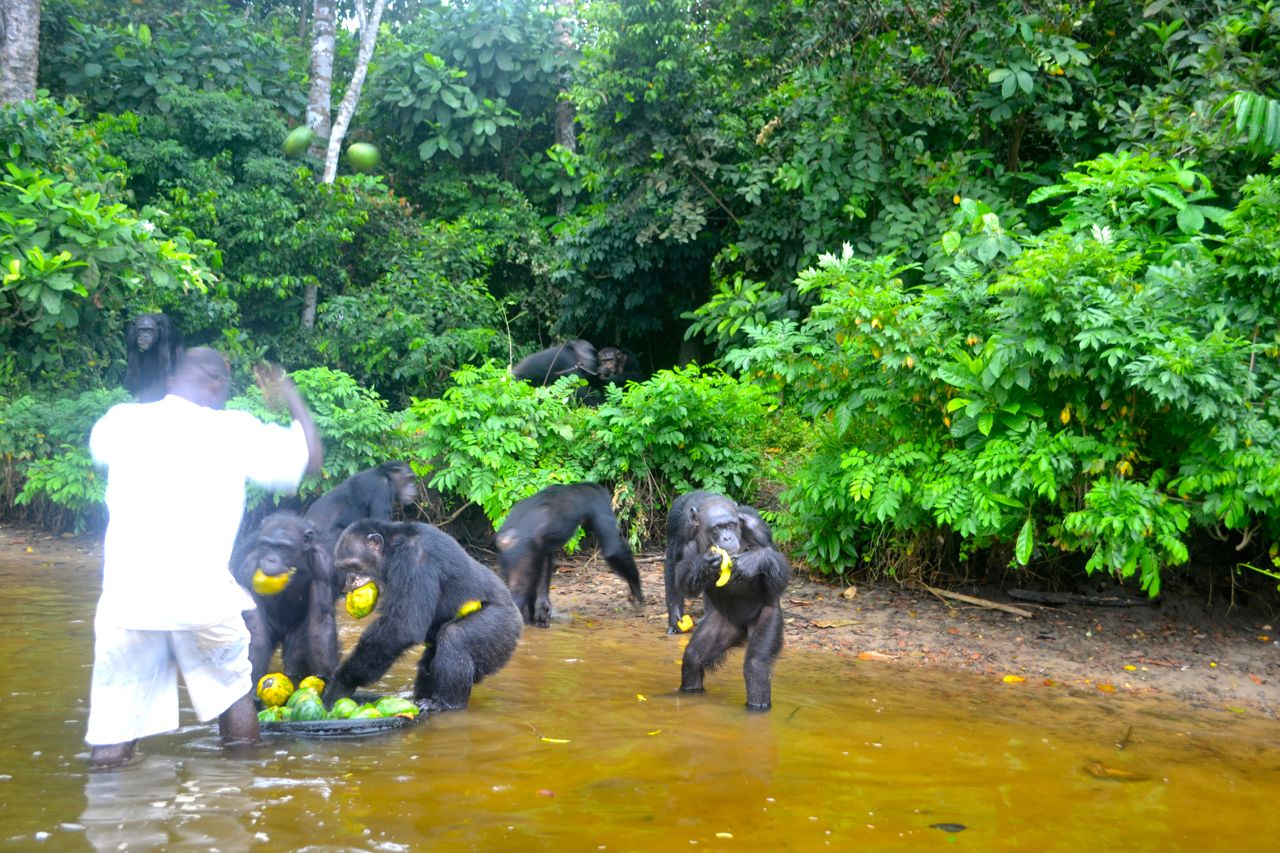
We travelled down the Farmington River for less than a half an hour until we reached Island 5. The chimps had heard the sound of the outboard motor and were eagerly awaiting their fruit, sugar cane and milk. John bounded out of the boat into shallow water and began distributing fruit from a basin. The chimps shrieked and hooted their happiness, and then dug into the food like famine refugees, which in a way they were.

The chimpanzees dig into the fruit basin with delight. (Photo: D. Stiles)

The chimpanzees dig into the fruit basin with delight. (Photo: D. Stiles)

8a


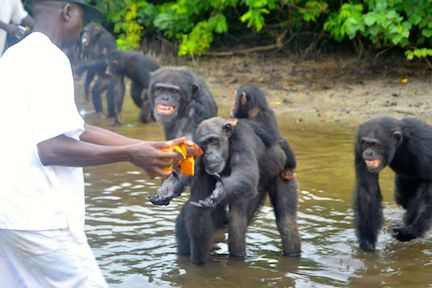
Each chimpanzee was also administered a measured amount of milk. (Photo: D. Stiles)

Each chimpanzee was also administered a measured amount of milk. (Photo: D. Stiles)

I was surprised at how self-disciplined the hungry chimpanzees were. There was no fighting, and no chimpanzee tried to grab the basin or jump into the boat. When the feeding had finished, we continued down the river past the village of Marshall on the right bank, and then swung to the left up the Little Bassa River past a long sand bar, on the other side of which I could see waves crashing from the Atlantic Ocean. We passed the opening to the sea and soon we reached Island 1. John and two assistants repeated the feeding procedure.

Chimpanzees waited in the trees for the boat to arrive. The blue barrel marks the site of where fresh water is piped to the island, as the islands have no permanent water source. The river water is salty from mixture with sea water. The water pumps periodically break down, and if they aren’t repaired quickly the chimps could die an agonizing death from dehydration. (Photo: D. Stiles)

Chimpanzees waited in the trees for the boat to arrive. The blue barrel marks the site of where fresh water is piped to the island, as the islands have no permanent water source. The river water is salty from mixture with sea water. The water pumps periodically break down, and if they aren’t repaired quickly the chimps could die an agonizing death from dehydration. (Photo: D. Stiles)

11


Island 1a had infants, so milk was particularly important here. (Photo: D. Stiles)

Island 1a had infants, so milk was particularly important here. (Photo: D. Stiles)


I could see that the islands would make a perfect sanctuary, if the funds could be found. One of the biggest problems with most chimpanzee sanctuaries was escape. Chimps are very intelligent and can usually find their way out of a fenced compound, if they are determined to get out. Sweetwaters in Kenya has periodic escapees, and on my visits to Tchimpounga in the Congo and Lola ya Bonobo in the DRC I learned that escapes were common – the tracking of one was in progress when I visited Lola.

Chimpanzees could not swim naturally, their huge torsos and relatively short legs made them sink like stones if they got into deep water. There would be no escapes from the islands.

Soon after returning to Kenya, Liberia was declared Ebola-free by the WHO. I met with Kenya Wildlife Service (KWS) veterinary and captive wildlife officials and discussed the possibility of bringing the chimpanzees to Sweetwaters on Ol Pejeta Conservancy. I assured them that the chimpanzees were healthy and were being kept in quarantine-like facilities, away from contact with any potential virus carriers. In another meeting I met with the head of the Species Conservation & Management Division and officers in the CITES department – KWS is both CITES Management and Scientific Authorities for Kenya. They were very cooperative and helpful.

I eventually managed to obtain an official letter from KWS approving the importation of the Liberian chimpanzees and informing us that we should proceed with obtaining the necessary permits to allow the import. I sent this letter to the Liberian CITES office and requested them to issue an export permit, assuring them that Kenya would issue a CITES import permit on the basis of the letter.

In late June, Jim and Jenny Desmond arrived in Liberia from Kenya, where they were temporarily staying after completing work in Uganda. Jim is a wildlife veterinarian and Jenny is an experienced primate caregiver, both of them having worked for years in many primate sanctuaries and conducting primate health research around Africa. Jim was now the Veterinary and Technical Advisor and Jenny was Consulting Director on behalf of the Humane Society of the United States. They had come to Liberia to work with the LIBR chimpanzees and look into the possibility of establishing a sanctuary for them. HSUS was vigorously leading a huge coalition campaign to find funding, including compelling the NYBC to resume support for the chimpanzees. To date, the crowdfunding site has raised an astonishing USD 232,500.

Jim and Jenny were very helpful in assisting getting the CITES export permit issued and obtaining an official health clearance letter from the Ministry of Agriculture. Jim prepared a document certifying that he had examined the chimpanzees and they were free of disease. This was all sent to KWS and PEGAS made an official application for a CITES import permit on behalf of Ol Pejeta Conservancy. Jim and Jenny were returning on 28th July to Kenya and offered to accompany the chimpanzees on their journey, so this offered a good target date to finalize all the paperwork.

In the meantime, I found out from the Nairobi office that the Kenya Airways plane flying the Monrovia-Nairobi route, which had now resumed, had quite strict dimension requirements for cargo shipments. We would have to construct transport carriers in Liberia that could meet the required dimensions. I communicated this to Phoebe and the Desmonds and they set about organizing construction of two carriers.

KWS then informed me that we would need an import permit from the Director of Veterinary Services (DVS), under the Ministry of Agriculture, Livestock and Fisheries, before a CITES import permit could be issued. I wrote to the DVS explaining the situation and enquired how to go about obtaining the required permit. No reply.

There is no need to go into the details of all of the efforts made to obtain the DVS import permit, but the final result was that no permit was obtained before 28th July – in spite of KWS support – and no permit has been obtained since. The problem was no doubt the fact that after Liberia was declared Ebola-free, other cases cropped up. Even though it was virtually impossible that Guey and Sweetpea could be carriers of the virus, it was simply impossible politically to allow the importation.

The chimpanzees have been moved to the LIBR facilities in Charlestown, where they are looked after by trained staff. PEGAS reimbursed Phoebe McKinney for six months of care for the chimpanzees (May to end-October) and the construction of the transport carriers. The Desmonds have returned to Liberia to carry on their extraordinary work of improving the lives of captive chimpanzees, and they report that Guey and Sweetpea are like sisters now, enjoying each other’s company every day.

If Phoebe had never reached out to PEGAS that fateful day in March 2015, the two orphan chimpanzees would still today be living a horrible existence alone, one chained to a rusting vehicle and the other staring out of bars from a bleak chamber.

Sweetpea enjoying a little reading in the afternoon sun. (Photo: J. Desmond)

Sweetpea enjoying a little reading in the afternoon sun. (Photo: J. Desmond)


Guey enjoys a banana, free of her chain. (Photo: J. Desmond)

Guey enjoys a banana, free of her chain. (Photo: J. Desmond)


It’s playtime for Guey and Sweetpea at LIBR (Photo: J. Desmond)

It’s playtime for Guey and Sweetpea at LIBR (Photo: J. Desmond)


[1] See the gripping film about ‘Monkey Island’ at http://www.vice.com/video/the-lab-apes-of-liberia.

PEGAS rescues two chimpanzee orphans in Liberia – Part I

Part of the PEGAS mission is to rescue captive great apes held in deplorable conditions and relocate them to a sanctuary. So earlier this year when PEGAS received an email from an expatriate working in Liberia asking if we could help save infant orphan chimpanzees in Monrovia, we arranged to go take a look to assess what the situation was. The expat sent photographs of a hapless 2-year female named Jackson that was tied up to a rusting VW bus wreck. She was being looked after by some policemen, but her situation was quite grim.

Jacksy before rescue. (Photos: Phoebe Mckinney)

Jacksy before rescue. (Photos: Phoebe Mckinney)

Jackson before rescue. (Photos: Phoebe Mckinney)

Phoebe McKinney, the American woman who contacted PEGAS, was working in Liberia to rebuild the primary education system there that was destroyed by the civil war. And now they had to deal with the Ebola outbreak, which closed the schools for a time. But by the time I arrived, Ebola was on the wane and there had not been a new case in weeks. This gave me the hope that Liberia would soon be declared Ebola-free by the World Health Organization, which should allow the chimpanzees to be relocated to Sweetwaters Chimpanzee Sanctuary on Ol Pejeta Conservancy. There is no sanctuary in Liberia. Phoebe had already contacted nearby sanctuaries, Tacugama in Sierra Leone and the Chimpanzee Conservation Centre in Guinea, but they had no space. Sweetwaters was the last hope.

Phoebe, an energetic, enthusiastic woman with a soft spot for primates (she has a pet potto, Frankie) had constructed with her own resources a fledgling sanctuary for monkeys next to the Libassa Ecolodge, about 40 km southeast of Monrovia, the capital. Being also an optimist, she had constructed a large wire mesh enclosure to hold young chimpanzees temporarily, with the expectation that they would be transferred to a more permanent home. She said that there were several captive chimpanzees scattered around Monrovia being held in appalling conditions.

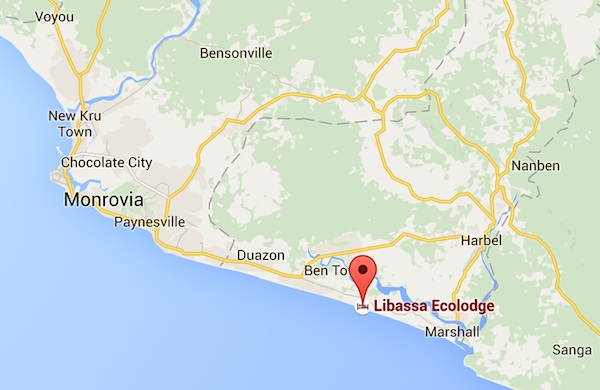
The location of Libassa Ecolodge and the Libassa sanctuary

The location of Libassa Ecolodge and the Libassa sanctuary

An aerial photo of the Libassa Ecolodge, located in the lower right. The red circle indicates the location of the sanctuary. (Courtesy Libassa Ecolodge)

An aerial photo of the Libassa Ecolodge, located in the lower right. The red circle indicates the location of the sanctuary. (Courtesy Libassa Ecolodge)

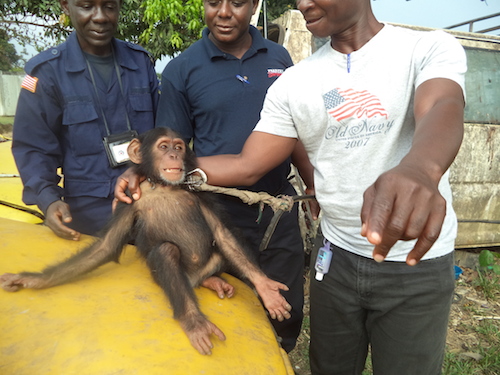
A few days before my arrival, Phoebe rescued Jackson from the VW wreck and transported her to Libassa, where she happily played around inside the enclosure, free for the first time in a year of the metal neck collar. The collar had left a nasty friction wound on the back of her neck.

One of the first things I did while there was to visit Libassa and see Jackson, now renamed ‘Guey’, meaning chimpanzee in Kru, the local language. Guey was full of fun and I entered the enclosure and played with her for a while. She ran around tumbling and jumping and enjoyed herself as I flipped her in somersaults.

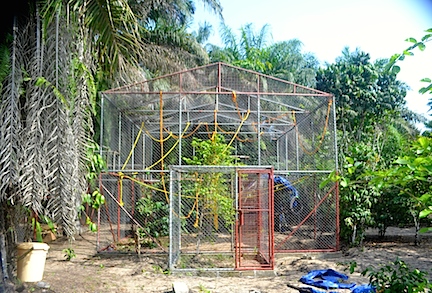
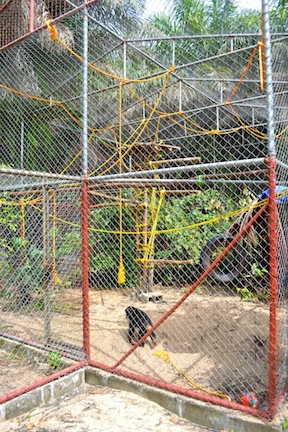
The chimpanzee enclosure at Libassa, fitted out with greenery, ropes and structures to climb and swing on. Sure beats being tied up to a rusty VW wreck. (Photos: D. Stiles)

The chimpanzee enclosure at Libassa, fitted out with greenery, ropes and structures to climb and swing on. Sure beats being tied up to a rusty VW wreck. (Photos: D. Stiles)


Stiles5


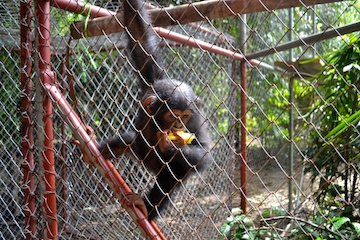
Guey enjoying a mango in her new home in Libassa. (Photo: D. Stiles)

Guey enjoying a mango in her new home in Libassa. (Photo: D. Stiles)


The PEGAS manager playing with Guey. (Photos: P. Mckinney)

The PEGAS manager playing with Guey. (Photo: P. McKinney)


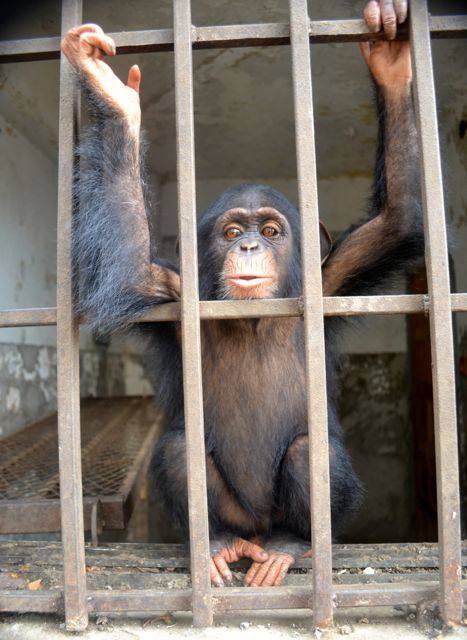
Phoebe and I next went to visit another 2-year old female named Jacksy who was being held behind bars in a squalid chamber that faced onto a littered alley. Jacksy looked stunted and I learned that she was fed mainly with biscuits and left-overs from the food hawkers on the street next to the cage. The Chinese woman who ‘owned’ her ran a beauty salon nearby. We met with Alfa, the caretaker hired by the Chinese woman to look after Jacksy. He seemed agreeable that we come back the next day to pick up Jacksy and take her to Libassa. This seemed too easy.

Jacksy behind bars. (Photos: D. Stiles)

Jacksy behind bars. (Photos: D. Stiles)

8Jacksy


We returned the next day, hoping to take Jacksy with us to Libassa, but now Alfa said that the Chinese owner had told him that she wanted USD 500 as compensation for costs involved in acquiring Jacksy and for upkeep. I told Phoebe that this was completely unacceptable, PEGAS could not be party to what effectively was ape trafficking. If we paid for Jacksy, the woman would be motivated to go out and get another infant chimpanzee. A long negotiating session ensued. While Phoebe went into the beauty salon to talk with the ‘owner’, I sat down to chat with Alfa to try and find out more about why the woman kept the chimpanzee. It did not seem to be a pet.

Alfa said that the woman had brought Jacksy from the forest herself in her car, he did not know from where. She had returned recently from a trip to China where she had attempted to sell the chimpanzee, but was unsuccessful. I imagine the Ebola outbreak had made selling animals from the affected countries quite difficult. So now she was willing to sell Jacksy at a discount because of Ebola. There were stories of villagers killing chimpanzees after they learned that they were Ebola carriers, another incentive to get rid of it.

Phoebe had no success. The woman stuck at USD 300 and refused to budge. Phoebe was willing to pay it, but I said that if she did I would be unable to relocate the chimpanzee to Sweetwaters.

I made arrangements to meet with the head of the Liberia CITES Management Authority and went out of town to the Forestry Development Authority (FDA) offices where Theo Freeman, the head, was located. He seemed very willing to cooperate and introduced me to some Wildlife Officers, who offered to accompany me the following day to confiscate the chimpanzee. Phoebe had already been in contact with the FDA and they had approved her keeping primates at Libassa. They were in the process of signing a memorandum of understanding for the establishment of the Libassa Wildlife Sanctuary involving the FDA, Phoebe’s NGO called ISPARE, and Rudolph Antoune, owner of Libassa Ecolodge, who was generously donating the land.

The following morning the Wildlife Officers informed me by telephone that they unfortunately were unable to come into town to conduct the confiscation and said that Phoebe and I should do it. During Phoebe’s lunch break we returned to the Oriental Beauty Salon to resume our efforts to rescue Jacksy. Finally Phoebe pulled her trump card and told the Chinese woman that she was holding the chimpanzee illegally and that if she did not release it we would return with the authorities to arrest her and seize the chimpanzee.

The woman spoke poor English, so she rang her daughter, who lived in Monrovia and who spoke better English. Phoebe repeated what she had said about the illegality of holding the chimpanzee to the daughter. The daughter translated to her mother in Chinese, which miraculously transformed her attitude. Now she was more than willing to release Jacksy. We told her that she could come any time that she wanted to visit Jacksy at Libassa.

As Alfa was removing Jacksy from the chamber of horrors, she escaped and scampered around in the street. I bought an apple and put it under the beauty salon sign, which attracted Jacksy.

Jacksy came to pick up the apple. (Photo: D. Stiles)

Jacksy came to pick up the apple. (Photo: D. Stiles)


Alfa grabbed Jacksy and placed her in the transport cage that we had brought with us. Some nice sweet bananas were in the cage, so she was quite content to gorge herself. Phoebe had to return to work so I accompanied Jacksy to Libassa in the car with a driver I hired.

10 11

Jacksy being rescued and driven to Libassa. She quietly munched bananas on the drive there. (Photos: D. Stiles)

Jacksy being rescued and driven to Libassa. She quietly munched bananas on the drive there. (Photos: D. Stiles)


The Libassa Ecolodge has a wonderful Ivoirian pastry chef named Mbama who looks after the primates at the sanctuary. He has a knack with handling them. Mbama helped me carry the cage to the enclosure, where we sat it down outside so that the two chimpanzee girls could get acquainted. Mbama and I hit it off right away, as I was a Peace Corps Volunteer in Côte d’Ivoire for three years and I could joke with him using Ivoirian French expressions.

Jacksy, since renamed Sweetpea by Phoebe, looks at Guey in wonder. Guey is no doubt the first chimpanzee that Jacksy has seen since she was snatched from her mother’s dead arms as a baby. (Photo: D. Stiles)

Jacksy, since renamed Sweetpea by Phoebe, looks at Guey in wonder. Guey is no doubt the first chimpanzee that Jacksy has seen since she was snatched from her mother’s dead arms as a baby. (Photo: D. Stiles)

My original intention was to leave Jacksy in the outer entrance enclosure for a few hours so that the chimpanzees could get used to each other, but Mbama said that this was unnecessary and just took Jacksy out of her transport cage and pushed her into the enclosure. Immediately Guey rushed over and began chasing Jacksy around.

Guey, who is bigger and more aggressive than Jacksy, chased Jacksy around when she was released into the enclosure. Mbama acts as referee. (Photo: D. Stiles)

Guey, who is bigger and more aggressive than Jacksy, chased Jacksy around when she was released into the enclosure. Mbama acts as referee. (Photo: D. Stiles)


The two 2-year olds eventually settled down to share some mangoes. Jacksy is on the right. (Photo: D. Stiles)

The two 2-year olds eventually settled down to share some mangoes. Jacksy is on the right. (Photo: D. Stiles)


Phoebe and I later went to find another chimpanzee that she had heard about. We found the house, but the owner was not at home. We could see the adult female chimpanzee through an opening in the wall locked up in a cramped cage in the front courtyard of the house. She saw us and reached out an arm imploringly. We banged on the gate and a house servant came out to speak to us. The chimpanzee had lived in the cage for the six years that the house servant had worked there, but she did not know when the chimpanzee had arrived or how old it was. A male was living with it when the servant had first started working there, but it had died a couple of years earlier.

The lonely chimpanzee living in the courtyard of a Liberian senator. (Photo: D. Stiles)

The lonely chimpanzee living in the courtyard of a Liberian senator. (Photo: D. Stiles)

Phoebe subsequently established that the chimpanzee belonged to a senator in the national legislature, a well-known businessman. The senator would have to agree voluntarily to free his pet. The adult was too big to keep in the Libassa enclosure – adults are extremely strong – so I decided that I had better limit our first attempted relocation to the two young orphans. If that succeeded and the procedure was established, a larger group of chimpanzees could be rescued and relocated to Sweetwaters in future.

Part II to come

Pan African Sanctuary Alliance sanctuary managers and executive board members visit Sweetwaters Chimpanzee Sanctuary

The Pan African Sanctuary Alliance (PASA) held a PASA Strategic Development Conference in Nairobi 4-7th November. PASA is a coalition of wildlife sanctuaries and NGO’s working across Africa to protect primates in the wild and to ensure those orphaned primates are cared for to the highest standards.

As part of the conference activities a number of the delegates from all over Africa came on a special visit to our sanctuary. The delegates included other primate sanctuary managers from chimpanzee range states and ape conservation programme managers, as well as some of the PASA Executive Board and the new Executive Director who had flown in from Oregon, USA. They visited the Sweetwaters Chimpanzee Sanctuary so they could see for themselves the excellent facilities we have here on Ol Pejeta Conservancy for looking after these very special primates.

Stephen Ngulu, the Sweetwaters manager, guides PASA visitors

Stephen Ngulu, the Sweetwaters manager, guides PASA visitors

During their day they of course visited the chimps themselves and spent time seeing how much they enjoyed living in Laikipia. They also got an exclusive behind the scenes tour to see the housing facilities we have here. The most recent extension to the housing was completed in April 2013 and expanded the capacity of the sanctuary by 35 so we now have space for approximately 75 chimpanzees. Sweetwaters could expand even further in future if necessary.

Sweetwaters chimpanzees live a good life

Sweetwaters chimpanzees live a good life

The PEGAS Project Manager was on hand to explain exactly how this extra capacity can help relieve some of the population pressure on other sanctuaries who are close to or full to capacity. Despite some sanctuaries being full there are still many apes out there in range states that need rescuing from the illegal bushmeat trade or the illegal international trade in live apes. They also need a home within a PASA sanctuary and the SCS with its new increased capacity is ready to fill the places with chimps in dire need of somewhere to stay.

This visit has been followed up by a meeting held on Monday 9th November in Nairobi, hosted by PEGAS to further discuss ways we can all come together to find the best way we can all cooperate to do what is best for the chimps that are in such desperate need of our help.


Jane Goodall Institute prepares architectural plans for Egypt

Great apes and monkeys have been seized – or not seized – on many occasions when detected at the Cairo International Airport in Egypt in illegal trade incidents. There has been a long-standing problem of what to do with primates that are caught being trafficked through the airport. This problem has been discussed within CITES, by the Pan African Sanctuary Alliance and by GRASP. They all recommend that a new facility be constructed to hold seized great apes, and Egypt has pledged to do this.

Currently the Giza Zoo is designated as the only rescue centre in Egypt for seized apes and monkeys. But the Giza Zoo was built in Victorian times (1891 to be exact) and is not an appropriate place to hold trafficked primates, particularly if they are to be returned to their country of origin as Egyptian national law and CITES regulations call for.

PEGAS has been working with Egyptian government authorities, the Jane Goodall Institute, and Egyptian animal welfare activist Dina Zulfikar to establish the new rescue centre. JGI has kindly prepared a very professional set of architectural plans for the facility. We hope that the Egyptian government will use these plans to construct this much needed facility.

Architectural plans for a great ape and monkey rescue center in Egypt prepared by the Jane Goodall Instutute

Architectural plans for a great ape and monkey rescue center in Egypt prepared by the Jane Goodall Institute (click to download, file is more than 50 mb)


Arrested Guinea former CITES official also signed Armenia permits

Ansoumane Doumbouya, the former Guinea CITES official arrested recently in Conakry for wildlife trafficking using fraudulent CITES permits, also signed permits for the export of bonobos to Armenia in 2011. No bonobos live in West Africa, they are restricted to the Democratic Republic of Congo.

Ofir Drori of EAGLE reports that Doumbouya has been transported to prison to be held for trial. An unsigned blank CITES permit was found in his bag!

The following story published in an Armenian newspaper gives some background and links to earlier stories about great ape imports to Armenia.

Arrest of Guinean Official Implicated in Illegal Animal Trade; Signed Export Permits for Armenia as Well

Kristine Aghalaryan

24 August, 2015

A bonobo smuggled into Armenia with a Guinea CITES permit

A bonobo smuggled into Armenia with a Guinea CITES permit

Ansoumane Doumbouya, former head of the CITES Management Authority of Guinea and a key player behind the illegal export of hundreds of chimpanzees and gorillas to China and elsewhere, was arrested on August 21.

EAGLE (Eco Activists for Governance & Law Enforcement) announced the arrest of Ansoumane Doumbouya, along with the infamous wildlife trafficker Thierno Barry, in Conakry, Guinea’s capital.

Hetq has the following CITES export permit, signed by Doumbouya in 2011, under which two bonobo primates were imported by the Zoo Fauna Art company in Armenia.

The CITES export permit signed by Doumbouya

The CITES export permit signed by Doumbouya


A Hetq investigative series into the illegal animal trade in Armenia led to criminal charges against Zoo Fauna Art owner Artur Khachatryan.

The investigative division of Armenia’s Ministry of Finance has been dragging out an inquiry into the matter for one and a half years.

Even after he lost his position with CITES, Doumbouya retained a position within the Guinean Ministry of Environment as Commander of the national wildlife and forestry mobile enforcement brigade and was still signing CITES permits for traffickers.

Former head of CITES in Guinea arrested

On 21st August 2015 EAGLE (Eco Activists for Governance & Law Enforcement) announced the arrest of Ansoumane Doumbouya, the former head of the CITES Management Authority of Guinea, along with the infamous wildlife trafficker Thierno Barry in Conakry.

Doumbouya has long been known as a key player behind the illegal export of hundreds of chimpanzees and gorillas to China and elsewhere using fraudulent CITES export permits (see The Conakry Connection). Even after he lost his position with CITES he continued to fraudulently sell permits to traffickers to allow them to ship protected wildlife around the world, in spite of the fact that there is currently a CITES suspension of trade from Guinea (PEGAS is in possession of a copy of such a fraudulent permit, signed by Doumbouya a year and a half after he was removed from the CITES office).

 Ofir Drori, head of EAGLE, has told PEGAS that there is huge political pressure from high government officials in Guinea to free Doumbouya. Those who wish to see the scourge of great ape trafficking stopped must protest political interference. Read the announcement by Charlotte Houpline, Director of GALF, below:

 Today is a special day of victory against high level corruption and complicity.

Since the beginning of the collaboration between GALF and the Guinean Government, many traffickers have been arrested and condemned. Today, however, we are proud to send one of the biggest traffickers behind bars – the former head of CITES in Guinea – Ansoumane Doumbouya.

Abusing his position as the authority of this international convention he has been assisting and collaborating with traffickers. Different reports, including one from the CITES secretariat, implicated him in illegal exports, but he is still holding a position within the Ministry of Environment as Commander of the national wildlife and forestry mobile enforcement brigade and still signing CITES permits for traffickers.

Doumbouya signed CITES permits to send wild-caught chimpanzee orphans to China to perform in circuses

Doumbouya signed CITES permits to send wild-caught chimpanzee orphans to China to perform in circuses


The shocking hidden footage in the link below shows a trafficker explaining in details the corrupt system.

https://youtu.be/M_KDIW1nLC8

This time, the vicious cycle of impunity has been broken. Our long and meticulous investigation that led to this arrest took more than a year as Doumbouya is experienced and cautious in his illegal activities. He had just delivered a CITES permit for 2 primates to an international trafficker, Thierno Barry that has been regularly exporting protected species to China and other part of the world, with the CITES’ head’s complicity. Thierno Barry have been arrested. The two operations have been conducted by the BCN INTERPOL and the GALF project.

The case of Doumbouya became one of the most known examples of CITES high level corruption and has been discussed in the convention’s international meetings. Several hundreds of apes and many other totally protected species, were known to have been exported through this corrupt system.

The former head of CITES was even convoked and interrogated by the police early last year, where he declared that all the CITES permits, bonobos, chimpanzees and others were falsified. He pretended to have lost his official stamp, and that the traffickers imitate his signature.

Our investigation aimed to demonstrate that Mr Doumbouya kept on delivering CITES permits to several wildlife traffickers. He was using an old stock of permits that he had kept with him even after he lost his position as the head of CITES.

The satisfaction from this arrest is very personal to me. During the 10 years I spent in Guinea, and before I started fighting in wildlife law enforcement, I was an advisor to the Ministry of Environment for 2 years, and it is in the neighboring office that Mr Doumbouya -the CITES head of Guinea, provided wildlife traffickers with CITES permits, abusing the same national laws and international conventions that he was entrusted to protect.

Thierno Barry, the director of a fictive company involved for a long time in the international wildlife trade (BARRY PETS COMPAGNY IMPORT-EXPORT) have been arrested holding protected primates and a CITES permit signed by Ansoumane Doumbouya. Before his arrest, during several months of undercover investigation, he explained the implication of the former CITES MA in the international illegal wildlife trade.

Here is the criminal’s description of the corrupt system:

Email –  “I have talked with the former director, head of CITES. He confirmed that he can provide me with the permits. He says he’s a bit afraid because he is no more the head of CITES. Chinese are difficult and often ask for confirmation”.

Hidden footage: “He is no more the head of CITES now, do you understand? When we take the CITES to send in Jordan, there could be problems if they see on the internet that he is not holding the position. He can say that I betrayed him. The former director has been fired but he has kept the old permits. But if there is some kind of confirmation, there will be some problems.

Do you understand? If the former director gives me, you know that he’s not allowed to give the CITES because he’s been fired, so if he gives me the CITES, I take the CITES and I send to Mr Hassan. If Mr Hassan sends to his ministry in Jordan to see the confirmation, there will be phone call to the one who is now in charge of CITES. This will create a lot of problems”.

Today, Mr Doumbouya faces the Justice. According to the penal code of Guinea, Mr Doumbouya faces charges from 6 months to 10 years of prison for usurpation of qualification and office, unlawful extension of authority, forgery on public acts and documents, forgery of administrative documents, receiving, complicity and corruption.

After a long suspension from CITES, Guinea has an important responsibility to send a strong message to its citizen and the international community. Doumbouya should be severely punished according to the law.

Please warmly congratulate these Ministers and ask for the maximal sentence for the former CITES head of Guinea.

Minister of Justice, Cheick SAKHO : cheick.sako1@gmail.com or moussakourouma90@yahoo.fr

Minister of Environment, Hadja Kadiatou NDIAYE : tenin-souleymane@yahoo.fr or hadjakadiatoundiaye@gmail.com

Charlotte

*************************************************

Charlotte Houpline

Directeur GALF / Guinée- Application de la Loi Faunique www.wara-enforcement.org

First Time in World History a Judge Recognizes Chimpanzees as Legal Persons

In a landmark decision, the Nonhuman Rights Project has won the first step in granting habeas corpus to a nonhuman species. The court’s ruling effectively recognizes chimpanzees as “legal persons”. A court hearing will be held in May to decide if the decision can survive the State of New York’s response that there exists a legally sufficient reason to continue imprisoning the two chimpanzees.

If chimpanzees are considered to be “legal persons” in New York state, the repercussions would be great. Legal challenges could be launched across the United States to prohibit chimpanzees being owned as pets (orangutans already are), to be freed from zoos, circuses and safari parks, and to no longer be used in entertainment. There are more than two thousand chimpanzees in the U.S..

The implications are daunting. Where would they all go?

The article follows:

Judge Recognizes Two Chimpanzees as Legal Persons, Grants them Writ of Habeas Corpus

April 20, 2015 – New York, NY – For the first time in history a judge has granted an order to show cause and writ of habeas corpus on behalf of a nonhuman animal. This afternoon, in a case brought by the Nonhuman Rights Project (NhRP), Manhattan Supreme Court Justice Barbara Jaffe issued an order to show cause and writ of habeas corpus on behalf of two chimpanzees, Hercules and Leo, who are being used for biomedical experimentation at Stony Brook University on Long Island, New York.

Under the law of New York State, only a “legal person” may have an order to show cause and writ of habeas corpus issued in his or her behalf. The Court has therefore implicitly determined that Hercules and Leo are “persons.”

A common law writ of habeas corpus involves a two-step process. First, a Justice issues the order to show cause and a writ of habeas corpus, which the Nonhuman Rights Project then serves on Stony Brook University. The writ requires Stony Brook University, represented by the Attorney General of New York, to appear in court and provide a legally sufficient reason for detaining Hercules and Leo. The Court has scheduled that hearing for May 6, 2015, though it may be moved to a later day in May.

The NhRP has asked that Hercules and Leo be freed and released into the care of Save the Chimps, a sanctuary in Ft. Pierce, Florida. There they will spend the rest of their lives primarily on one of 13 artificial islands on a large lake in Ft. Pierce, Florida along with 250 other chimpanzees in an environment as close to that of their natural home in Africa as can be found in North America. In the second step of the process, the Court will determine whether the reason given by Stony Brook is legally sufficient, or whether Hercules and Leo should be freed.

Hercules and Leo’s suit was originally filed in the Supreme Court of Suffolk County in December, 2013. A Justice of that Court refused to issue the requested writ of habeas corpus, and the Appellate Division, Second Department, dismissed the appeal on the ground that the NhRP lacked the right to appeal.

In the belief that both courts erred, the Nonhuman Rights Project respectfully re-filed its petition for an order to show cause and writ of habeas corpus on behalf of Hercules and Leo in March, 2015, in the New York County Supreme Court in Manhattan, which led to today’s decision.

In two similar cases on behalf of two other chimpanzees, Tommy and Kiko, the Nonhuman Rights Project has filed Motions for Leave to Appeal to New York’s highest court, the Court of Appeals. Decisions in both cases are pending.


United Arab Emirates – research into illegal wildlife trade

PEGAS recently completed eight days of investigations into wildlife trade in the UAE, focusing on great apes. A local NGO assisted greatly.

The UAE is made up of seven emirates, each with its own local government headed by a hereditary sheikh. The federal government is based in Abu Dhabi and the federal President is Sheikh Khalifa bin Zayed Al Nahyan and the Vice President and Prime Minister is Sheikh Mohammed bin Rashid Al Maktoum, Ruler of Dubai.

Map of the UAE. The red line shows the places that PEGAS visited.

Map of the UAE. The red line shows the places that PEGAS visited.

PEGAS visited the following facilities and individuals:

  • The Dubai Zoo – director of the new Dubai Zoo and Safari Park and a Dubai Zoo veterinarian.
  • Sheikh Butti bin Juma Al Maktoum Wildlife Centre, Dubai – the manager.
  • A Pet Care Clinic, Dubai – The veterinarian owner
  • Al Ain Zoo, Abu Dhabi – a veterinarian and a species coordinator.
  • Arabia’s Wildlife Centre, Sharjah – a South African weekend manager, spoke to us on short notice.
  • Al Bustan Zoological Centre, Sharjah – Closed to the public, but spoke with the guard and later had correspondence with the manager.
  • Sharjah Birds and Animal Market
  • Environment Agency, Ministry of Environment and Water, Abu Dhabi – Dr. Shaikha Al Dhaheri, Executive Director, Terrestrial and Marine Biodiversity Sector and Pritpal Soorae, Unit Head, Terrestrial Assessment and Monitoring, Terrestrial & Marine Biodiversity Sector.
  • We tried to meet with Dr. Ahmed Esmaeil Al Hashmi, head of CITES-UAE and Director, Biodiversity Department, Ministry of Environment and Water, Dubai, but he said that he would have to obtain clearance from the Ministry of Foreign Affairs, which never came.

Dubai Zoo

The current small and cramped Dubai Zoo will be closing down near the end of the year and the animals will be moved to the new, much larger grounds out of town on the road to Sharjah. Press reports indicated that the new zoo and safari park would hold over 1,000 animals, but the new director said the actual number would be closer to 3,000. Many additional animals will have to be legally sourced from zoos and animal dealers. Elephants are also planned, but PEGAS received conflicting information about whether they would be from Asia or Africa.

Dubai safari park

A sign for the new safari park in the Dubai Zoo.

There are currently 7 great apes in the Dubai Zoo, all held in old cages with concrete substrate and few enrichment amenities. Two gorillas said by the zoo to be of the eastern lowland subspecies (Gorilla beringei graueri) arrived as undocumented infants, which the veterinarian said were the result of illegal trade confiscations. The CITES Trade Database contains no reports of any kind involving any gorilla subspecies for the UAE. The International Studbook for the Western Lowland Gorilla (Gorilla g. gorilla) confirms that the two in Dubai were captured in the wild from an unknown source. The male, Digit, was thought to have been born in 1994 and arrived in the zoo in October 1996. The female Diana was born about 1999 and arrived in January 2000.

Diana is in a particularly bad state and shows signs of severe depression, including grooming herself to the extent that she has pulled out quite a bit of hair on her arms. According to the new director, she has tried to interact with the male, but is rebuffed. The director thinks it’s because the male was captured so young he has not learned how to behave towards females.

Digit the male does not seem too badly off, but Diana shows signs of deep depression.

Diana shows signs of deep depression.

5gorilla

The male does not look so badly off.

PEGAS and a local NGO have made a plea to free the gorillas and relocate them to a sanctuary. Debby Cox of the Jane Goodall Institute (JGI) is assisting in assessing whether this would be possible. The director said that he wishes to have replacement gorillas in place before the Dubai municipality, which owns the zoo, would allow relocation of Digit and Diana. The new zoo plans call for a one-acre (0.40 ha) gorilla enclosure, which could house several gorillas comfortably.

The first order of business is to conduct DNA testing of the gorillas to confirm what subspecies they belong to. Additionally, the Congolese CITES and wildlife authorities (ICCN) must agree to request the return of the gorillas, if indeed they originated in the DRC, and agree that they go to a sanctuary, and a gorilla sanctuary must agree to take them.

The zoo has 4 chimpanzees, 2 each in two cages. None of them are listed in the European zoos chimpanzee studbook. Since 1990, when the UAE joined CITES, only two chimpanzees are reported in the CITES Trade Database as being imported for zoos, one in 1992 and one in 1999. Therefore, at least two of the Dubai chimpanzees were imported illegally. A local NGO will assist PEGAS to work with the zoo to see if more can be learned of the chimpanzees’ origins and when they arrived.

The four chimpanzees are held in two squalid cages.

The four chimpanzees are held in two squalid cages.

6Dubai25


PEGAS requested that the chimpanzees be freed on the grounds that they were imported illegally and are living in poor circumstances, and has offered to assist their repatriation to an appropriate sanctuary in Africa. As with the gorillas, unless replacements can be found, this most likely will not occur. The new Dubai Zoo director intimated that he wishes to display a large group of chimpanzees in the new facility under construction.

There is one baby orangutan that the zoo veterinarian said was dropped off as a 4-5 month-old infant by an unknown person. It appears to be about 2 years old now. There are no records of orangutan imports to the UAE in the CITES Trade Database. It, too, is a victim of trafficking.

The baby orangutan is in a barren cage alone with no enrichment. PEGAS saw it rolling around trying to play.

The baby orangutan is in a barren cage alone with no enrichment. PEGAS saw it rolling around trying to play.

7orang


Sheikh Butti bin Juma Al Maktoum Wildlife Centre

The manager was kind enough to take us on a complete tour of the 17-hectare private breeding centre and wildlife park. The centre has no great apes and does not plan to acquire any. He did know of people who owned great apes, however, and provided information on routes and methods that he was aware of for smuggling illegal wildlife from Saudi Arabia, Oman and the sea into the UAE.

The Sheikh Butti Wildlife Centre is a well-managed private wildlife breeding centre.

The Sheikh Butti Wildlife Centre is a well-managed private wildlife breeding centre.

A Pet Care Clinic

The veterinarian owner treats the pets of many wealthy Emiratis and expat residents, including royal family members. The royal families import exotic animals at will, often using their own jet planes. They are not subject to normal CITES and other procedures and there are no authorities that can use legal means to halt the trade. He has made attempts to create awareness about animal welfare issues, but has been warned that he will be made to leave the UAE if he says anything negative about the government. This is a situation that affects all expatriate residents. He knew of illegal pet trading, but could say little specific about it. He did not think that great ape ownership was very common in the UAE.

Al Ain Zoo

The zoo has one gorilla and 7 chimpanzees. The western lowland gorilla, named Lady, was born about 1974 in Cameroon, according to the gorilla studbook, and was captured in the wild. She came to Al Ain Zoo in May 1978 with a male named Maxi, who died around 2006. The male is not in the studbook. Lady is kept in a fairly large enclosure with a grass and earth substrate and good enrichment amenities. There are no bars to the enclosures at Al Ain, but rather a number of reinforced glass windows are set in artificial “rock” walls for viewing. Lady lives in isolation, except for a rabbit that has been put in the enclosure for company. A large group of local boys was taunting the gorilla during the PEGAS visit.

Lady is a western lowland gorilla that arrived at Al Ain Zoo in 1978. She has been alone since about 2006.

Lady is a western lowland gorilla that arrived at Al Ain Zoo in 1978. She has been alone since about 2006.


9al ain

A group of young boys was taunting Lady at the time of the visit.

The chimpanzees are divided up into two groups, one consisting of 4 that is on view to the public, and 3 others that are kept out of view. All 7 are listed in the European chimpanzee studbook. The origin of 6 is unknown, while one is an in situ birth. The arrival dates do not correspond with any reported dates in the CITES Trade Database, thus all were imported outside of CITES procedures, all but one imported before the UAE joined CITES. The one enclosure on view to the public appeared to be well-maintained with good substrate and enrichment amenities.

11al ain

The chimpanzees looked content and healthy.

The spacious chimpanzee enclosure contained four animals.

The

The spacious chimpanzee enclosure contained four animals.

As with the Dubai Zoo, the Al Ain Zoo is currently expanding to become a more than 900 hectare wildlife park and resort, dedicated to wildlife conservation education. Hundreds of new animals are being imported to stock the open drive-through safari park, including several white rhinos that have already arrived from South Africa. PEGAS was told no new great apes or elephants are planned to be imported, even though a large, new ape house was being constructed. We asked to be informed if staff at Al Ain hear anything about great ape trade from the dealers they do business with.

An idealized vision of the new Al Ain safari park.

An idealized vision of the new Al Ain safari park.

Arabia’s Wildlife Centre

PEGAS and MEAF visited this facility on a Friday (the weekend) before it opened at 2 p.m. A workman telephoned the weekend manager, who drove to meet us. He informed us that the centre had no primates other than indigenous hamadryas baboons. The centre breeds wild species found in Arabia and supplies other vetted facilities on request. He said that the centre receives complaints from people about neighbours who keep noisy or dangerous exotic pets, but they advise people to contact the authorities in Sharjah.

The Arabia's Wildlife Centre has no great apes.

The Arabia’s Wildlife Centre has no great apes

Sharjah decreed a new law last November that outlawed private ownership of exotic animals that had been imported illegally. Since the amnesty for handing in animals expired in late December, the centre has been receiving a rash of exotic pets turned in to the government or anonymously dumped at the gate. Since most of them cannot be used for breeding and there is a lack of space to keep them, they are euthanized. They even found a baboon dressed in designer clothes and with a meticulously shaved beard chained to the gate.

As with other informants in the UAE, the manager was reticent to share information about wildlife traffickers and illegal trade, but said that he knew it occurred on a regular basis. The new Sharjah law might curb it.

Al Bustan Zoological Centre

This privately-owned zoo is not open to the public, but the guard at the gate said that chimpanzees had recently been brought and left there by private owners. PEGAS subsequently got into contact with the manager to find out the circumstances surrounding the chimpanzees. The two animals appear to be the result of illegal import as infant pets at least 15 years ago. They were originally kept in the house, but as they grew up and became dangerous they were moved out into an enclosure on the grounds. With the new law, the owners decided to dispose of the pair at Al Bustan.

The Al Bustan Zoo is privately owned.

The Al Bustan Zoo is privately owned.


It is closed to the public, but the guard said that chimpanzees had recently arrived there.

It is closed to the public, but the guard said that chimpanzees had recently arrived there.

PEGAS has offered to relocate the chimpanzees to Sweetwaters. The zoo is owned by an advisor to the President of the UAE. The manager said that he would consult with the owner and inform PEGAS of what they decided to do. PEGAS has requested Al Bustan to inform us of any future great ape arrivals.

Sharjah Birds and Animal Market

This infamous pet market has received considerable negative press and sparked campaigns to close it. Mammals, reptiles and birds are crammed into small cages and sold like they were inanimate commodities, not live creatures. It used to contain many exotic species, but since the new law, very few remain. PEGAS saw no primates in a tour of the market. It was deemed a waste of time to enquire about buying great apes, as con men abound there and they would simply spin a tale about how anything wanted could be obtained. It is hoped the absence of exotic animals will be long-lasting.

Environment Agency

PEGAS and a local NGO met with the Executive Director, Terrestrial and Marine Biodiversity Sector, and Pritpal Soorae, Unit Head, Terrestrial Assessment and Monitoring, Terrestrial & Marine Biodiversity Sector. Dr. Al Dhaheri briefed us on the new bill that aims to regulate the possession and trade of predatory, dangerous and semi-dangerous animals and protect people from harm and from spreading animal diseases. She confirmed that great apes were included. The bill has passed many of the lower level stages of approval and is now with the federal cabinet. The Environment Agency expects the bill to become law before the end of 2015 and this will provide the legislative foundation upon which to enforce regulation of the illegal pet trade.

PEGAS raised the issue of airports such as Dubai and Abu Dhabi being used as both destination and transit points for illegal wildlife trade, for example chimpanzees and bonobos that are known to have transited Dubai to go to Armenia. Dr. Al Dhaheri said that the government does not have legal authority to seize anything in transit, but if something illegal was found they would notify the destination country authorities. The government has recently been communicating with the national airlines (Emirates, Etihad and Air Arabia) and obtaining agreements from them not to carry illegal wildlife products. There are a number of royal family, cargo and low-cost airlines registered in the UAE, it is unknown if these were also contacted.

PEGAS has not revealed all of the information that was communicated by the different informants because of requested confidentiality, and because it could compromise ongoing investigations. A trafficker was also found that operates out of Dubai and India and who has posted online numerous great apes, other primates, wild cats, exotic birds, etc. Investigations are ongoing.


Dubai Crown Prince imports 7 elephants from Zimbabwe

In an update to an earlier news post regarding the capture of baby elephants in Zimbabwe for sale to the UAE, China and possibly other countries, PEGAS learned recently during a visit to the UAE that Dubai Crown Prince Sheikh Hamdan bin Mohammed bin Rashid Al Maktoum was the importer of the 7 elephants that the UAE reported to the media.

Sheikh Hamden, importer of the 7 Zimbabwe elephants

Sheikh Hamden, importer of the 7 Zimbabwe elephants


PEGAS was told that the 7 elephants had been held in captivity for some time and that they were not part of the group of baby elephants captured in the wild. There is at least one female adult in the group.

Elephants in the wild, where they belong

Elephants in the wild, where they belong


The elephants are being held as part of a private collection of wildlife. It is common for wealthy Emiratis to have private zoos and breeding centers, and many individuals keep exotic pets such as cheetahs, tigers and great apes. PEGAS will be publishing a news item shortly on the results of a nine-day visit to Dubai, Abu Dhabi and Sharjah, all Emirates in the UAE. Wildlife trade is rife, though the government is taking steps to curb the fashion trend of owning exotic wild animals. The royal families, naturally, are exempt.

Update 7 April 2015

PEGAS continues to receive erroneous claims that baby elephants from Zimbabwe are still destined for the UAE and that no elephants have  yet been sent. The UAE government has yet again substantiated the version PEGAS reported above on 25 March. The elephants are already in the UAE.

Fazza photographing one of his Zimbabwean elephants

Fazza photographing one of his Zimbabwean elephants

Non-Human Rights Project

This is an issue that will become increasingly important in the 21st century. 

New NhRP Video Series: “What is the Nonhuman Rights Project?”

We’re excited to share with you this new short animated video about the Nonhuman Rights Project’s mission—the first in a series of videos designed to help members of the public understand why legal personhood for great apes, elephants, dolphins, and whales is so important.  Please share far and wide!

Further efforts to free trafficked great apes in Egypt

Ian Redmond, chairman of both Ape Alliance and The Gorilla Organization, visited Egypt 3-6 March with funds provided by PEGAS. The purpose was to follow up on matters arising from the visit made in November last year by PEGAS.

One of the priority matters is the freeing of the approximately 25 chimpanzees held at the Safaga Breeding Center, owned by Gamal Omar, a wealthy Egyptian businessman with close links to deposed President Hosni Mubarak, and friends with Tony Blair, former UK prime minister. Mr. Blair owns two properties in Sharm el Sheikh not far from the breeding centre and he is a visitor to Mr. Omar’s Tower Hotel & Country Club, where the breeding facility is located. All of these chimpanzees were either imported illegally, or are offspring of the trafficked apes.

The entrance to the Safaga Breeding Center, located on the grounds of the Tower Hotel & Country Club

The entrance to the Safaga Breeding Center, located on the grounds of the Tower Country Club

Ian gathered some very useful information during his necessarily brief visit. He first went to the Giza Zoo where the Egyptian CITES Management Authority is located. He met with Dr. Fatma Tammamm Mahmoud, Head of the Egyptian CITES Management Authority (MA), and Dr. Ragy Fakhry Toma, General Director of the Egyptian Wildlife Service and Deputy Head of the CITES MA.

In a meeting in Dr. Toma’s office, Ian was shown the microchip registration document that lists all of the “legally” held great apes in the country. Dr. Toma only showed the details of the chimpanzees held in the Giza Zoo and those held by Ashraf Enab, owner of the breeding facility formerly known as Utopia and now named the Egyptian Agricultural Farm, according to what Enab told PEGAS last November.

Ian Redmond, on right, in discussions with Dr. Ragy Toma of CITES-Egypt

Ian Redmond, on right, in discussions with Dr. Ragy Toma of CITES-Egypt

The Giza Zoo lists 7 chimpanzees, although one female, Mouza, died the day before Ian arrived from a longstanding medical condition. There is supposedly a new resident of the zoo, a baby chimpanzee seized at the Cairo airport on 8th February this year. More will be said about this baby below.

A visit to the Giza Zoo by PASA in 2009 noted that there were 8 chimpanzees there, while other visits by anonymous investigators reported by Karl Ammann stated that in early 2010 there were 3 young chimpanzees and in early 2011 there were 4 young chimpanzees, plus Mouza, who arrived in April 2010 from Safaga Breeding Center, as she could no longer breed due to her illness. Unfortunately, the Ammann reports are not complete enough to know whether the three and then four young chimpanzees (plus Mouza) observed were the total number. Dina Zulfikar reported that some chimpanzees were moved temporarily to Alexandria Zoo in 2010 and returned to Giza Zoo in 2011.  Hilda Tresz reported in October 2011 that there were 7 chimpanzees at Giza Zoo, including 3 infants with a pair of surrogate ‘parents’, plus 3 males at the Alexandria Zoo. PEGAS reported 7 chimpanzees in Giza Zoo in November 2014, which was confirmed as the total from knowledgeable informants. There were none in Alexandria Zoo, one was said to have died. That still leaves 2 chimpanzees unaccounted for from October 2011 (7 at Giza, 3 at Alexandria, 1 died).

Koko, said to be a long-standing inhabitant of Giza Zoo, but was not mentioned as being present in Ammann's 'Cairo Connection II' report.

Koko, said to be a long-standing inhabitant of Giza Zoo.


The microchip list indicates the 7 long-term residents are:

  1. Prince – Adult M, born February 2000
  2. Enjy – Adult F, born February 2000
  3. Loza – F, born June 2005
  4. Bobbo – M, April 2004
  5. Mesh Mesh – M, born June 2006
  6. Koko – Adult M, born October 1996
  7. Mouza – Adult F, born November 2003 (deceased March 2015)
Sign in the Giza Zoo explaining Mouza's illness (photo: Hilda Tresz)

Sign in the Giza Zoo explaining Mouza’s illness (photo: Hilda Tresz)


Ashraf Enab’s chimpanzees, which until 2010 were at his Hauza Hotel in Sharm el Sheikh, were listed as being:

  1. Frisca – F – 4.5 years (now 10)
  2. Naema – F – 5 years (now 10.5)
  3. Beauty – F – 4.5 years (now 10)
  4. Memo – M – 7-8 years (now 12.5-13.5)
  5. Simba – M – 3.5 years (now 9)
  6. Sonchi – M – 1.5 years (now 7)

Mr. Enab told PEGAS in November 2014 that two chimpanzees had been born at his breeding facility recently and that now he had 8. Given the ages of the females, producing offspring would be highly unlikely. Chimpanzees normally have their first offspring at 13-14 years of age. No female had even reached 11 years of age by last year when the births supposedly took place. This suggests two baby chimpanzees were added in 2014 illegally to Enab’s breeding facility.

Dr. Ragy said that the Africa Safari Park had 4 chimpanzees, which if true means that one has been added since PEGAS visited last year. Where did it come from?

Safaga Breeding Centre was reported to have 17 chimpanzees, but Dr. Ragy declined to show the details (the official permit list is shown in the News report of the PEGAS Egypt visit). PEGAS confirmed that Gamal Omar had 25 chimpanzees at Safaga in November 2014.

Ian attempted to see the seized baby chimpanzee that was supposed to be in the Giza Zoo, but was told that the baby was ‘settling in’ and was being kept in the indoors quarters of a cage that was empty (PEGAS also observed an empty cage in the chimpanzee section of the zoo). Is the seized chimpanzee still in Giza Zoo?

There have been various versions of the circumstances surrounding the seizure of the baby chimpanzee. Dina Zulfikar, a well known animal welfare activist in Egypt, questioned publicly the government’s handling of the seizure case, which elicited official responses from different government offices. Dr. Ragy gave Ian his version, which differed somewhat from the official written responses.

The seizure actually occurred at about 9 p.m. on 8th February during the passenger departures security screening, not on 9th February as reported in the press. A Kuwaiti man was carrying a baby chimpanzee in a pet transport carrier, intending to fly to Kuwait on Egyptair. Security considered it a potential risk to passengers and apparently airport police and a wildlife veterinarian were summoned. The written documents stated that the Kuwaiti man was unaware that it was illegal to export the chimpanzee without CITES and health documents so “the police dismissed the passenger”, according to Dina Zulfikar’s translation provided to PEGAS. Zulfikar insists that no proper police report was filed with a tracking case number, though the government reply stated that a memo report was made by the airport police.

Dr. Ragy stated that the trafficker was fined according to Article 84 of Law No. 9 of 2009, therefore proper procedures were followed. The written replies make no mention of this and state that the airport police applied Law No. 4 of 1994 and Law 1150 of 1999 to justify seizure of the chimpanzee and its transfer to Giza Zoo. Ms. Zulfikar continues to call for prosecution of the Kuwaiti trafficker and repatriation of the baby chimpanzee to its country of origin, as determined by DNA testing, in conformance with Article VIII of the CITES convention. Dr Ragy agreed that a DNA test should be taken to determine which sub-species of chimpanzee it was and its likely area of origin, and that repatriation to a suitable sanctuary would be the best outcome.

The seized baby chimpanzee with a veterinarian at the Giza Zoo at the time it was deposited. Is it still there?

The seized baby chimpanzee with a veterinarian at the Giza Zoo at the time it was deposited. Is it still there?

The chimpanzee’s country of origin is being treated by the authorities as Egypt, however. They are using this to explain why no quarantine was carried out. Dr. Ragy told Ian that the Kuwaiti man had obtained the chimpanzee from a Saudi resident in Egypt. If Dr. Ragy knows this, why isn’t the Saudi being investigated for illegal CITES Appendix I species trading? There are many inconsistencies in the Egyptian government accounts.

After Giza Zoo, Ian attended the 15th African Ministerial Conference on the Environment, which was taking place in Cairo. He had the opportunity to inform a CITES officer who was attending of the chimpanzee seizure, and brief Achim Steiner, Executive Director of the UN Environment Programme, and Bradnee Chambers, Executive Secretary of the Convention on Migratory Species, on the purpose of his visit. PEGAS hopes that CITES will investigate further the continuing illegal movement of great apes into and out of Egypt.

Ian then travelled to Sharm el Sheikh where he held two meetings with Ashraf Enab and a joint meeting with Enab and Gamal Omar. These two men are arguably the most active dealers in great apes in Egypt. Important points to emerge from these meetings are:

  • The Safaga Breeding Center has 25 chimpanzees and 3 gorillas. This means that two gorillas have been disposed of since late last year. Enab confirmed that Omar had sold one male that he was aware of. Where did they go?
  • Enab believes that the baby chimpanzee seized at the Cairo Airport originated in the Safaga Breeding Center. DNA testing could provide proof that the baby was bred at Safaga.
  • Omar sells chimpanzees for USD 10,000 each.
  • Omar promised that Ian could visit Safaga, but in the end the visit did not materialize.
  • Ashraf Enab repeated his willingness to acquire the chimpanzees and relocate them to a sanctuary, subject to Gamal Omar being willing to allow it. Gamal Omar seemed open to collaborating, but did not commit to anything and said he needed to check with his Minister (the Minister of Agriculture, under which CITES is located and Safaga’s holding permit emanates).
  • No chimps have been imported to Egypt in recent years because of the revolution in Libya; they used to come from Nigeria, Niger or Sierra Leone, on Afriqiyah Airlines flights from Tripoli, but the civil war put a stop to that (flights have been suspended).
  • Only three private facilities are licensed to keep great apes in Egypt, those of Enab, Omar and the Africa Safari Park.
PASA Egypt gorillas

Two of the five gorillas listed in the Safaga Breeding Center’s holding permit have apparently been illegally sold. (Photo: PASA)

It is clear that in spite of two visits by the CITES Secretariat to Egypt (2007 and 2010) and numerous promises by the Egyptian government to halt great ape trafficking and to take action when it occurred, that it is business as usual. The Safaga Breeding Center is producing great apes for sale with the blessing of CITES-Egypt.

It is well past time that the great apes acquired illegally and held captive at Safaga be freed. They should be sent to appropriate sanctuaries, preferably in their countries of origin. DNA tests should be carried out immediately, as CITES-Egypt promised to do at the 15th CITES Conference of the Parties. They have so far reneged on their promise.

CITES-Egypt has been written to recently requesting DNA testing and repatriation of the seized baby chimpanzee, copied to the CITES Secretariat and GRASP. We await a reply.

New Dubai Zoo to hold more than 1,000 animals

The current Dubai Zoo has been crammed into a 1.5 hectare space for several years. It holds hundreds of animals, including Eastern lowland gorillas and chimpanzees. The zoo will be moving to a new 120 hectare plot of land and expanding into the Dubai Safari Park. The Safari Park will have four sections, African, Asian and Arabian Villages and an open parkland for animals coming from different geographical locations, with an architecture and landscaping to match.

Will the new Dubai Safari Park import illegal great apes?

Will the new Dubai Safari Park import illegal great apes?

The new safari park will no doubt need new animals to stock its huge expansion. What species will they be? Where will they come from? Will they be imported following CITES regulations?

We ask those questions because the current Dubai Zoo has two Eastern lowland gorillas, named Digit and Daina, but the CITES Trade Database shows no gorilla imports since 1990, the year the UAE joined CITES. Were they imported prior to 1990?

PEGAS hopes to answer the questions, particularly in regard to great apes, in the coming months.

Conflicting reports in Cairo seized chimpanzee case

In a further development of the baby chimpanzee that was seized at the Cairo International Airport on 8th February, the CITES-Egypt Scientific Authority has announced that quarantine procedures and DNA testing were not carried out because the chimpanzee originated in Egypt. The infant would not have come from a public zoo. The Kuwaiti trafficker was said by CITES-Egypt to be carrying the infant in a pet carrier and he was heading for Kuwait on Egyptair. Supposedly he was fined and allowed to continue his travels because he was unaware of Egyptian laws. The truth, according to an investigation carried out by the Ministry of Agriculture reported by Dina Zulfikar, is that the chimpanzee was concealed in a closed bag and the trafficker was let go with no penalty, and not even a proper police report.

The investigation report that indicated that the Kuwaiti trafficker was concealing the chimpanzee, indicating that he knew trying to export it without CITES and health papers was illegal (Photo: Dina Zulfikar)

The investigation report that indicated that the Kuwaiti trafficker was concealing the chimpanzee, indicating that he knew trying to export it without CITES and health papers was illegal (Photo: Dina Zulfikar)

There are three facilities licensed by CITES-Egypt to hold chimpanzees: the Safaga Breeding Center in Sharm el-Sheikh, the Egyptian Farm for Agriculture (aka Utopia Farm) about 65 km from Cairo on the Alexandria road, and the African Safari Park further along that road. Did it come from one of those? PEGAS gained information in Egypt last November that Safaga had several baby chimps and that the owner was planning to sell some.

Will CITES-Egypt try to enforce its own laws and investigate the origin of the chimpanzee? Or will it do as it has done in the past and simply cover it up?

Update on Cairo Airport chimpanzee seizure

The veterinarian at the Giza Zoo said that the baby chimpanzee seized at the Cairo Airport last week was smuggled in from a third country. PEGAS is attempting to find out which country it was and the transport mode of entry.

From at least the early 1990s until recently, a well-known Egyptian-Nigerian dual nationality woman trafficker was known to smuggle chimpanzees and gorillas sourced from many African countries to Cairo. Conakry, Guinea and Kano, Nigeria were two of her primary dispatch cities. She was aided by an Egyptian veterinarian and her daughters. See “Africa’s Lost Apes” on our Publications page for more details. Is one or both of these trafficking routes still operating?

The baby chimpanzee seized in the Cairo Airport was put into a cold, hard cell in the Giza Zoo. (Photo: Mohammed And Elhammid)

The baby chimpanzee seized in the Cairo Airport was put into a cold, hard cell in the Giza Zoo. (Photo: Mohammed And Elhammid)

Both Ethiopian Airlines and Egyptair fly Kano-Cairo via a neighboring country, and both airlines have been implicated in illegal wildlife transport in the past.

Baby chimpanzee seized in Cairo airport

Last Monday (9 February) a man from Kuwait nervously put his carry-on bag into the security x-ray machine at Cairo International Airport and prayed. His prayers were not answered as the security agents seized the bag and opened it. A frightened baby chimpanzee, hunched up into a ball, stared up at them.

The agents confiscated the chimpanzee and called Dr. George Michelle of the Egyptian Wildlife Services, an arm of the national CITES Management Authority, who is the designated wildlife trade officer at the airport. It is still unclear who made the decision, but the Kuwaiti trafficker was released without charge to continue his journey, and thus we will never know the circumstances of the attempted illegal trade. Where did the chimpanzee originate? Where was it going and for what purpose? Dr. Michelle sent the chimpanzee to the Giza Zoo.

Dr. Dina Zulfikar, an Egyptian animal welfare activist, declared to the Egyptian government on her Facebook page [edited], “As a civil society representative I inquire why an interrogation did not take place with the Kuwaiti passenger, why were national law and the international convention (CITES) not applied? I also inquire why a DNA test was not ordered, why also did this case of violation of laws and international conventions not follow normal procedures in compliance with the CITES Egypt statement to CoP10….? Transparency should be the policy of all Egyptian Governmental entities according to the law and the constitution, thus you are kindly asked in public to provide a statement about the confiscation and procedures taken. We care to follow, so does all the world.”

Will the Egyptian government comply with her plea?

The Giza Zoo is the only legal holding facility for seized, illegally trade wildlife in Egypt. The CoP 10 (10th CITES Conference of the Parties, 2010) document referred to by Dr.Zulfikar, stated that the Egyptian government recognized that it did not have an appropriate rescue centre for confiscated illegally traded wildlife, but that they would build one. They have not done this, so under what conditions is this poor baby chimpanzee being held? The photo below shows the deplorable type of cage that chimpanzees are kept in at the Giza Zoo.

1giza

Photo: Dan Stiles

All facilities holding CITES-listed species must be registered and monitored by CITES-Egypt. The CoP 10 document (SC58 Doc. 23 Annex), which can be read here, states that all captive great apes held at these facilities would be DNA-tested and microchipped. If these pledges have indeed been complied with, the identity of the facility and/or African subregion origin of the baby chimpanzee should be able to be established by DNA testing of the baby.

What should happen in a case like this? Both CITES, in Article VIII, and Egyptian law, in Ministerial Decree 1150, call for prosecution of the offenders and either return of the seized animal to its country of origin, or placement of it in an appropriate facility. A cage in the Giza Zoo is not an appropriate facility for a baby orphan chimpanzee.

The management of the Sweetwaters Chimpanzee Sanctuary in Kenya has written to CITES-Egypt to inform them that it is willing and able to accept up to 30 captive chimpanzees, as long as all Egyptian and Kenyan laws and CITES regulations are respected. PEGAS has offered to pay for their transportation from Egypt to Sweetwaters.

Why does CITES-Egypt not even have the courtesy to reply to our offer? Why won’t they free the captive great apes held in bondage in contravention of CITES regulations? Will CITES-Egypt just return the baby chimpanzee to the breeding facility in Sharm el-Sheikh?

Lebanon animal welfare law in the works

Jason Mier of Animals Lebanon, a PEGAS partner, has sent us the draft of the Animals Protection and Welfare Law. It is one of the most advanced pieces of legislation that we have ever seen for protecting wild, domestic and farm animals from mistreatment. The contents of this bill could be used as a template to be initiated in many other countries, particularly where abuses are well known. If anyone would like to see a copy, please contact PEGAS. The following article from the Lebanon Daily Star provides a summary:

The smile hasn’t left the face of Animals Lebanon Director Jason Mier since it was announced Wednesday that the organization’s animal welfare bill had been approved by the Cabinet after over three years of campaigning.

“So much time and resources, by so many good people, and the outcome is exactly what we hoped for,” Mier tells The Daily Star.

chimps march 08 061The group first began thinking about the project back in September 2009 after Mier attended a conference in Jordan on animal welfare in the region and the importance of legislation.

“Then there was more than a year of research, understanding laws in the region, international conventions, best practices and general trends of animal welfare worldwide, and legislation that directly influences Lebanon (EU, trading partners and so on),” he says, before the group began putting pen to paper.

The draft law was then presented to the Ministry of Agriculture and international organizations for animal welfare such as CITES (Convention on International Trade in Endangered Species) and OIE (World Organization for Animal Health) for feedback.

What followed was the public launch of the draft law in November 2011 under the patronage of then-Agriculture Minister Hussein Hajj Hasan, a near yearlong consultation process between Animals Lebanon and the ministry to refine the law – under the final say of Animals Lebanon – and a revised version of the law launched in February 2013 for public feedback.

The campaign then continued under the new agriculture minister, Akram Chehayeb, who submitted the final draft for Cabinet approval in late October 2014.

“The purpose of this law is to ensure the protection and welfare of live animals and regulate establishments which handle or use such animals, in compliance with the related international conventions and regulations, especially CITES and OIE,” Article 2 of the draft law states.

Approved by the Cabinet Wednesday, the comprehensive bill has articles detailing the appropriate response in line with animal welfare in scenarios ranging from general handling, to strays, to outlawing the giving of animals as prizes.

The welfare of animals in Lebanon has been brought to the fore recently following multiple scandals that broke out after Health Minister Wael Abu Faour began a crackdown on food safety standards back in November.

Since, there have been closures and improvements made in slaughterhouses but there are still many instances where animal welfare falls short. While the problems associated with stray animals and the municipalities handling of them have been gaining attention, there are also less publicized issues, such as dog fighting.

“Even on the waterfront we’ve seen dog fighting,” Mier tells The Daily Star. “Some of these people are online – there are people with websites now on how to train your animals for fighting, which steroids to give them, locally made products to be able to train for fighting.”

The Animals Protection and Welfare Law seeks to criminalize such behavior, and provide a comprehensive set of regulations to standardize and improve the conditions of animals in Lebanon.

“The law is also for the public good, [it] improves our compliance with international conventions, and improved animal welfare can bring economic, social and health benefits for individual citizens and society as a whole,” Mier says.

While it has now passed through Cabinet, the bill must still be approved by Parliament to be published in the Official Gazette and become law.

Animals Lebanon is confident of passing that final hurdle. The organization has been in contact with MPs from the beginning of the campaign and believes there is a lot of support for the bill in Parliament.

There is still much work to be done however, Mier says, both in terms of having the law enacted and then enforced.

“Compliance of any law is never 100 percent, this is why there are police and penalties, and enforcement is never 100 percent as there are always going to be competing priorities. What we want to see, and expect to see, is a continual increase in the compliance and enforcement,” he says.

With the organization now turning its focus to the passage of the bill through Parliament, they acknowledge that that the law is “not an end or solution” but rather a “vital tool” in continuing to make animal welfare improvements in Lebanon.

Read the original article here:

Chinese television show to feature great apes

PEGAS has learned that Hunan TV, a popular, nationwide, free television channel in China will launch a new “reality” show on January 24th featuring five pop stars playing zookeepers at the Chimelong Safari Park in Guangzhou, which claims to be the largest animal theme park in Asia. It covers 130 hectares (over 320 acres) and imprisons over 20,000 animals and 500 species. The show is sponsored by vip.com, an Amazon-type online shopping corporation based in Guangzhou, which is listed on the New York Stock Exchange.

IMG_6418 - Copy

A trailer from the TV show showing three of the pop star “zookeepers” with an infant orangutan. 

“If this show turns out successful, there will be sequels or copy-cats…”, warned a Chinese great ape expert (who wishes to remain anonymous), who found out about the new show.

Chimelong is infamous for its spectacular animal entertainment acts, using great apes, elephants, bears and many other animals. A report by Animals Asia in 2009 concluded, “Zoos and safari parks are ideally placed to foster compassion for animals and raise awareness and understanding of the welfare and conservation needs of individual animals and species. Xiangjiang [a.k.a. Chimelong] Safari Park, Guangzhou Crocodile Farm and Chimelong International Circus make no attempt to provide this knowledge and to educate their visitors for the benefit of welfare and conservation.”

Animals Asia found that the animals at Chimelong were kept in cramped quarters and that cruel methods were employed to train them to perform circus acts.

Where are the great apes coming from? Is illegal trade involved? This is something that PEGAS will attempt to establish.

Chimelong chimp

Two chimpanzees are housed in a small barren enclosure containing plastic bottles, which have been thrown into the enclosure by the public. The chimpanzees’ indoor enclosure has one complete glass wall, and no private area, therefore the chimpanzees cannot escape from the public glare. (Photo: Animals Asia)

PEGAS would also not be surprised to see baby African elephants from Zimbabwe turn up on the TV show sometime in the not too distant future. Currently there are only Asian elephants at Chimelong.

Stay tuned.

Russia under the microscope as ape trade booms there

This Daily Mail article singling out Russia as a large-scale great ape import-export centre comes as no surprise to PEGAS. We had already begun an analysis of CITES great ape trade data, which shows an unusually high proportion of great ape trades involving Russia, often with countries formerly part of the USSR. Investigations by the Hetq newspaper in Armenia also identified a wildlife trafficking kingpin based there that exported large numbers of great apes and monkeys to Russia. One must ask the question after reading the Daily Mail article: What is the Russia CITES Management Authority doing? One must also ask: What will CITES do about this obvious abuse of the Articles and Resolutions in its international Convention?

The Daily Mail reports:

Baby orangutans are being bred in Russia as exotic pets to sell as playthings for the super-rich and are being advertised for sale on the internet for £24,000, a MailOnline investigation has found.

2454AB3200000578-2891073-One_of_the_baby_orangutans_being_offered_for_sale_to_the_super_r-a-3_1420472163860

A baby orangutan at Exotic Zoo in Desna village outside Moscow (Photo: EAST2WEST)

And the endangered creatures are not just being reared in Russia but also being imported in an apparent defiance of international rules.

With very little regulation and a myriad of legal loopholes, a booming animal trade has grown with a shocking selection of animals – from macaques to falcons – being offered up for sale over the internet.

At a “nursery” called Exotic Zoo in Desna village outside Moscow, MailOnline was offered an orangutan for two million roubles (£23,845).

The great apes are in the Red Book, an internationally recognized list of endangered species.

Dealers claim that they have “all the documentation” and boast that they make ideal pets because they mimic their owners, “won’t bite” and can be dressed in clothes and nappies.

The male orangutan we were offered was around one year old and and appeared to be in good condition.

The seller, who did not give his name but was in his 40s, told our reporter, who was posing as the representative of a rich potential buyer: “Here you are, please hold it. Don’t be afraid, they are like babies.

“He won’t bite, he’s curious about you. Let him hold your clothes with his hands and legs. He is about one year old, this is a perfect age to find a new home for him.

“This is a lovely pet, you can communicate with him, they are often like family members. They’re never aggressive if they are born and brought up by people.”

One dealer here told potential customers that all the animals “were born in the nursery under supervision of experienced professionals” and that they are regularly checked by vets.

“The young ones are absolutely domestic. They love to play, they have no problems wearing clothes or Pampers.”

Our reporter, Tanya, was allowed to hold the orangutan for around 15 minutes. The curious animal looked intently into her face.

“Please tell your boss to make up his mind quickly, many are interested in orangutans and they are not born very often,” said the dealer, evidently expecting a rush of business ahead of New Year, when Russians traditionally exchange seasonal gifts.

2454AAB600000578-2891073-image-m-7_1420472687942

(Click to enlarge) This Russian exotic animal website offered a chimpanzee for sale. (Photo: EAST2WEST)

Another dealer at Exotic Zoo told Tanya: “I expect you have been calling other advertisements too.

“Please be careful with other offers, there are many people who bring these animals illegally from abroad.

“I’m sure your boss does not want problems with his new pet.

“We are the only legal nursery (in Russia) because we have the appropriate licenses.”

He claimed their work was entirely above board.

“Our animals are born in Russia because we are a nursery, this is why all their documents are in order,” he said.

“When you buy an animal from us, you get its international passport and all the necessary veterinary documents.

“Having all these, you can easily travel with your animal wherever you want – around Russia or even abroad if you need it.

“Our monkeys have electronic chips in their bodies with international numbers, they can be easily identified if necessary.

“This is why our monkeys and other animals are quite expensive but if your client is serious, he would understand the difference.

“We have been in this business for many years. We have co-operated not only with private clients but also with zoos.

“We will give you all necessary recommendations how to take care of the animal.

“We will stay in touch if you need any help in the future.”

The nursery took strict measures to stop any photography at its site, though MailOnline obtained pictures inside this breeding centre for rare tropical animals which is based in two converted family houses.

2454AAD200000578-2891073-image-a-17_1420473492073

Another captive baby orangutan offered for sale (Photo: EAST2WEST)

Unless she made a down payment of thousands of pounds undertaking to buy the baby orangutan, Tanya was told she was not permitted to photograph the creature or the facilities.

Tanya was told the breeders were scared of interest from journalists in their facility which is located behind a barrier in two modern villas in a gated and secure residential compound within easy reach of Moscow.

“We don’t want to see the pictures of our place all over the internet,” said the dealer. “We are doing a really good job here, as you can see. We do not need extra publicity.”

Exotic Zoo – and many facilities like it – claim to be running an entirely legal operation.

Russia is a signatory of the Convention on International Trade in Endangered Species (CITES) which prohibits their unlicensed international trade, notably for ownership by private individuals.

CITES told MailOnline that Exotic Zoo was not registered with them, which means the nursery may not be licensed to supply the correct documentation for the animals to be taken abroad.

However, there is no suggestion Exotic Zoo is trading internationally.

Russia’s own laws, however, do not impose curbs on nurseries which conduct their own breeding programs of these rare animals, nor on sales of the resulting animals to wealthy people wanting exotic pets.

Even where there are penalties relating to the movement and ownership of endangered animals, the fines are too small to act as a deterrent.

In Britain, the keeping and breeding of orangutans requires a strict license under the Dangerous Wild Animals Act which experts say would not be granted unless at an approved zoo as part of an international breeding program and certainly not for use as pets or domestic trade.

Because they are an endangered species, all breeding is controlled by the EEP (an endangered species program). Zoos and others who do not follow this can be prosecuted.

Some primates, however, are allowed as pets in the UK, but conservationists are pushing for a complete ban as seen in other EU countries including the Netherlands and Hungary.

Claire Bass, executive director of Humane Society International UK, said: “Keeping any primate as a pet unquestionably compromises their welfare, threatens species conservation and puts human health and safety at risk.

“Monkeys and apes have very complex needs that cannot possibly be met in people’s homes as pets.

“Larger monkeys like macaques are powerful and potentially dangerous animals who are quite capable of inflicting severe bites, particularly if they are kept in stressful and inappropriate conditions.”

In November, the International Fund for Animal Welfare sounded an alarm over the rampant sale of exotic animals over the web. The report highlighted Russia and China as the worst offenders.

The report stated: “Although there is a considerable difference in the size of the market, with a $1,953,060 turnover a year, Russia is the second biggest illegal animal market among the 16 countries we studied, after China $2,744,500.”

Anna Filippova, a campaigner for IFAW Russia, told MailOnline: “There is a colossal, large-scale problem.

“Primates, parrots and reptiles are in the greatest demand among the animals traded via the internet.”

So any publicity that throws a spotlight on the distasteful practice is unwelcome and may prompt a crackdown.

Another dealer active on the web – called Viktor Sergeevich, evidently with a different supply chain – also offered orangutans to MailOnline, quoting a price of $40,000 (£25,700).

“I have two young orangutans for sale, both about one year old. They were not brought from anywhere, they were born in a special nursery in Russia,” he told us by telephone.

“We know the parents and we can be sure they are healthy. All documents are in Russian. All are in order, you can check yourself, if you like.”

A third trader in rare animals – called Viktor Saveliyev, based in Volgograd – said his orangutans were imported rather than bred in Russia.

His outfit, called Zoo Ekzo, amounts to an online mail-order service.

2454AB2A00000578-2891073-image-m-9_1420472819989

(Click to enlarge) A screenshot of Zoo Ekzo’s website showing the huge selection of animals for sale. (Photo: EAST2WEST)

Customers specify their desires for exotic pets, and his company seek to supply them accordingly.

“I do not have males, only female, several, all about eight months old,” he claimed when asked about his current stock of orangutans.

“They are imported but they have passed quarantine, vets have checked them, all of them are healthy. There won’t be any problem with them. They are currently in Moscow.”

He warned: “I hope you understand the price is high – it is $60,000 (£38,600).”

He promised the animals would have “all the necessary documents with them”. But he said providing “official” documentation would lead to an extra 7.5 per cent in the price.

He urged: “Think, and call back.”

Ever the salesman, Saveliyev challenged claims from other breeders that orangutans could be raised effectively in captivity.

He claimed his source was unspecified “European zoos”, and that the orangutans were legally imported – even though animal rights experts dispute that there can be legitimate imports for private clients.

Saveliyev said he had “ties” with breeders in Russia, other ex-Soviet states as well as foreign countries – “and also zoos, circuses and catchers”.

Having made an order for an exotic animal, customers collecting it from his company pay 50 per cent in advance. Those who expect delivery, shell out 100 per cent at the point of order.

“The nursery was established over 10 years ago,” the company states on the internet. “If you do not live in Moscow we will help to get (the rare animal) delivered to you anywhere in our motherland…

“We do not resell or buy illegal monkeys, parrots or other creatures. All our animals have gone through quarantine. They have all have certificates and papers.”

MailOnline also discovered a varied number of web adverts for orangutans in Russia, as these examples show:

“For real connoisseurs of exotic animals. Offering an orangutan primate. Orangutans are very smart animals. In their natural habitat they use tools, in captivity they pick up the human traits and try to resemble their owners. One year old male and female available. Social, playful.”

“Offering very kind and playful baby-orangutans. These primates resemble humans and will be perfect for a mini-zoo. Not only a smart, unique, and intellectually developed animal, but also a full family member and friend who will always cheer you up. To find out the price and the procedure to buy the animal call…”

“Orangutan for sale. Male and female available. Passport, all documents, everything proper. Shipment to different regions.”

“Exotic monkeys for sale. Always available, males and females. Only legal. All animals were born in the apery, healthy, and taken care of by professionals.”

Phone numbers posted by advertisers are regularly changed. During the course of this investigation we also discovered sales of rare monkeys, falcons, leopards, crocodiles and snakes.

Ms Filippova said: “Most often the exotic animals are bought to be used for commercial purposes – for example, for taking photos, which is legal.

“Or they are kept in menageries (a small collection of exotic animals) – which are still legal in Russia, even though we live in the 21st century. But these breeding centres are not licensed in any way.”

She explained there are a number of “nurseries” or “foster care centres” around thirty to two hundred miles from Moscow.

She said that many animals arrive in Europe through illegal or legal means and are then transported via Turkey and Ukraine to Russia.

“There are all sorts of ways that animals are smuggled in. There was a case in the Far East (of Russia) when baby turtles were attached to the bottom of a car with sticky tape,” she said.

“Only 20 per cent of the animals survive the journey but that’s enough to pay off for the expenses in this trade.

“If it is a big primate, it is brought to Russia as a cub. The customs authorities shut their eyes to it, which is in a way understandable. It is not clear what they can do with an animal if they impound it.”

She added that if an animal is taken out of the wild and put in a zoo legally because of injury or the destruction of its habitat, there is nothing in place to regulate its offspring being sold on.

Legislation is a “huge black hole”, she said, adding that there is no specific laws which govern the breeding centres or the conditions that the animals should be kept in.

Ms Filippova added that owners can “show any sort of printed paper to prove that an animal has legal origins”.

Natalia Dronova, WWF-Russia species coordinator, said: “Legal and illegal animals mix up.

“Nurseries develop their own sorts of documents, vet passports and other sets of documents”.

Read the original article here.

Trafficking great ape body parts in Cameroon

PEGAS had been noting for some time the unusual number of great ape bone and skull seizures being announced by LAGA in Cameroon, wondering what was going on. This Al Jazeera article explains that ape parts are increasingly being used in “mystical” ceremonies involving Nigerians and that trafficking networks now run across the border to big cities in neighboring Nigeria. This is a frightening new development that threatens great ape survival even more.

Congo Gorillas

New poaching of great apes for skulls and limbs is further threatening dwindling populations (Photo: AP)

Al Jazeera reports:

For years, traffickers fueled the slaughter of gorillas and chimpanzees in Cameroon’s rainforests to meet demand for bush meat – an activity conservationists feared could wipe out the great apes in the wild in a few decades.

But now they fear a far worse scenario is taking place.

A previously unknown trade in ape heads, bones and limbs – rather than full bodies for meat – is encouraging poachers to kill more animals than previously done, and wildlife law enforcement officials say it is speeding up population decline.

“We may be looking at something that is developing down the road of ivory trafficking,” said Eric Kaba Tah, deputy director of the Last Great Ape Organisation (LAGA), a non-profit wildlife law enforcement body based in Cameroon’s capital, Yaounde.

“Gorillas and chimpanzees were hunted mainly for bush meat. The babies were captured and sold as pets. Heads and limbs were cut off and left behind because they resemble human parts,” Tah told Al Jazeera.
However, a new picture has now emerged.

“What we are seeing increasingly is that poachers are recovering the heads and limbs of chimps and gorillas and leaving the bodies behind to rot,” said Tah.

“Limbs and heads fetch more money and if they think the body is going to be a burden to remove from the forest, they simply abandon it and bring out only the high-value products.”

Anti-poaching campaigners fear this trend will increase pressure on the already dwindling population of gorillas and chimpanzees, and are warning the great apes could disappear “in our lifetime”.

“Body parts are easier to conceal and transport. Because of this, poachers will be tempted to kill more animals than they already do,” Tah said.

The exact number gorillas and chimpanzees roaming Cameroon’s forests is difficult to estimate because researchers have conducted few studies. But wildlife officials say there are only a few hundred per species. One estimate puts the number of Cross River gorillas in the wild at less than 300.

In the past four months alone, game rangers and security forces have arrested some 22 ape traffickers with a total booty of 34 chimp skulls and fresh heads, 24 gorilla skulls and heads, and 16 ape limbs, according to LAGA. Others have been arrested with jaw bones and other parts.

“If the situation continues, great apes may no longer be around in 10 to 15 years,” Tah said.

It is still unclear what is driving the demand for ape parts. However, wildlife officials and anti-poaching campaigners say they have found a connection between the illegal trade and Nigerian communities inside Cameroon and across the border.

“We think ape products are being used for mystical practices,” said an official at the ministry of forestry and wildlife, who did not want to be identified because he was not authorized to speak to the press.

20151495820991580_20

Officials say trade in ape heads and limbs is driven by demand from Nigeria (Photo: Eugene Nforngwa/Al Jazeera)

Trade in ape parts is not entirely new, though it is only recently that law enforcement agents have uncovered “sophisticated and well-organized” trafficking of ape skulls, heads, limbs and bones.

“The more we crackdown, the more we see things that were unknown to law enforcement officials,” said Tah, whose organization has been helping the government of Cameroon to fight wildlife crime for the past 10 years.

“We decided to focus on the trade in ape parts this year, and as a result we uncovered the magnitude of an old phenomenon,” said Ofir Drori, founding director of Eco-Activists for Governance and Law Enforcement.

“If we had done this in Congo, Gabon, Democratic Republic of Congo, Central Africa Republic or [any] other country, I am sure we would get the same result. The work in the last months in Cameroon has shown how organized and socialized the ape trade is, and exposed a worrying magnitude,” Drori told Al Jazeera.

Traffickers were mainly small-time poachers and dealers, police official Julius Anutemet said. But over the years, they have become skilled, well-funded and organized. Networks now run across the border to big cities in neighbouring Nigeria and a few powerful people could be involved.

“These are professional traffickers, people who live entirely off the trafficking they do,” said Anutemet, who has hunted wildlife traffickers since 2003 and made about 580 arrests.

“They have people who supply them with cash and ammunition. They know where the checkpoints are; what roads to take in the forest to avoid being caught. They have men [advising] them about the position of the police and forest guards.”

Traffickers are now arrested on a weekly basis. Yet, the crime goes on.

“Our objective is to get the big dealers,” Tah said. “When you cut off the head, the body dies. The more you get people up the chain the more successful you are.”

Catching people up the chain is often easier said than done, Tah admitted. Widespread corruption means the powerful men behind the crimes are never caught, or get away with “ridiculous fines”.

20151495710273734_20

Wildlife traffickers arrested with ape skulls during a crackdown in Cameroon (Photo: Eugene Nforngwa/Al Jazeera)

“When you see some court decisions, you are forced to ask if there are other reasons other than legal considerations,” Tah said.

The penalty for illegal poaching and trade in protected wildlife is one to three years imprisonment, or a combination of jail time and a fine of up to US$20,000. But anti-poaching campaigners say arrested traffickers often walk away with less than the minimum punishment.

“Wildlife crimes are still not viewed as serious crimes in Cameroon, even by officials involved in fighting the crime at the level of the state,” Tah said. “Officials arrest and release people on grounds that are not very clear. We have arrested people who had been arrested in the past but let go.”

LAGA estimates that corruption is a factor in about 80 percent of the legal cases the organization has helped to build.

“The illegal trade in apes is rooted in corruption and complicity,” said Drori. “These are the real enemies we fight. What drives the extinction of our closest relatives is greed.”

“Enforcement has to be stepped up with only one target in mind – [the] number of traffickers put behind bars. The law must be enforced – or we lose these magnificent creatures forever in our lifetime.”

Read the original article here.