
Tag Archives: conservation

How DRC’s endangered chimpanzees end up in a billionaire’s Indian zoo

Ed. note: Africa Geographic first published this article https://africageographic.com/stories/how-drcs-endangered-chimpanzees-end-up-in-a-billionaires-indian-zoo/.

Posted on April 10, 2025 by Daniel Stiles
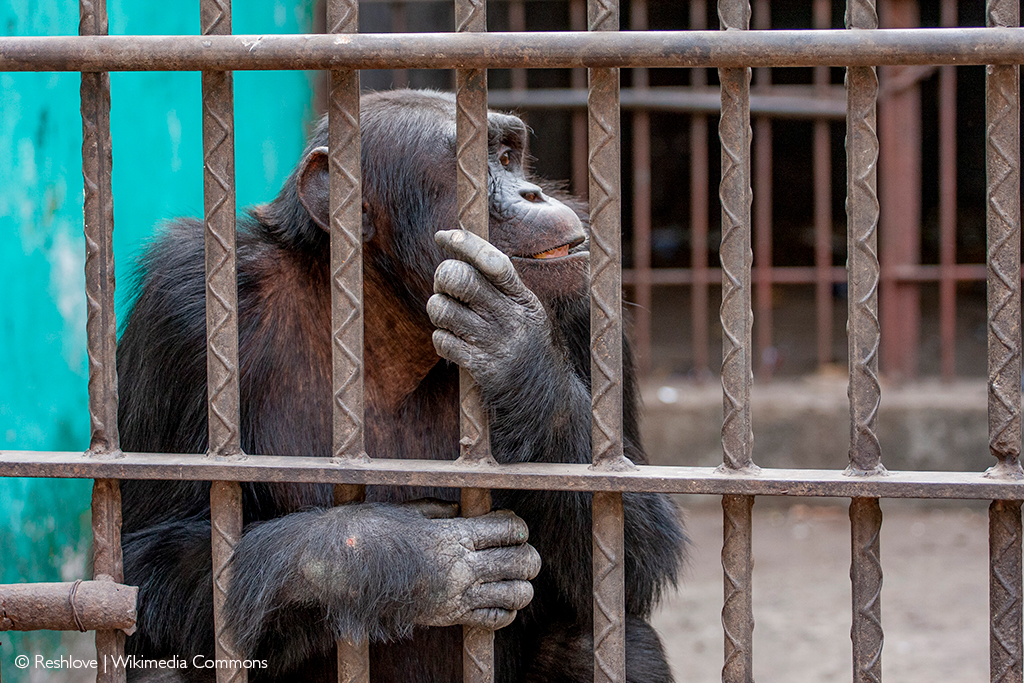
A chimpanzee at Kinshasa Zoo. The zoo is at the centre of a saga involving the illegal export of chimpanzees to India © Reshlove <courtesy of Wikimedia Commons, CC BY-SA>

An operation involving the transfer of endangered chimpanzees from the Democratic Republic of the Congo (DRC) to India has sparked international outrage and serious questions about wildlife trafficking, corruption, and misuse of CITES permits. At the centre of the controversy is a high-profile Indian zoo project, Vantara, and DRC wildlife authorities accused of misrepresenting wild-caught animals as captive-bred to facilitate their export. Conservationists warn that this case could signal a dangerous new chapter in the global illegal wildlife trade.

The trafficking of chimpanzees from the DRC has long been a troubling issue. The country is home to vital populations of great apes, but widespread poaching – often for the bushmeat trade – frequently results in orphaned young chimpanzees being captured and sold. Sanctuaries like Lwiro Primate Rehabilitation Centre serve as a refuge for these animals, working to provide care and eventual rehabilitation. However, these efforts are threatened by corrupt practices, as highlighted by the recent attempt by DRC’s Congolese Institute for the Conservation of Nature (ICCN), the wildlife authority of the DRC, to remove chimpanzees from Lwiro, allegedly under the guise of a zoo revitalisation project.

In early January this year, the staff at Lwiro in the eastern DRC were surprised when a delegation led by the head of the Kinshasa Zoo arrived unannounced with a letter authorising them to pick up 12 chimpanzees.
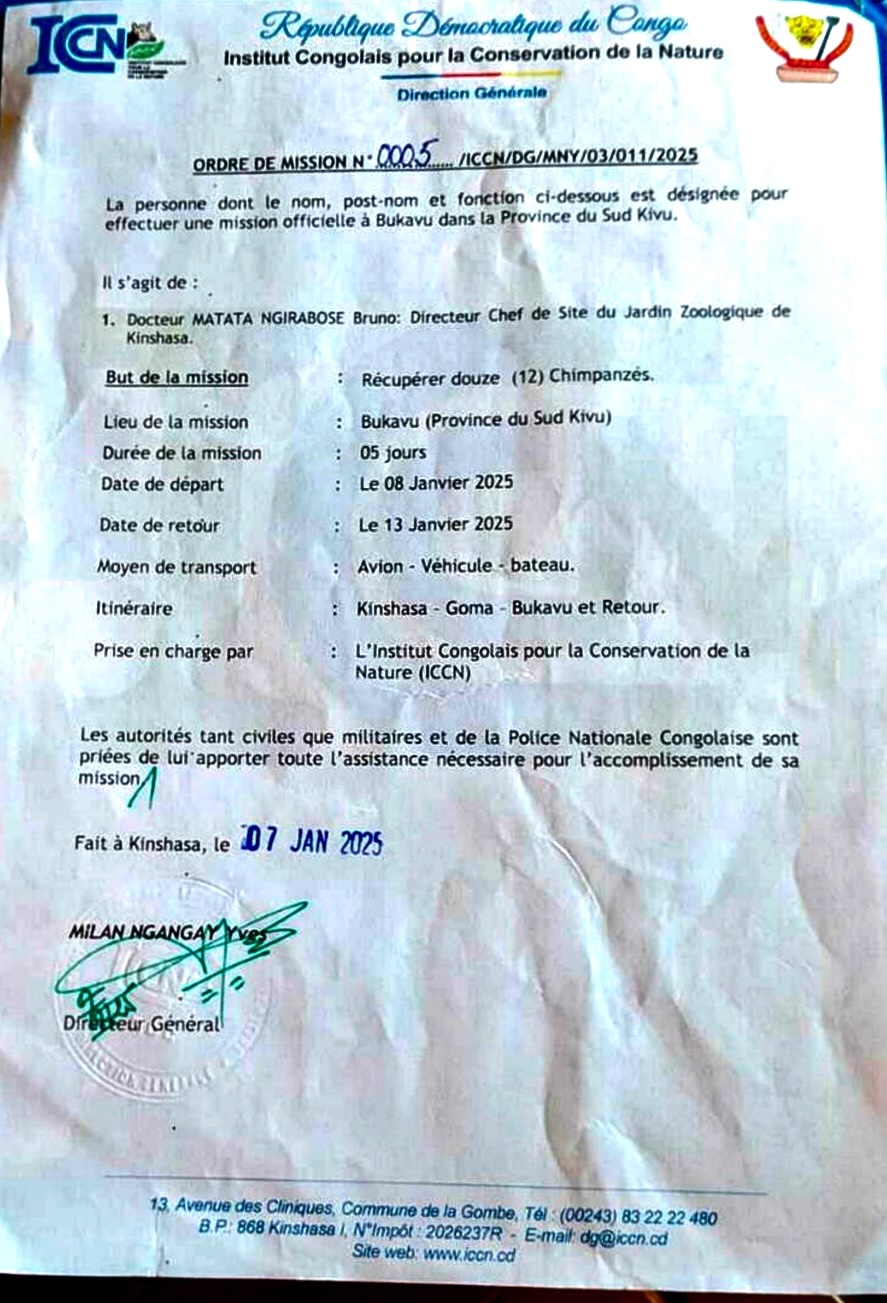
CCN letter authorising the Kinshasa Zoo director to “recover” 12 chimpanzees

The letter was signed by Yves Milan Ngangay, Director General of ICCN, which is also responsible for the nation’s sanctuaries and public zoos.

The Lwiro sanctuary, situated in a tropical forest 45km from Bukavu, just outside Kahuzi-Biega National Park, is home to about 130 chimpanzee survivors of poaching and attempted trafficking. Many saw their mothers butchered for bushmeat before their eyes and are undergoing rehabilitation at Lwiro.

The staff courageously refused to hand over the chimpanzees, and ICCN left empty-handed. Local community and conservation groups heard about the incident and issued a strong press release on 12 January condemning the attempt to “capture 12 chimpanzees at the Lwiro Primate Rehabilitation Centre. This action, initiated by the ICCN general management, constitutes a serious threat to the conservation of these endangered primates and undermines the commitment of many international partners.”

Two days later, Ngangay released an official communique.
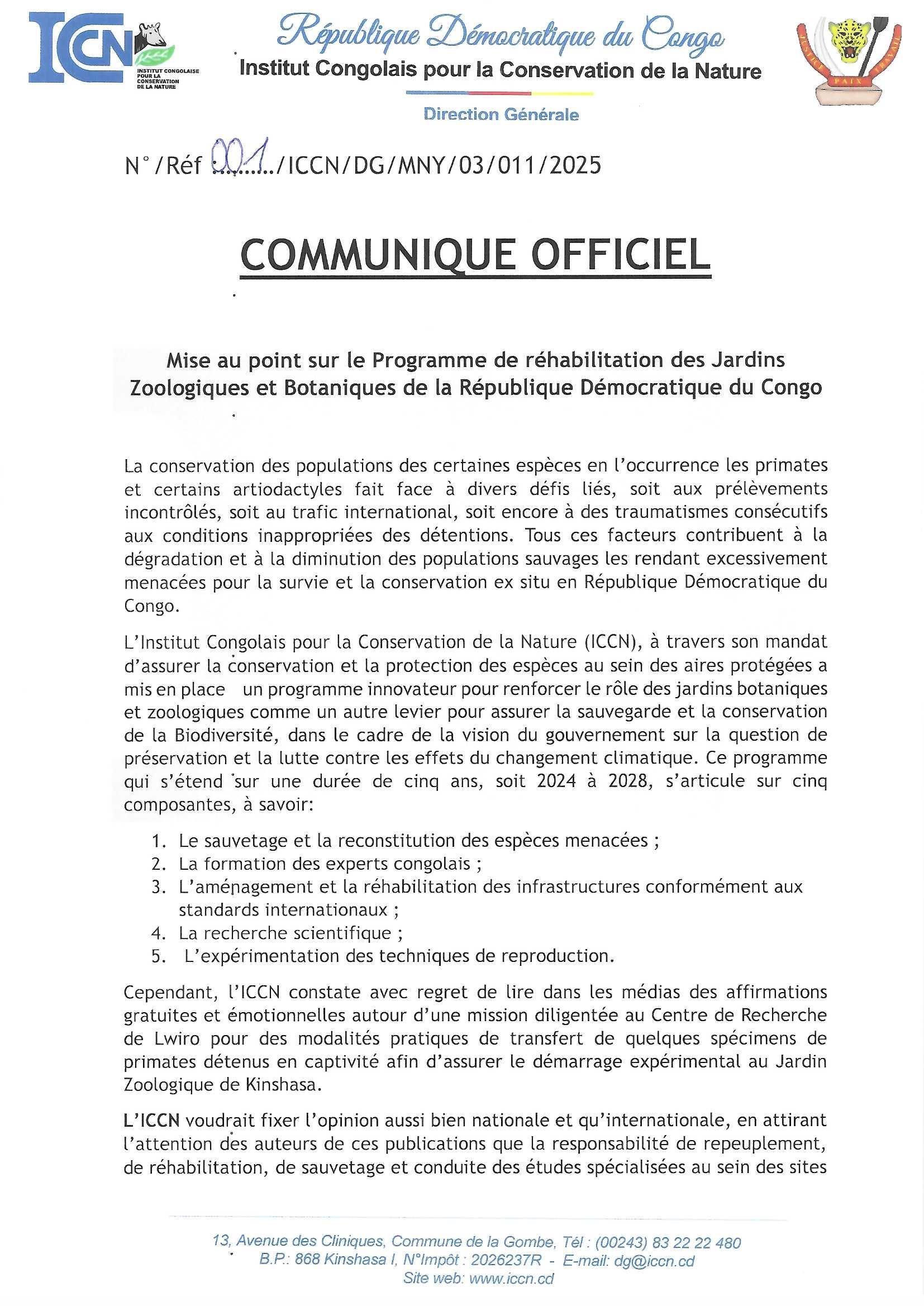
The communique issued by ICCN

The communique announced a five-year programme to renovate the country’s zoos and botanical gardens to strengthen their role in biodiversity conservation by collecting various primate and artiodactyl (even-toed ungulate) species for research, staff training and conservation breeding.

In the communique, he criticised those who had stopped the lawful transfer of the primates to begin the “experimental” work at the Kinshasa Zoo.

Most noteworthy in the communique was that “the collection of specimens by the Institute in this vast programme can only be made from sanctuaries or else from rehabilitation centres and public and private animal parks, depending on their status and relationship with the Institute”

Several critics of the scheme have pointed out that the dilapidated Kinshasa Zoo does not have the facilities, staff or financial capacity to implement the programme presented by ICCN.

“If the mission is true, the chimpanzees will be sent to a real death trap,” warned Sara Rosenberg, a former volunteer at the Lwiro Primate Rehabilitation Center, referring to the transfer.

AG has received screenshots from videos taken on 25 January 2025 showing the zoo and chimpanzees in cages there. In the videos, the zoo indeed did appear to look in a deplorable state, with animals sitting in filthy, cramped, dilapidated cages with no items or structures offered for enrichment.

Chimpanzees at Lwiro Primates Rehabilitation Centre have carers attending to any special needs and live in natural surroundings. @Lwiro Primate Rehabilitation Centre.

Chimpanzees turn up at Kinshasa Zoo – from where?

On 13 February this year, Ofir Drori, founder-director of the wildlife law enforcement NGO EAGLE, posted a press release on their website, seen by AG but since removed, stating that in recent months, nine chimpanzees had arrived at the Kinshasa and Kisangani zoos from unexplained sources. Drori speculated that the chimps had been collected with the intention of selling them and stated:

“Links from ICCN lead to a likely buyer of the chimps. There has been a major rise in primates and other wildlife shipping to India for the past 6 months, with a sole buyer: the so-called Greens Zoological Rescue and Rehabilitation Centre (GZRRC).” GZRRC is the original name of Vantara, which aims to be the biggest zoo in the world. It is owned by Mukesh Ambani as part of GZRCC and headed up by his son, Anant Ambani.
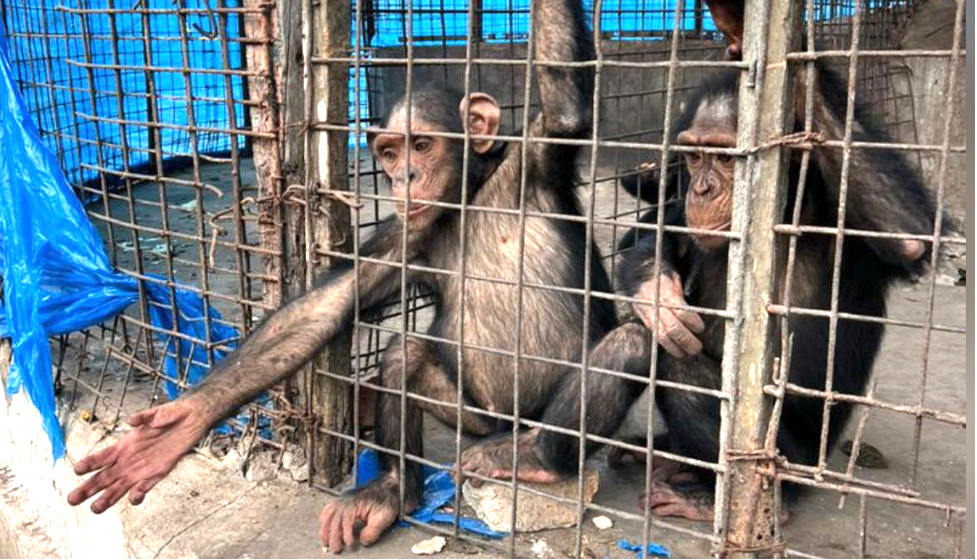
Recently arrived chimpanzees in Kinshasa Zoo live in dirty, cramped cages

Later that day, on 13 February, the chimps were flown to India on a private jet. Our sources later confirmed that the chimpanzees had arrived at Vantara.

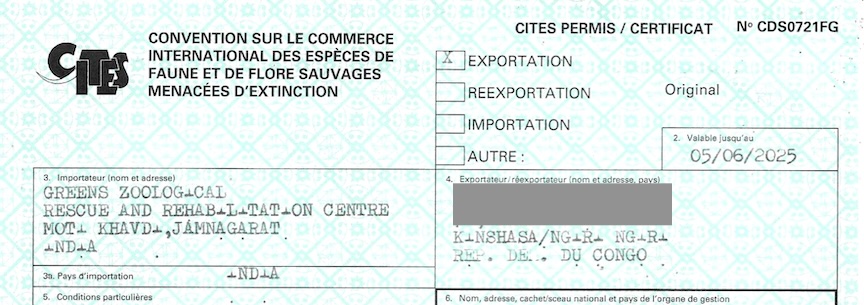
The DRC CITES export permit lists nine chimpanzees in the shipment, with a “Z” (zoo) purpose code and “C” (captive-bred) origin. To use a “C code”, the Appendix I specimens must have been second-generation born in captivity, and their progenitors must have been acquired legally.

The DRC CITES export permit

Contacted by AG, Ofir Drori said, “There are no great ape breeding facilities anywhere in Africa, and the chimps at the Kinshasa Zoo were certainly not bred in captivity. The wild is the only logical source for them.”

The chimpanzees, therefore, were not acquired from lawful sources. This contradicts the specification made in the  ICCN official communique that states collection “can only be made from sanctuaries or else from rehabilitation centres and public and private animal parks according to the laws applying to them”. The CITES permit states that the Kinshasa Zoo is the exporter. This fact also contradicts the stated purpose of collecting the chimpanzees in the first place, which was “for research, staff training and conservation breeding”.

“They were collected to sell,” said Drori.

ICCN has denied the selling of chimpanzees. In an interview with Mongabay Africa, chief site director of the Kinshasa Zoo, Matata Ngirabose Bruno, who also headed the ICCN mission that visited Lwiro, categorically said that “the zoo does not sell animals”.

It is also important to note that past instances of wildlife trafficking have involved permits allegedly falsified by the ICCN.

The probable source of the chimpanzees

ICCN documents dated 27 December 2024, seen by AG, authorise the collection of eight chimpanzees found in captivity in villages around Buta, which is in northeastern DRC about 200 kilometres north of Kisangani. They were to be transferred to the Kinshasa Zoo by 12 January 2025.

Therefore, these chimpanzees will have been present in Kinshasa Zoo when EAGLE reported the arrival of chimps from unknown sources. It also placed these chimps at Kinshasa Zoo just a month before nine chimpanzees were exported from the zoo to Vantara.

The young chimps found in captivity in villages were likely collateral damage to bushmeat hunting, and therefore, they were captured from the wild. Under normal circumstances, such recovered chimpanzees are sent to a sanctuary for rehabilitation and proper care – not to a zoo, with little capacity to offer care and rehabilitation to the young chimps.

This also brings into question the listing of the source of these chimps as “Code C” (born in captivity). The fraudulent listing of source codes as “Code C” is a well-known tactic in trafficking circles, known as a “C-scam”. Examples of the relatively common C-scam can be found in a recent report on great ape trafficking published by the Global Initiative Against Transnational Organised Crime. CITES has dealt with such cases in the past by ordering a suspension of trade by the offending parties until remedial action is taken.

Not the first shipment to Vantara

On 6 March 2025, United for Wildlife released an alert alleging that “from March of 2024 at least eight consignments of CITES-listed primates, including chimpanzees, an Appendix I species, and other wildlife were shipped on flights from the Democratic Republic of Congo (DRC) to India.”

The alert stated: “The consignments possibly contained laundered and smuggled species hidden amongst legally traded animals, including chimpanzees, bonobos, and gorillas, and permits associated with the consignments may have been falsified, according to multiple confidential sources.”

DRC CITES export permits issued between 6 December 2024 and 30 January 2025 also indicate the importer as GZRRC.
One of the permits for exporting primates, birds, and turtles to GZRRC was from a known DRC animal trader. Were great apes concealed in some of the shipping crates?

Other allegations made against Vantara

In March of 2024, M Rajshekhar published an article on Vantara in the Himal Southasian newspaper. The article highlighted numerous irregularities in the origin of Vantara’s elephants from within India. It also pointed to further irregularities in the origin of other endangered species from international suppliers who were not the usual sources of animals in need of rescue and rehabilitation. The sources appeared to be commercial exotic animal traders or sources with records associated with illegal wildlife trade.

On 6 March this year, the Wild Animal Protection Forum of South Africa issued a report that questioned the extensive range of species (36) and high number of animals (765) exported to Vantara. It highlighted various problems with the different species exported, which Vantara asserts were all rescues from detrimental circumstances.

The WAPSFA report expressed concern about Vantara’s breeding plans: “The lions and tigers exported from South Africa appear to have been purchased and exported from breeding facilities in South Africa… They will now be transformed into breeding machines, exploited within the numerous animal breeding facilities (nurseries) outside the main zoo.”

The report continued: “WAPFSA would need to be convinced, based on independent, verifiable evidence that the additional list of species exported from South Africa were saved or rescued from adverse conditions.”

Later in March, the UK-based Independent reported that Vantara had dismissed the complaint by the South African coalition as “entirely false and baseless” and said they had served them a legal notice over the report.

Anant Ambani at Vantara. © Bohoindian <courtesy of Wikimedia Commons, CC BY 4.0>

On 13 March, the Süddeutsche Zeitung published an investigative article that alleged many irregularities regarding the sourcing of animals at Vantara, including the probability that some had been sourced from the wild, not captivity. The article alleged that 39,000 animals were being kept in Vantara by the end of 2024.

A European wildlife dealer is quoted in the article as stating, “Regardless of which wholesaler I talk to, the supply of wild animals is bought up. The supply lists are getting shorter because everything goes to India.” The fact that this demand also leads to more wild captures was “obvious” to the animal dealer.

Further action

ICCN is currently collecting other animals listed in Vantara’s “rescue list”, including bonobos and gorillas. A concerned group of wildlife NGOs has drafted a letter to the CITES Secretariat detailing several instances of trade irregularities involving Vantara, including the chimpanzee trade reported here, and entreating amongst other measures that the Secretariat and the Standing Committee (SC) request that:

  • India agrees to suspend imports of live specimens of CITES-listed species until this issue can be discussed at the 79th meeting of the CITES Standing Committee (SC79);
  • Parties refrain from issuing permits to export live animals of CITES-listed species to India until this issue can be considered at SC79.

The 79th meeting of the CITES Standing Committee will be held in November this year in Samarkand, Uzbekistan, immediately preceding the Conference of the Parties. The issue around Vantara is set to be one of the most contentious items on the agenda, pitting NGOs against a powerful billionaire family.

As international scrutiny intensifies, the case of the trafficked chimpanzees highlights the urgent need for stronger enforcement of wildlife trade laws and greater transparency in both exporting and importing countries. The upcoming CITES Standing Committee meeting in Uzbekistan could prove pivotal in setting new precedents for accountability, especially when powerful private interests are involved. For now, the fate of the trafficked chimpanzees – and potentially many more endangered species – rests on whether global conservation authorities are willing to confront systemic loopholes and hold perpetrators to account, regardless of their influence or wealth.

Can one baby gorilla rescued in Istanbul stop the deadly great ape traffic?

Reprinted from Animals 24-7 – Ed.

DECEMBER 24, 2024 BY MERRITT CLIFTON 

ISTANBUL,  Turkey––An approximately eight-month-old baby western lowland gorilla,  rescued from a coffin-like wooden crate on December 22,  2024 at the Istanbul Airport in Turkey,  may be the “missing link” between two of the other horrific stories in the news that day.

“Children executed and women raped in front of their families as M23 militia unleashes fresh terror on the Democratic Republic of Congo,” headlined Guardianwriter Mark Townsend from Goma,  DRC,  and Kigali,  Rwanda,  detailing the latest explosion of violence in western gorilla habitat.

The Thai connection

The other horrific story, from Georgie English,  foreign news reporter for the British tabloid The Sun,  detailed how “One of the loneliest gorillas in the world is set to spend her 41st Christmas trapped in a tiny concrete cage” on an upper floor of the Pata Pinklao Department Store Zoo in Bangkok,  Thailand,  opened in 1983 with the then-infant western lowland gorilla Bua Noi as the star attraction.

“Bua Noi” is the Thai iteration of the Swahili word bwana, meaning “boss” or “master,”  but Bua Noi has never in her life been “boss” or “master” of anything.

Both the baby gorilla confiscated from traffickers at the Istanbul Airport and Bua Noi were captured from the eastern rainforests of the Democratic Republic of Congo,  at probable cost of the massacre of their parents and extended families,  who would have fought to try to save them,  and may have ended up in the cooking pots of soldiers,  loggers,  or miners.

Both western lowland babies,  more than 40 years apart,  may have been traded westward for guns and ammunition,  among other commodities in urgent need among the combatants and exploiters of central Africa.

Both were likely flown out of Lagos,  Nigeria,  after passage by truck through the Central African Republic and Cameroon.

The central African region,  bisected by the Congo River, has been wracked by recurring mayhem overtaking both apes and humans since 1885,  when King Leopold II of Belgium claimed it as the Congo Free State and ran it until 1908 as his own personal slave plantation without ever actually setting foot there.

Pongo,  the first gorilla in Europe.

Master Pongo

Even before Leopold,  gorilla exports had begun with Master Pongo,  shipped through Angola to Berlin in 1876. Master Pongo,  however,  died at age three in November 1877,  after just a year in captivity. The Bristol Zoo gorilla Alfred arrived at about age two in 1930. Surviving until 1948,  Alfred’s popularity touched off 35 years of competition among zoos and private collectors worldwide to obtain gorillas.

The various United Nations member nations eventually adopted and ratified the 1975 Convention on International Trade in Endangered Species,  putting gorillas off limits to commercial traffic,  but implementing the trade ban took more than a decade.

The race to grab gorillas was actually intensified by the success of gorilla advocate Dian Fossey’s 1983 best-selling book Gorillas In The Mist and the 1988 film dramatization of the book,  starring Sigourney Weaver.

Together the book and film made saving gorillas an international cause celebre––and enabled zoos quick to cash in on gorilla notoriety to claim that every gorilla obtained by whatever clandestine illegal method arrived as a “rescue.”

Fossey blamed poachers for the decline of both mountain gorillas and western lowland gorillas throughout their habitat in the mountains of Rwanda,  Uganda,  and the Democratic Republic of Congo.

This was accurate enough in close focus,  from Fossey’s perspective at the Karasoke research station in Rwanda,  but neither Fossey nor anyone else prominent at the time did much to expose the population pressures in overcrowded Rwanda,  the political pressures resulting from the murderous reign of dictator Idi Amin in Uganda,  1971-1979,  and the poverty and instability in the DRC that drove the poaching.

As Townsend explained in his December 21,  2024 Guardian exposé,  “Eastern DRC holds huge, widely coveted reserves of precious minerals.  The battle over billions of dollars worth of minerals, alongside the settling of old scores,  has plunged eastern DRC into near continuous conflict,”  gaining in ferocity since the 1994 massacre of at least 800,000 members of Tutsi tribe by members by Hutu tribe in Rwanda.

Since then,  Townsend summarized,  “More than six million people are thought to have died and a similar number forced from a swathe of the DRC,  whose government has lost control in the east” to a multitude of militias,  of which M23 is currently the strongest.

“Shortly after the massacre,”  Townsend wrote,  after newly armed Tutsi survivors fought back,  “more than a million Hutus fled to DRC,  including many responsible for the slaughter.

“Twice,  Rwandans invaded their neighbor,  ostensibly to hunt down the génocidaires.

“In turn, Hutu militias linked to the carnage started to regroup,  plotting a return to Rwanda to seize power.  To counter this threat,  Rwanda began arming Tutsi militias – forerunners to the M23 – inside the DRC.”

(The General Directorate of Nature Conservation & National Parks photo).

Turkey tracked the flight

Meanwhile,  on the morning of December 21,  2024,  the Turkish newspaper Daily Sabahreported,  “Customs enforcement teams from the Ministry of Trade intercepted the attempt to smuggle” the rescued baby gorilla via Istanbul Airport.

“According to a statement from the ministry,”  the Daily Sabah said,  “the Customs Enforcement Smuggling & Intelligence Directorate at Istanbul Airport tracked a cage-type cargo shipment departing from Nigeria, destined for Bangkok,  Thailand,  as part of risk analysis efforts aimed at protecting wildlife and natural habitats.

“Upon inspection,  the team discovered that the cage,”  actually just a wooden box with air holes in the sides,  “contained a western gorilla,  a species listed under Appendix I of the Convention on International Trade in Endangered Species of Wild Fauna and Flora,  indicating her critically endangered status.

“The baby gorilla has been handed over to the relevant units of the Ministry of Agriculture & Forestry,”  the Daily Sabah finished.

As the baby gorilla cannot be safely repatriated back to her family,  probably long since massacred in her war-torn and politically unstable homeland,  she will probably be kept at one of the better of around a dozen public zoos in western Turkey.

From Bangkok,  Wildlife Friends Foundation of Thailand founder Edwin Wiek posted to Facebook,  “Who ordered this animal and who shipped her?  We need serious investigations going both ways!”

A reasonable guess might be that the baby gorilla intercepted between flights in Istanbul might have been intended for delivery to the Pata Pinklao Department Store Zoo,  as a possible companion and eventual replacement for Bua Noi,  who is now in late middle age as gorillas go and in an unknown state of health.

Indeed,  the Pata Pinklao Department Store Zoo could reap a bonanza of naively favorable publicity by sending Bua Noi to a sanctuary before her eventual terminal decline,  with no loss of patronage if another gorilla occupies her cage.

“Even the environment minister of Thailand,  Varawut Silpa-archa,  has made clear he wishes to see Bua Noi moved to a sanctuary,”  wrote Georgie English.

“We collected donations from Bua Noi’s supporters. But the problem is that the owner refuses to sell Bua Noi,”  Varawut Silpa-archa told English.

Bua Noi. Bangkok, Thailand. (Wikimedia photo)

“One of the worst zoos in the world”

“When he does agree to sell her,  the price is too high.  Bua Noi is considered private property so we cannot do anything to remove her,”  Varawut Silpa-archa said.

People for the Ethical Treatment of Animals,  International Animal Rescue,  and the International Primate Protection League,  among others,  have campaigned unsuccessful for the Tahi government to close the Pata Pinklao Department Store Zoo and rescue Bua Noi almost since her arrival from the DRC by way of Germany at approximately age one.

“Pata Zoo is not only home to the somber gorilla,  but also more than 200 other animal species including tigers,  bears,  and pythons,”  wrote English.

“Many of the animals live in similar conditions to Bua,  in what Jason Baker,  PETA senior vice president for Asia,  calls “one of the worst zoos in the world.”

Zira at the Granby Zoo. (Merritt Clifton photo)

Another baby gorilla died at the Pata Zoo

In August 2017 a grossly erroneous but internationally distributed news story, originating from a careless headline above an otherwise accurate report by the Australian Broadcasting Corporation,  announced that Bua Noi and the other Pata Zoo animals would be freed from what Baker calls “pitifully small, barren enclosures,”  on the sixth and seventh floors of the shabby shopping center tower,  “denied sunshine,  fresh air,  and opportunities to exercise or engage in behavior that is meaningful to them.”

Some premature “victory” announcements followed,  but nothing actually changed.

Subsequent to Bua Noi’s arrival,  a 2009 Asian Animal Protection Network posting from U.S. gorilla rescuer Jane DeWar mentioned that,  “Some time ago a baby gorilla was acquired by the Pata Zoo,”  as an intended companion for Bua 

Bua Noi appears to have been captured and exported from the DRA around the same time as another female baby western lowland gorilla named Zira.

International Primate Protection League founder Shirley McGreal learned in mid-1983 that Zira had been exported from Cameroon to the Granby Zoo in Quebec.

The zoo had obtained a permit for the transaction,  as required by the Convention on International Trade in Endangered Species,  but McGreal contended that the permit was issued in violation of the intent of CITES,  if not in violation of the actual letter of the treaty.

Zira meanwhile contracted avian influenza from the exotic birds with whom she was housed. McGreal asked Quebec newspaper columnist Bernard Epps to expose Zira’s plight.

Epps,  who died in July 2007,  passed the assignment to then-Sherbrooke Record farm and business reporter Merritt Clifton,  now coeditor with his wife Beth Clifton of ANIMALS 24-7.

Epps wrote supporting commentary while Clifton produced a series of exposés that culminated in a complete change of the Granby Zoo management and the transfer of Zira to the Toronto Zoo,  where she was restored to health and raised with other young gorillas.

Meanwhile,  warned Eric Kaba Tah of the German organization Berggorilla & Regenwald Direkthilfe,  citing cases from the 2005-2012 time frame,   “In recent years, the trafficking of Afri­ca’s apes has evolved into a highly organized criminal activity, demonstrated by the manner in which powerful traffickers use their perfected operational skill to run the illicit trade alongside other illegal ac­tivity such as the trade in drugs.

“The connection between drugs and wildlife trafficking,  and increasing prices for wildlife products,”  Eric Kaba Tah wrote,  “are attracting criminal syndicates with vast experience in organized crime,  as is typical for drug syndicates.”

Agrees Natasha Tworoski of the Pan-African Sanctuary Association,  via the PASA website,  “The great ape crisis is rapidly escalating.  Eastern gorillas,  western chimpanzees,  and Bornean orangutans were recently downgraded from endangered to critically endangered,  joining Sumatran orangutans and Western gorillas.  Other chimpanzee subspecies,  as well as bonobos, are currently listed as endangered.

“The United Nations Environment Programme’s World Conservation Monitoring Centre and the Great Apes Survival Partnership [GRASP] have created an Apes Seizure Database in order to get a more thorough understanding of how the specific threat of ape smuggling is currently affecting great apes,”  Tworoski wrote.

Through GRASP,  Tworoski said,  “1,800 great apes seized in illegal live traffic since 2005 were uncovered who had previously not been counted in international databases,  such as those managed by CITES.

“How could the numbers be so under-reported?  The majority of seizures,  over 90%,  took place within national borders and therefore were not counted by international conservation organizations.

“Now that Eastern gorillas,  Western chimpanzees and Bornean orangutans have been downgraded from endangered to critically endangered,”  Tworoski predicted,  “the next step will be extinction.”

Daniel Stiles & Esmond Bradley Martin Jr.
(Facebook photo)

Prices for great apes have quadrupled

Updated Rachel Nuwer for National Geographic on May 9,  2023,  “Working with a network of undercover investigators and informants,  Daniel Stiles,”  a wildlife trafficking investigator who formerly worked with the late Esmond Martin to document the global trade in poached elephant ivory,  “found that advertisements for live baby great apes are on the rise on WhatsApp and social media.

“Since 2015,”  Nuwer wrote,  “Stiles documented 593 ads for great apes posted by 131 individuals in 17 countries.  Prices for the animals have quadrupled compared to a decade ago,  with chimps now selling for up to $100,000,  bonobos for up to $300,000,  and gorillas for up to $550,000.

(Beth Clifton collage)

Rising demand from China

“Most of the African apes go to China,  Pakistan,  Libya,  or the Gulf States—especially the United Arab Emirates—where they become pets or,  increasingly, attractions at private zoos.

“Some 10,000 zoos opened in China between 2013 and 2020,  nearly doubling the total number,  Stiles reports.

The 23-member Pan African Sanctuary Association and Stiles were severely critical,  to Nuwer,  of alleged Convention on International Trade in Endangered Species [CITES] indifference toward the escalating great ape trade.

Summarized Nuwer,  citing Stiles,  “Representatives from Niger,  Ivory Coast,  Kenya,  and Uganda did attempt to create a CITES working group dedicated to great apes, in 2014 and 2016. But these requests,  Stiles says,  were ‘refused’ by the CITES representative chairing the meeting.

Iris Ho, representing the Pan African Sanctuary Association,  told Nuwer that  “In March 2022,”  Nuwer continued,  “Gabon,  supported by Senegal,  Guinea and Nigeria, requested—to no avail—that great apes be put on the agenda for CITES.  She says the U.S. also emphasized the importance of paying attention to this issue.”

Cautioned Stiles, “If the international community does not begin to take great ape trafficking seriously,  it will continue to grow,  threatening the survival of our closest relatives.”

The baby gorilla rescued in Istanbul on December 21, 2024 brought global attention to great ape trafficking.

But only time will tell whether one baby gorilla can turn the great ape trafficking crisis around.

Editor’s note: Bua Noi means Little Lotus in Thai, it is not a transliteration of Bwana, which was a different gorilla imported in 1983 from a German zoo. For full information see https://medium.com/@danielstiles/the-saga-of-bua-noi-and-pata-zoo-efa8ce67ba2d/.