
Ed. note: This article is translated from French from Geo magazine.
While the Democratic Republic of the Congo is in the grip of violent clashes, the capital’s zoo plans to acquire great apes from the country’s public and private sanctuaries, alarming sources interviewed by GEO. However, the establishment itself has just sent 12 chimpanzees to a zoo in India, according to the NGO fighting against wildlife trafficking EAGLE.
NASTASIA MICHAELS Published on15/02/2025
Twelve: that’s the number of chimpanzees which the Congolese authorities had planned to transfer from the Lwiro Primate Rehabilitation Center (LPRC), located in the South Kivu province, in the east of the country, to the Kinshasa zoo described by a former volunteer as “dying”.
And it is also the number of chimpanzees coming from the Kinshasa zoo which has just been sent “in the greatest secrecy” to India, confided the EAGLE network, an NGO fighting against poaching and wildlife trafficking, to GEO on Thursday February 13.
If the violent clashes following the invasion of Goma by a militia unofficially supported by Rwanda seem not to have posed an obstacle to this international transfer, the domestic transfer project between Lwiro and the capital – which raised indignation in January, as reported by the local press and by the Point – has not been able to succeed to date either.
However, this center of primates located on the front line in the ongoing conflict (150 kilometers by road from Goma) is not the only one concerned by the risk of seeing its protégés escape it.
“Rehabilitate” Congolese zoos
Consulted by GEO, an official press release from the Congolese Institute for Nature Conservation (ICCN) reports a program of “rehabilitation” of the zoological and botanical gardens in Kinshasa and Kisangani (to the northeast), intended to receive new “specimens” whose origin is explicit: sanctuaries, rehabilitation centers and animal parks, “public and private.”
The country currently has three rehabilitation centers and sanctuaries housing chimpanzees and small monkeys (Lwiro, JACK and P-WAC) as well as a sanctuary collecting bonobos (Lola Ya Bonobo) and another housing gorillas (GRACE). However, according to the management of a sanctuary concerned, whose identity we will not mention, the situation is “more than delicate”. “With the political situation, we are taking a back seat”, laments our source.
If the Kinshasa and Kisangani zoos do not seem to have either the required personnel or the financial resources to take care of primates from shelters, the ICCN is also suspected to reserve a completely different fate for the latter. The local press had thus raised the hypothesis of the sale of animals to “foreign firms” (7sur7.cd).
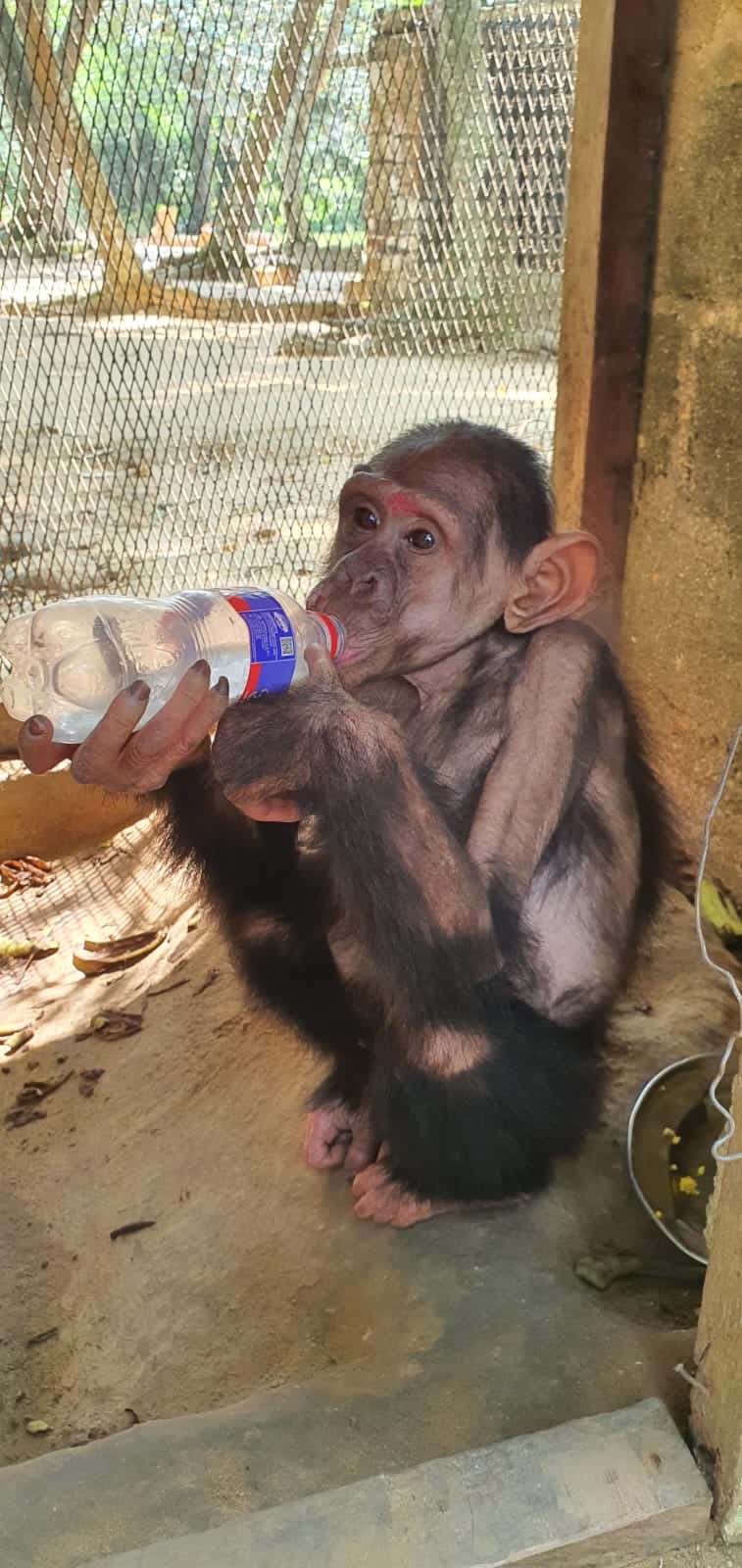
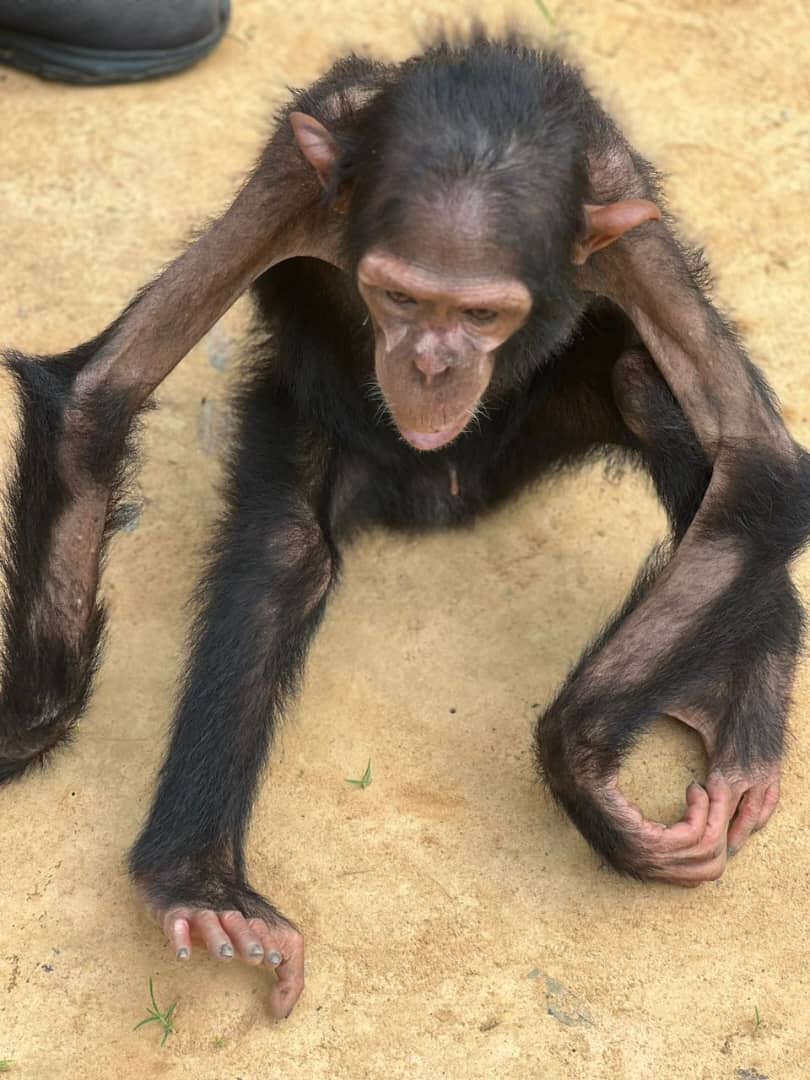
Chimpanzees photographed at Kisangani Zoo, Democratic Republic of Congo EAGLE Network
The trail of an Indian billionaire
According to the NGO EAGLE, the chimpanzees sent to India are “supposed to be routed to the Greens Zoological Rescue and Rehabilitation Center (GZRRC)”, known to the public as Vantara. A project financed by Indian multi-billionaire Mukesh Ambani, CEO of the giant petrochemicals Reliance Industries, with the ambition to make it the largest zoo in the world.
“Could ICCN’s decision to quickly collect great apes for Congolese zoos be linked to the fact that the GZRRC can easily obtain primates through transfers between zoos?”, the association already wondered in a press release published on February 10, just before being informed of the actual sending of chimpanzees to Asia.
Built on an oil refinery site, Vantara was investigated by the independent media outlet Himal (March 20, 2024), revealing in particular transactions with dubious organizations to fill its enclosures. His lions, for example, come from a South African establishment known for breeding wild animals intended for “canned hunting”, a controversial practice of trophy hunting in a closed environment.
Few images of this place have filtered out… at least until its inspiration, a certain Anant Ambani – youngest son of the richest man in Asia – made the zoo the setting for his “pre-wedding” party in March 2024. Some guests, including celebrities, then posed with a captive elephant and shared their photos on social networks.

The hidden side of animal trafficking
To try to understand the threat that could weigh on primates in Congolese sanctuaries, we contacted Cécile Neel, investigator for EAGLE, whose teams work in particular in countries neighboring the DRC. In terms of form, nothing prevents the Indian billionaire from signing a contract with the authorities to legally recover primates from Congolese zoos.
“What we know at this stage is that the (Indian) zoo has already received primates from the DRC, and that it has approval allowing it to carry out exchanges with other zoos”, summarizes Cécile Neel. However, such transactions can also be a way, she explains to GEO, to “launder” the real origin of wild animals.
“We’ve had the case of one before of a bonobo found in Armenia, whose CITES permit (Convention on International Trade in Endangered Species of Wild Fauna and Flora) indicated Guinea as the country of origin”, she illustrates, “which is obviously impossible, since bonobos only live in the DRC.”
The EAGLE network, whose Togolese branch recently seized around forty monkeys from the DRC and destined for Thailand, notes that victims are often drugged to be hidden in cages among other animals. A treatment that not all survives.
The Indian animal park already has received this year nearly thirty chimpanzees from the United Arab Emirates – “an important crossroads for trafficking in protected species” – as well as a bonobo which could come from Iraq, identified the investigator based on data from the CITES.
A dangerous precedent
On the DRC side, concern is palpable. The repopulation of zoos as envisaged by the Congolese institute would in fact constitute, to Cécile Neel’s knowledge, a first on the African continent. And would therefore create, according to her, a dangerous precedent.
Despite the attention paid to each of their protégés, as well as the time and funds devoted to their well-being in the perspective of a reintroduction in the natural environment, should the managers of the shelters concerned fear seeing the services in charge of the transfer ring their doorbell?
“If some think that given the current political situation, no one will come due to lack of logistical means, it is possible on the contrary that the threat will go unnoticed and that the project will be implemented”, fears one of them.
“Our closest cousins are threatened with extinction by trafficking and corruption, and now our investigations show that Congo’s orphaned great apes who survived their family’s massacre are once again under imminent threat from the same enemy”, said Ofir Drori, director and founder of the EAGLE network, in the recent press release.
 Project to End Great Ape Slavery (PEGAS)